
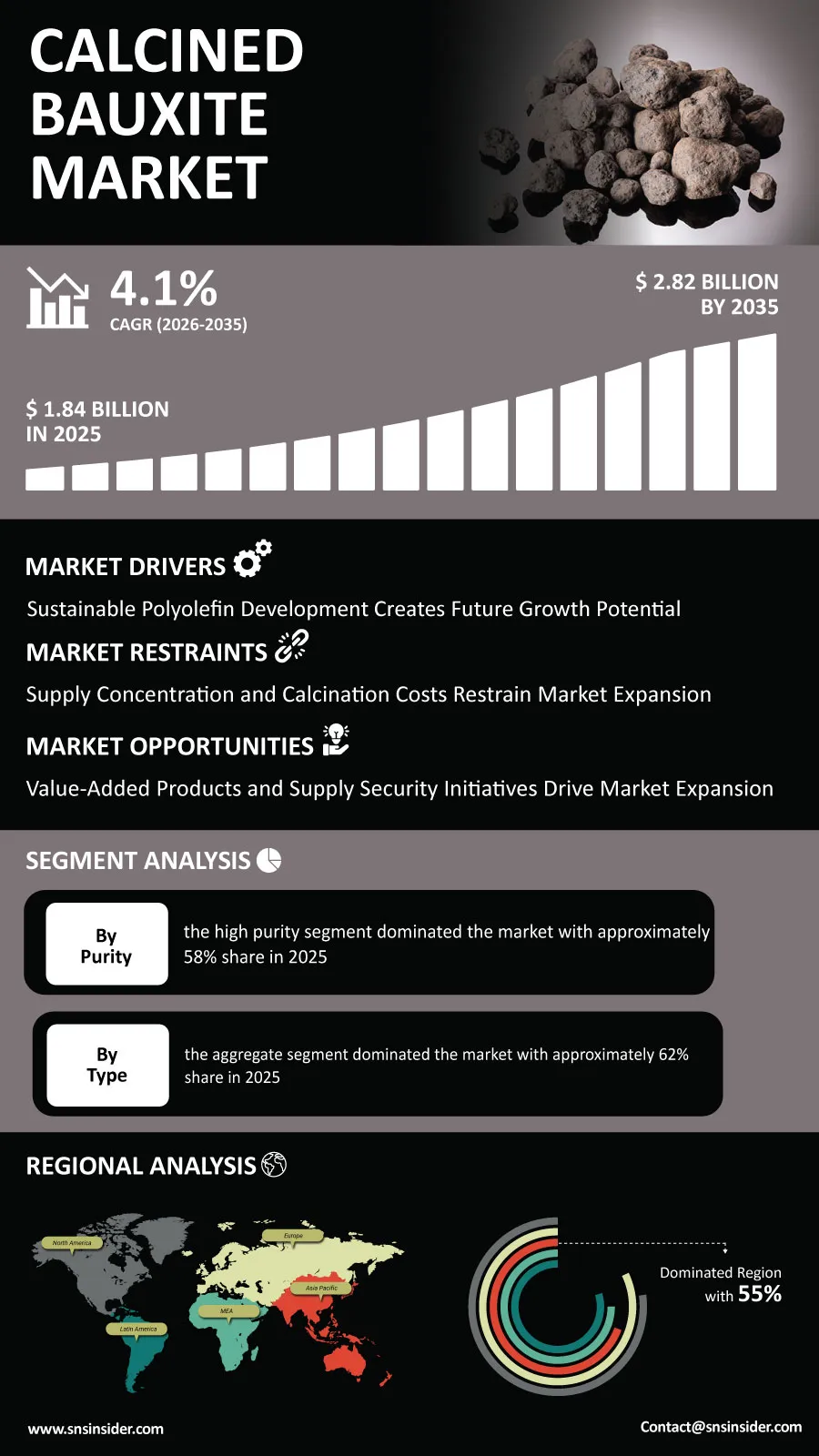
The global market for Calcined Bauxite is predicted to sustain healthy growth owing to the growing demand for quality refractory products and industrial minerals due to the expansion and modernization of industries. “According to a recent study by SNS Insider, the global Calcined Bauxite Market size valued at USD 1.84 Billion in 2025, is anticipated to grow to USD 2.82 Billion by 2035, registering a CAGR of 4.1% over the 2026–2035 forecast period.”
The market is gaining advantage through the rising production of steel, increasing processing of non-ferrous metals, and usage of durable materials that can withstand very high temperatures during operations. Calcined bauxite continues to be an important feedstock for the production of refractories, abrasives, ceramics, and friction pavements owing to its good hardness and resistance to heat and chemicals. The rise in investments in infrastructure in developing nations is also boosting consumption.
To Get Detailed Insights on the Calcined Bauxite Market – Request a Sample Report
Premium Industrial Materials Create Long-Term Growth Opportunities
Demand for top-grade calcined bauxite is growing because companies are looking for materials that will offer greater efficiency in the process of production when used in the steel-making, cement-making, and specialty metal industries. Calcined bauxite materials with high alumina content are gaining in value because such materials are needed in industries where there is a need for materials that can withstand thermal shock, corrosion, and mechanical wear.
There is also an opening up of markets as infrastructure development opens up the use of calcined bauxite in areas other than refractories. Transportation organizations have been using calcined bauxite as aggregates in highways, airports, highways, and other pedestrian areas to increase road friction. In addition, alternative sourcing from non-traditional locations is improving resilience within the global supply chain.
Key Market Insights Highlight Expanding Industrial Applications
Through purity, the High Purity category held around 58% share in 2025, driven by rising demand from refractory makers, specialty ceramics, and abrasives applications that require top-quality alumina content. On the other hand, the Low Purity category is projected to have the fastest growth until 2035 due to the increasing use of cost-effective industrial aggregates in infrastructure and construction.
Segment-wise, the Aggregate category made up for almost 62% of the market revenue in 2025 due to the widespread use of aggregates in refractory products and road surfacing materials. On the other hand, the Powder category is projected to have the fastest growth due to the increasing use of powder in industrial processing, coatings, and specialty manufacturing.
Segment-wise, the Refractory Grade held the biggest market share at around 64% in 2025 due to the growing investments in steel manufacturing and high-temperature industrial processes. Abrasive Grade is expected to grow at the fastest pace due to the growing demand for precise grinding, cutting, polishing, and industrial finishing solutions. In terms of application, the Refractory Materials held around 45% of the market revenue while Road Surfacing was expected to have the fastest growth.
Manufacturing Innovation Improves Product Quality and Efficiency
The manufacturers are also increasing their investment in calcination technology, automation of the processes, and efficient kilns so as to enhance the consistency in production as well as minimize costs of production. Improvements in quality control are helping suppliers produce more refined calcined bauxite that is fit for specialized industrial use.
Compliance with environmental standards has emerged as an important aspect of competition in the industry. The producers are adopting cleaner production technology, fuel management, and emission control systems in order to meet the sustainable standards.
Asia Pacific Dominated with 55% Revenue Share in 2025; North America and Europe Sustained Industrial Demand
Asia Pacific comprised 55% of the global market revenue in 2025, owing to high availability of steel manufacturing capacity, refractory manufacturing capacity, and construction of infrastructures. China is the largest manufacturer and consumer in the region, whereas India and South Korea are continuously growing in demand due to their investments in industrial manufacturing, transportation infrastructure, and heavy industries.
North America exhibits stable growth owing to continuous imports that facilitate manufacturing of refractories, industrial abrasives, and highway safety. Europe is another significant market owing to advanced steel manufacturing, whereas the Middle East & Africa and Latin America regions continue growing due to industrialization, mining investments, and transportation infrastructure.
Industry Participants Expand High-Purity Production and Global Supply Networks
The competition in the Calcined Bauxite Market in the world is all about enhancing the production capacity, purity of the products, and international supply chains. There has been an increase in investment by manufacturers in high-grade raw materials, efficiencies in production processes, logistics facilities, and diverse sourcing.
Key companies operating in the global Calcined Bauxite Market include LKAB Minerals AB, Almatis GmbH, First Bauxite LLC, Imerys Fused Minerals, Bosai Minerals Group Co. Ltd., SCABAL, Elfusa Geral de Electrofusao Ltda, Great Lakes Minerals LLC, Boud Minerals Limited, Sinocean Industrial Limited, EKC.AG, Rawmin Mining and Industries Pvt. Ltd., Orient Abrasives Ltd., Sibelco, Washington Mills, Carborundum Universal Ltd., Saint-Gobain Abrasives, Mineracao Curimbaba, Guizhou Zhijin Mining & Smelting Co., and Shanxi Haoyu Refractory Co.
An SNS Insider analyst Himanshu Sharma commented, "Rising investments in steel manufacturing, infrastructure modernization, and premium refractory materials are creating stable long-term demand for calcined bauxite. Companies expanding high-purity product portfolios, improving production efficiency, and strengthening diversified global supply chains are expected to gain a competitive advantage as industrial customers increasingly prioritize quality, performance, and supply security."
About the Author

Get in touch




