
The global central lab market is positioned for sustained growth through 2035 as pharmaceutical and biotechnology companies increase their reliance on standardized laboratory testing for multinational clinical trials. Expanding drug development pipelines, rising demand for precision medicine, and the growing complexity of clinical research are strengthening the commercial importance of centralized laboratory services.
According to the latest SNS Insider Central Lab Market report, the market was valued at USD 4.57 billion in 2025, is estimated to reach USD 4.85 billion in 2026, and is forecast to attain USD 8.28 billion by 2035, registering a CAGR of 6.12% during 2026–2035.
Central laboratories provide essential support for clinical trials by delivering consistent testing methodologies, reliable sample handling, and comparable analytical results across multiple research locations. Their services include biomarker analysis, genomic testing, clinical safety assessments, pathology, microbiology, and specimen management.
Demand is increasingly influenced by oncology research, personalized therapies, decentralized clinical trials, and the transition toward data-intensive drug development. Pharmaceutical sponsors are prioritizing laboratories capable of supporting complex testing requirements while maintaining regulatory compliance and consistent turnaround times.
North America remains the largest regional market, supported by established pharmaceutical research infrastructure. Asia Pacific is expected to experience the fastest expansion as clinical trial activity and local laboratory capabilities strengthen.
The long-term market outlook reflects a shift toward integrated laboratory networks combining specialized analytical expertise, digital specimen tracking, automation, and geographically distributed testing facilities.
To Get Detailed Insights on the Central Lab Market – Request a Sample Report
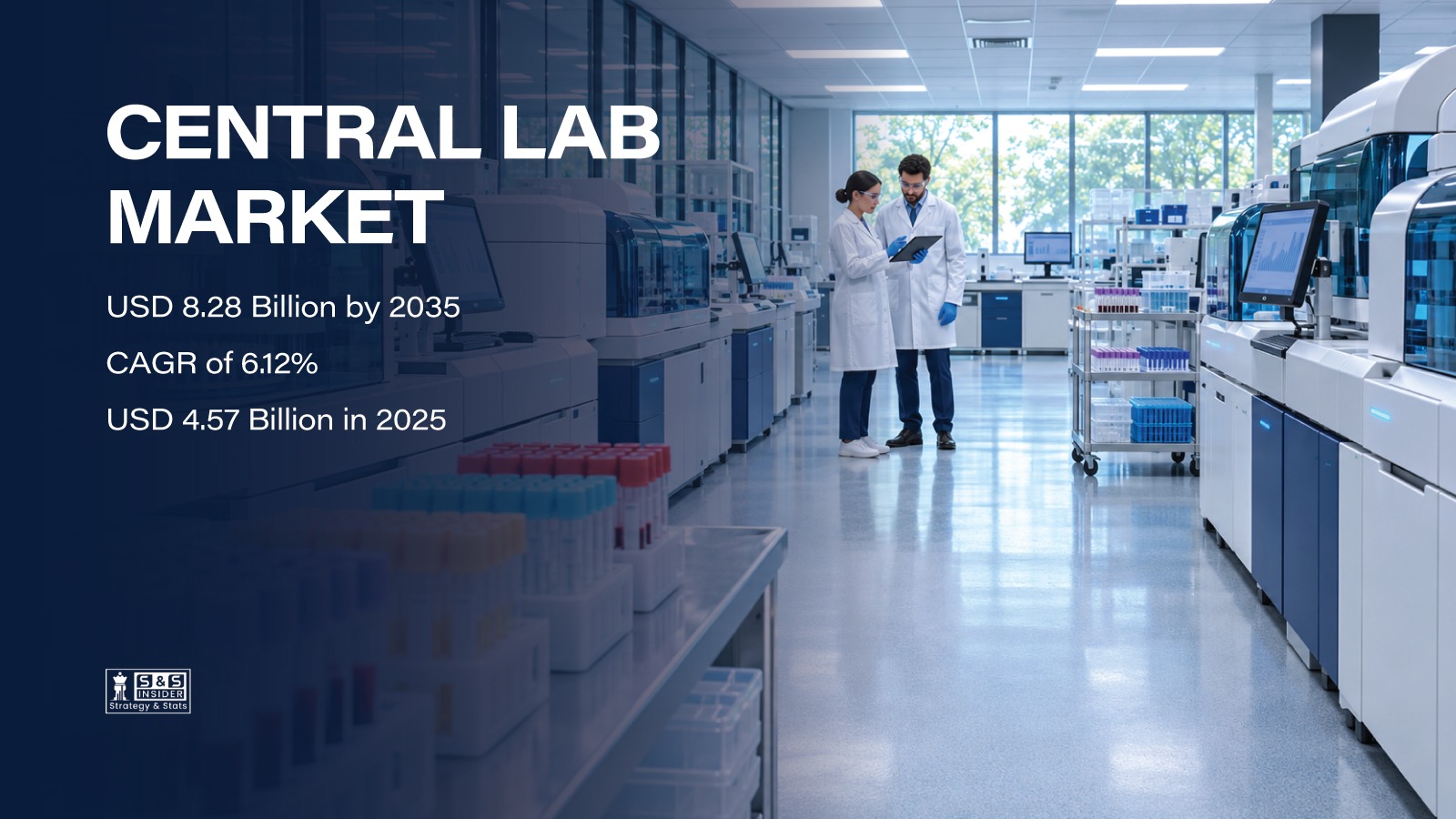
Central Lab Market Size and Forecast
|
Market Indicator |
Value |
|---|---|
|
Global Market Size, 2025 |
USD 4.57 Billion |
|
Global Market Size, 2026 |
USD 4.85 Billion |
|
Global Market Forecast, 2035 |
USD 8.28 Billion |
|
CAGR, 2026–2035 |
6.12% |
|
U.S. Market Size, 2025 |
USD 1.65 Billion |
|
Largest Regional Market |
North America (39.46%) |
|
Fastest-Growing Region |
Asia Pacific (7.66% CAGR) |
|
Leading Service Segment |
Biomarker Services (30.84%) |
|
Leading Therapeutic Area |
Oncology (33.72%) |
Demand Drivers and Market Constraints
Primary Demand Drivers
- Increasing multinational clinical trials: Pharmaceutical sponsors require standardized testing services that produce consistent results across geographically distributed research sites.
- Expansion of precision medicine: Biomarker-guided treatments and targeted therapies are increasing demand for sophisticated laboratory analysis.
- Growing outsourcing activity: Drug developers are engaging specialized laboratories to reduce infrastructure requirements and access advanced testing capabilities.
- Advancement in genetic testing: Greater incorporation of genomic profiling and molecular diagnostics into clinical research is creating demand for specialized analytical services.
- Adoption of decentralized trials: Remote sample collection and hybrid study models are increasing demand for reliable specimen logistics and digital tracking.
- Laboratory automation: Integrated information systems and automated analytical platforms are improving operational efficiency and data management.
Potential Market Constraints
- High infrastructure investment requirements for advanced testing equipment and accredited facilities.
- Increasing costs associated with specimen transportation, temperature-controlled storage, and international logistics.
- Shortages of experienced laboratory specialists and clinical research professionals.
- Complex regulatory requirements governing biological sample handling and laboratory accreditation.
- Operational challenges associated with cross-border specimen transportation and data interoperability.
Market Segmentation and Demand Structure
Biomarker Services Lead with 30.84% Market Share
Biomarker services accounted for approximately 30.84% of global central laboratory revenue in 2025, representing the largest service category.
Their leadership reflects the growing importance of biological indicators in clinical research, particularly for assessing treatment responses, identifying eligible participants, and supporting therapeutic development decisions.
Oncology and immunology research programs increasingly incorporate specialized biomarker testing to understand disease mechanisms and evaluate investigational therapies.
Central laboratories offering validated analytical methods, consistent sample processing, and advanced testing capabilities are becoming essential partners for pharmaceutical sponsors.
Current trend: Increasing integration of biomarker analysis into clinical trial design.
Major trends: Precision medicine, companion diagnostics development, molecular profiling, and advanced immunoassay technologies.
Genetic and Genomic Services to Grow at 8.04% CAGR
Genetic and genomic services are projected to register the fastest growth among service categories, with a CAGR of approximately 8.04% through 2035.
Increasing use of next-generation sequencing, polymerase chain reaction technologies, and molecular characterization is strengthening demand for genomic testing capabilities.
Clinical developers are using genetic information to identify relevant patient populations, evaluate molecular treatment targets, and investigate therapeutic responses.
Expanding cell and gene therapy research also creates additional demand for specialized analytical techniques and bioinformatics expertise.
Current trend: Growing adoption of genomic profiling across clinical development programs.
Major trends: Next-generation sequencing, molecular diagnostics, genetic screening, and bioinformatics integration.
Therapeutic Area Analysis
Oncology Accounts for 33.72% of Market Revenue
Oncology remained the leading therapeutic application in 2025, accounting for approximately 33.72% of central lab market revenue.
Cancer clinical trials frequently require comprehensive biomarker assessments, repeated safety testing, molecular profiling, and long-term monitoring of treatment responses.
The development of targeted therapies and combination treatment regimens creates additional analytical complexity, increasing demand for centralized laboratory support.
Multinational oncology programs particularly benefit from standardized testing processes that help maintain consistency between participating clinical sites.
Current trend: Strong demand for specialized oncology testing and molecular characterization.
Neurology Expected to Expand at 6.74% CAGR
Neurology is projected to be the fastest-growing therapeutic area, registering a CAGR of approximately 6.74% during 2026–2035.
Increasing research activity involving Alzheimer's disease, Parkinson's disease, and other neurological disorders is creating demand for advanced biomarker evaluation and genetic analysis.
Development programs may require specialized testing of blood, cerebrospinal fluid, and disease-related molecular indicators.
Growing interest in less invasive diagnostic approaches is also supporting innovation in neurological biomarker research.
Current trend: Increasing demand for neurological biomarkers and specialized clinical laboratory assays.
Clinical Trial Phase Analysis
Phase III Dominates with 47.38% Market Share
Phase III clinical trials accounted for approximately 47.38% of central laboratory revenue in 2025.
Late-stage trials typically involve large participant populations, numerous research sites, and extensive testing schedules. These characteristics generate substantial requirements for standardized safety assessments and laboratory data management.
Consistent testing methodologies are particularly important during pivotal trials, where analytical reliability contributes to the evaluation of therapeutic safety and efficacy.
Large pharmaceutical sponsors frequently establish long-term relationships with central laboratory providers to support these complex programs.
Current trend: Sustained demand for high-volume, standardized testing across multinational late-stage trials.
Phase II to Register 6.81% CAGR
Phase II is expected to register the fastest growth among clinical trial phases, with a projected CAGR of approximately 6.81%.
Mid-stage trials increasingly incorporate biomarker-driven participant selection, dose evaluation, and proof-of-concept assessments.
Biotechnology companies developing specialized therapies are especially dependent on external laboratories for analytical capabilities and efficient study execution.
Adaptive clinical trial designs may further increase the need for flexible testing services and rapid laboratory data delivery.
Current trend: Rising demand for specialized testing during early efficacy evaluation.
End-User Market Dynamics
Pharmaceutical Companies Hold 46.52% Share
Pharmaceutical companies represented approximately 46.52% of global central laboratory demand in 2025.
Their extensive clinical development pipelines, international trial operations, and specialized testing requirements support continued engagement with global laboratory service providers.
Centralized laboratory contracts allow sponsors to maintain consistent analytical standards while coordinating testing across multiple therapeutic programs.
Biotechnology companies, meanwhile, are projected to grow at the fastest rate of approximately 7.31% through 2035, supported by increasing reliance on outsourced infrastructure and specialized testing expertise.
Current trend: Continued outsourcing of laboratory activities by pharmaceutical and biotechnology sponsors.
Regional Market Dynamics
North America Leads with 39.46% Market Share
North America accounted for approximately 39.46% of global central lab market revenue in 2025.
Regional leadership is supported by established pharmaceutical research organizations, accredited laboratory infrastructure, and extensive clinical trial activity.
The United States generated approximately USD 1.65 billion in 2025, reflecting strong demand for clinical research laboratory services.
Investment in specialized biomarker technologies, automated testing platforms, and integrated specimen management systems continues to influence regional competition.
Direction: Established leadership supported by pharmaceutical research and advanced analytical infrastructure.
Europe Maintains a Strong Clinical Research Position
Europe represents the second-largest regional market, supported by established clinical research networks and sophisticated laboratory capabilities.
Germany, France, the United Kingdom, and other European markets contribute to demand for centralized testing across oncology, rare disease, and specialty therapeutic development.
Regulatory coordination and cross-border clinical trials encourage laboratory providers to maintain consistent analytical methods and reliable specimen logistics.
Direction: Stable expansion supported by clinical research activity and laboratory modernization.
Asia Pacific to Grow at 7.66% CAGR
Asia Pacific is projected to become the fastest-growing regional market, expanding at approximately 7.66% CAGR during 2026–2035.
China, India, Japan, South Korea, and Australia are attracting pharmaceutical research activity, supporting increased demand for regional laboratory services.
Investment in local analytical facilities is helping providers reduce international specimen transportation requirements and improve testing turnaround times.
China represented approximately 37.64% of Asia Pacific market revenue in 2025.
Direction: Accelerating growth driven by clinical trial expansion and regional laboratory capacity development.
Latin America and Middle East & Africa
Latin America and the Middle East & Africa represent developing opportunities for central laboratory service providers.
Brazil remains an important clinical research market in Latin America, while South Africa supports laboratory demand associated with pharmaceutical and infectious disease studies.
Investment in research infrastructure, accredited facilities, and regional specimen handling networks is expected to improve access to centralized testing services.
Direction: Gradual expansion supported by improving research infrastructure and international sponsor participation.
Competitive Landscape and Industry Developments
The global central lab market includes established laboratory networks and specialized clinical research service providers.
Major participants include Labcorp, IQVIA Laboratories, ICON Central Laboratories, Eurofins Central Laboratory, Medpace, Cerba Research, LabConnect, ACM Global Laboratories, Frontage Laboratories, and Precision for Medicine.
Competition is increasingly shaped by testing capabilities, geographic coverage, regulatory compliance, laboratory automation, and specimen management efficiency.
Recent developments highlighted in the SNS Insider report include:
- March 2025: IQVIA Laboratories introduced Site Lab Navigator, an electronic requisition solution supporting clinical trial laboratory workflows.
- March 2026: Frontage Laboratories completed its acquisition of Teddy Clinical Research Laboratory in Shanghai, strengthening its laboratory presence in China.
- September 2026: Labcorp acquired MLM Medical Labs, expanding its central and specialty laboratory capabilities.
These developments illustrate increasing industry emphasis on operational efficiency, geographic expansion, and integrated clinical laboratory networks.
Central Lab Market Outlook (2026–2035)
The SNS Insider baseline forecast projects that the global central lab market will reach USD 8.28 billion by 2035, reflecting sustained demand for specialized clinical trial laboratory services.
Future growth will be influenced by increasing biomarker requirements, more complex therapeutic development programs, and continued outsourcing by pharmaceutical and biotechnology companies.
Genomic technologies and laboratory automation are expected to strengthen service capabilities, while decentralized clinical trials will create additional opportunities in specimen logistics and digital sample management.
Asia Pacific offers significant expansion potential as international sponsors increase clinical research activity and local providers strengthen analytical infrastructure.
However, infrastructure costs, specialized workforce requirements, and cross-border logistics will remain important operational challenges.
Overall, the central lab market is positioned for steady expansion through 2035, with competitive advantage increasingly determined by analytical expertise, operational scalability, laboratory automation, and reliable global clinical trial support.
About the Author

Get in touch




