
Chemiluminescence Immunoassay Market is expanding due to the adoption of automated diagnostic systems in clinical laboratories, which are able to perform high throughput and provide biomarker measurements with high sensitivity. Development in immunoassays is helping with the diagnosis of diseases, such as oncology, cardiology, infections, thyrology, and neurology.
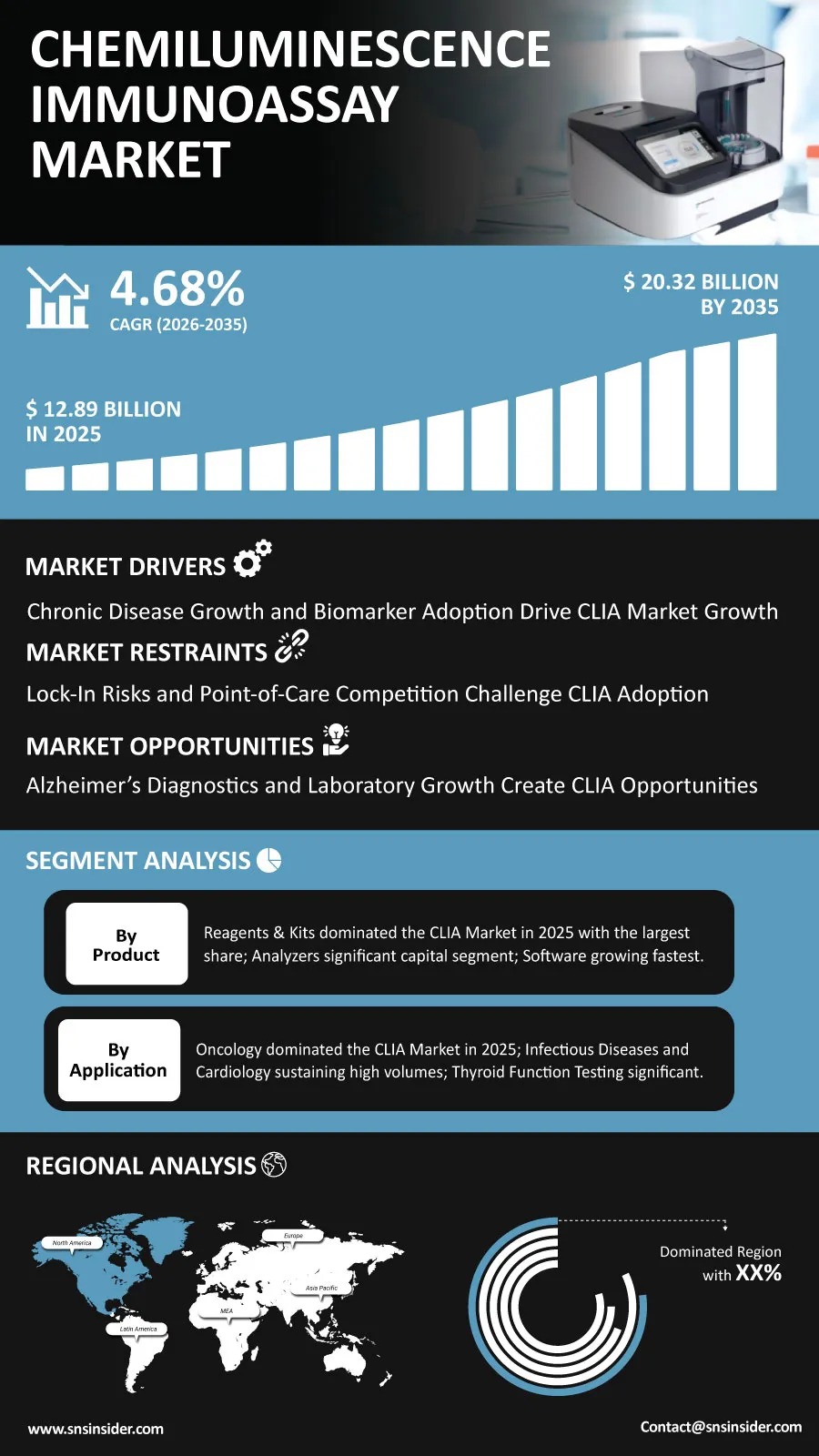
According to a recent study by SNS Insider, the global Chemiluminescence Immunoassay Market size valued at USD 12.89 billion in 2025, is anticipated to grow to USD 20.32 billion by 2035, registering a CAGR of 4.68% over the 2026–2035 forecast period. The market is benefiting from the growing need for reliable laboratory diagnostics, increasing chronic disease testing, and the transition toward automated workflows that can improve laboratory productivity.
To Get Detailed Insights on the Chemiluminescence Immunoassay Market – Request a Sample Report
Automation Reshapes Modern Laboratory Diagnostics
Laboratory facilities have begun to favor the integration of analyzers that have high levels of sensitivity along with easy sample handling process. Chemiluminescent analyzers have started to be incorporated into automated laboratory settings where the health care facilities are able to handle different types of tests without any manual effort.
These devices have also gained importance in urgent clinical settings. For instance, the high sensitivity cardiac markers are capable of enabling faster diagnosis in patients who present symptoms of cardiovascular incidents.
Oncology Leads While New Applications Gain Ground
Reagents and kits accounted for the biggest product category in 2025, driven by recurring demand created by already installed diagnostic platforms. Analyzers will continue being important for laboratory capital spending, whereas software is expected to see the fastest growth rate due to growing adoption of integration solutions in healthcare institutions for labs.
In terms of applications, oncology accounted for the biggest segment in 2025. Immunoassays based on chemiluminescent reactions are used to diagnose different biomarkers linked to various types of cancers, generating recurring diagnostics demand. Cardiology, infectious diseases diagnostics, and thyroid functions diagnostics also account for big testing volumes.
Another interesting use case is linked to using the platform for diagnostics in neurology. The development of blood markers for Alzheimer's disease can help reduce the number of more complicated or expensive tests, creating another promising area for highly-sensitive immunoassays.
Hospitals and Diagnostic Laboratories Remain Core Customers
Hospitals and laboratories were the most dominant end users in 2025. Hospitals need high throughput instruments for conducting routine tests, disease monitoring, and special testing. The immunoassay system is one of the essential equipment used in laboratories.
Research and academic institutions are showing emerging growth there are new developments in biomarkers. More collaborations between diagnostics companies, healthcare facilities, and research organizations would assist in the development of assays.
North America Maintains Market Leadership
North America continued to be the dominant regional market in 2025, with the US contributing around 88% to the regional revenues. In 2025, the value of the US Chemiluminescence Immunoassay Market stood at USD 4.10 billion and is estimated to witness a CAGR of 5.88% between 2026 and 2035.
Presence of well-equipped laboratories, high volume of tests, and adoption of automation in instruments drive the U.S. chemiluminescence immunoassay market. Companies such as Abbott, Roche, Siemens Healthineers, among others, have established themselves in the US, driving platform innovations.
Asia Pacific is forecasted to be the fastest growing regional market as the healthcare infrastructure is developed in countries, such as China, India, Japan, and South Korea. China was responsible for about 40% of regional revenue in 2025. Laboratory automation and investments in hospitals are boosting the growth of the regional market.
In Europe, Germany was responsible for about 27% of regional revenue. In Middle East & Africa, Saudi Arabia was responsible for around 38% of regional revenue, whereas in Latin America, Brazil held about 50% share in regional revenue.
Emerging Biomarkers Create New Growth Opportunities
The next stage of market development is going to be influenced by dedicated biomarker tests. The tests that will be used for diagnosing Alzheimer's disease have drawn specific attention of researchers to developing blood tests for phosphorylated tau and amyloid biomarkers.
Some recent events in the industry show that direction. In 2026, Elecsys pTau 217 Plus was introduced by Roche Diagnostics and in 2025 ALINITY hq ultra-sensitive troponin system was released by Abbott Diagnostics. It shows the main tendencies in the industry which are increased analyte detection sensitivity and reduced time-to-result.
However, laboratories are facing difficulties caused by platform-specific reagent ecosystem and competition from the POC immunoassays. Therefore, companies should pay more attention to developing broader assay menus, connectivity, automation, and dedicated testing solutions.
Major Companies Strengthen Diagnostic Portfolios
The competitive landscape includes Roche Diagnostics AG, Abbott Laboratories, Siemens Healthineers AG, Beckman Coulter Inc. (Danaher), bioMérieux SA, Fujirebio Inc., DiaSorin SpA, Ortho Clinical Diagnostics, Mindray Medical International Ltd., Autobio Diagnostics Co. Ltd., Snibe Co. Ltd., Shenzhen YHLO Biotech Co. Ltd., Tosoh Corporation, Sysmex Corporation, BioLis (JEOL Ltd.), Werfen Group, Randox Laboratories Ltd., MP Biomedicals LLC, Meridian Bioscience Inc., and Biokit SA.
An SNS Insider analyst Parry Kardani commented, “The next stage of chemiluminescence immunoassay development will be defined by the combination of automation, high-sensitivity biomarker detection, and expanding clinical applications. Diagnostic providers that can deliver efficient workflows alongside broader and more specialized assay menus are positioned to benefit from continued laboratory modernization.
About the Author

Get in touch




