
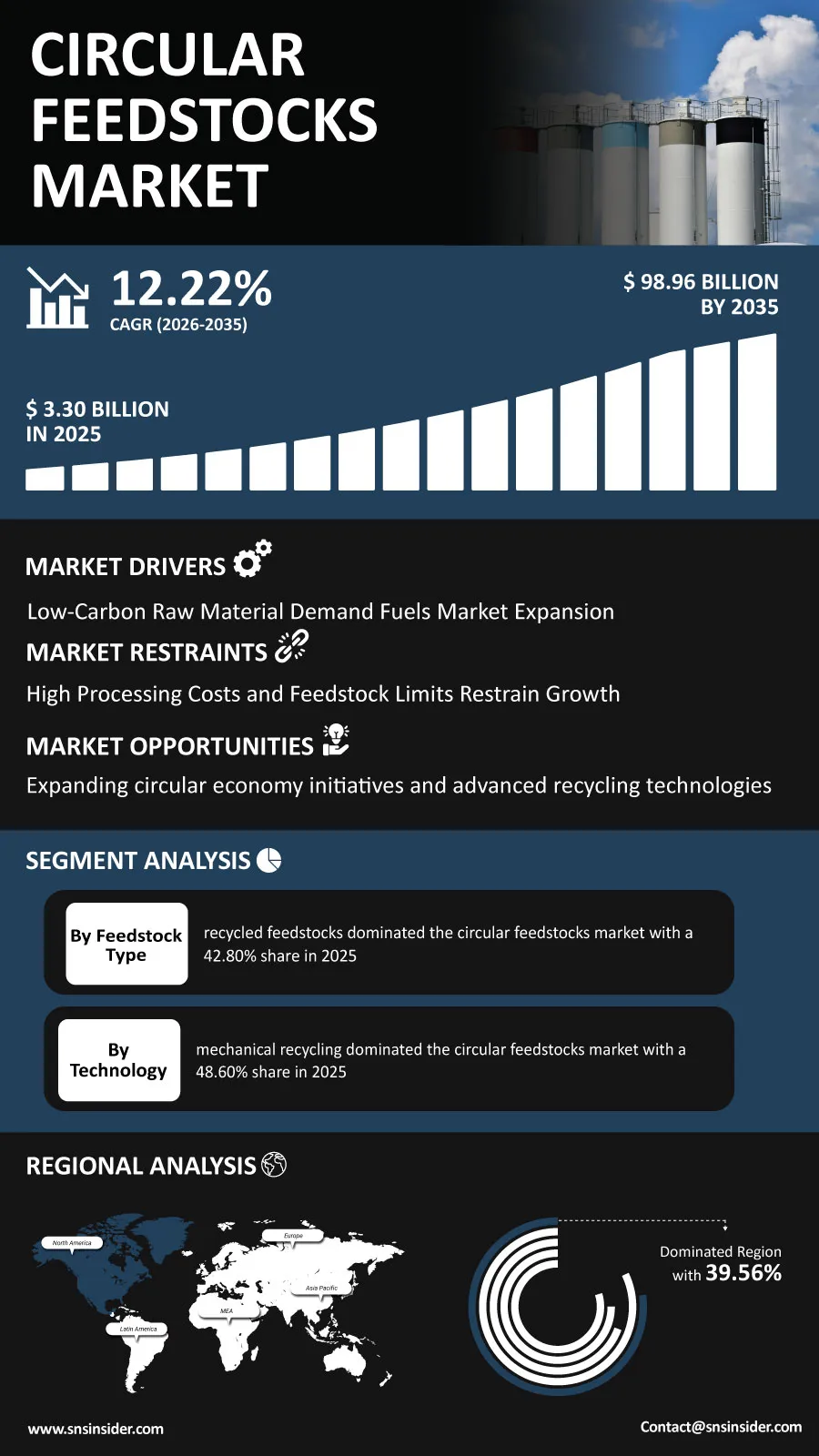
The global Circular Feedstocks Market is entering a period of accelerated expansion as manufacturers shift toward alternative raw materials that can reduce environmental impact and strengthen resource efficiency. “According to a recent study by SNS Insider, the global Circular Feedstocks Market size valued at 3.30 Billion in 2025, is anticipated to grow to USD 98.96 Billion by 2035, registering a CAGR of 12.22% over the 2026–2035 forecast period.”
The chemical industry, the polymer industry, and other manufacturers are making use of more and more materials like waste, renewable resources, or carbon capture as part of the production process. The development is driven by sustainable and carbon reduction policies and targets and by legislation that encourages higher material utilization.
To Get Detailed Insights on the Circular Feedstocks Market – Request a Sample Report
Industrial Decarbonization Creates Significant Market Opportunities
The drive toward reducing dependency on virgin fossil fuels is prompting businesses to rethink their approaches toward the sourcing of their raw materials. Plastics waste, biomass-based feedstocks, and other alternative raw materials are increasingly being considered by manufacturers as viable means to achieve low-carbon manufacturing without losing out on performance.
The area of technology is yet another one worth exploring. The recycling of hard-to-recover waste streams can be accomplished using chemical recycling technologies. On top of this, there are further technological advancements like biomass conversion and carbon capture and utilization that are making possible the creation of sustainable industrial raw materials.
Key Market Insights Highlight Technology and Feedstock Shifts
Among feedstock types, the recycled feedstock had a market share of 42.80% in 2025 thanks to an existing collection system, regulations for the use of recycled content, and demand for plastics and chemicals production. Bio-based feedstocks are set to become the fastest-growing segment of the market with 14.11% CAGR up to 2035 as investments in biomass transformation, biorefining, and renewables chemicals production increase.
Among technologies, mechanical recycling accounted for 48.60% of the market in 2025 due to its existing industrial base and relatively cost-efficient process economics. Chemical recycling is forecast to show the highest growth rate of 15.92% CAGR, as advances in pyrolysis, depolymerization, solvents recycling, and other technologies that can deal with more complicated waste emerge.
By applications, plastic and polymers occupied 44.50% of the market in 2025. On the other hand, chemicals and petrochemicals will become the fastest-growing applications with 14.19% CAGR as producers adopt circular feedstocks for intermediates, specialties chemicals, and other industrial products. By end-use industries, packaging was the leader of the market with 38.70% share, while automotive is set to show 14.51% CAGR.
Advanced Recycling Technologies Reshape Feedstock Supply
The evolution of circular feedstock systems has been found to be intimately related to advancements in material recovery and conversion technology. Technologies such as automation, improved mechanical processing, chemical recycling, the use of biomass, and carbon capture technology have assisted manufacturers in accessing more kinds of alternative raw material.
Moreover, mass-balance manufacturing approaches have assisted chemical producers in incorporating sustainable and recycled raw materials into the current manufacturing setup. Such advancements in technology can help in ensuring that the feedstocks are commercially viable.
Regional Markets Demonstrate Strong Expansion Potential
In North America, the share of revenue from the market was 39.56%, which was attributed to environmental regulations, recycling investments, sustainability efforts of corporations, and the rising demand for low-carbon industrial materials. The US occupied the dominant position of 86.10% of the regional market owing to its strong manufacturing and chemical industry.
The Asia Pacific is expected to experience the fastest growth rate during the forecast period, due to industrialization and expansion of manufacturing capacity, investments in waste management solutions, and the increasing use of sustainable materials. In 2025, China accounted for 39.20% of the regional market. Europe continues to develop through circular economy policies and sustainable manufacturing efforts, whereas the Middle East & Africa and Latin America continue to evolve through recycling investments, biobased materials, and low-carbon industrial materials.
Industry Participants Accelerate Circular Material Innovation
The core of competition is now revolving around scaling up sustainable feedstocks, increasing capacity for recycling, and creating technology that uses alternative sources of raw materials within existing industrial processes. Strategic collaborations and investments are assisting major companies in building circular products and meeting growing demands of plastics, chemicals, packaging, and auto companies.
Key companies operating in the global Circular Feedstocks Market include BASF SE, Neste Oyj, LyondellBasell Industries N.V., Dow Inc., SABIC, Eastman Chemical Company, Covestro AG, Braskem S.A., Borealis AG, TotalEnergies SE, Shell plc, Exxon Mobil Corporation, Chevron Phillips Chemical Company LLC, INEOS Group Holdings S.A., OMV AG, Repsol S.A., LG Chem Ltd., Mitsubishi Chemical Group Corporation, Arkema S.A., and Berry Global Group, Inc.
An SNS Insider analyst Himanshu Sharma commented, “The transition from conventional fossil-based inputs toward recycled, renewable, and waste-derived raw materials is becoming a strategic priority across major industrial value chains. Continued progress in advanced recycling, biomass conversion, and carbon utilization technologies will be critical to expanding the availability and commercial competitiveness of circular feedstocks worldwide.”
About the Author

Get in touch




