
Circular Feedstocks Market Report Scope & Overview:
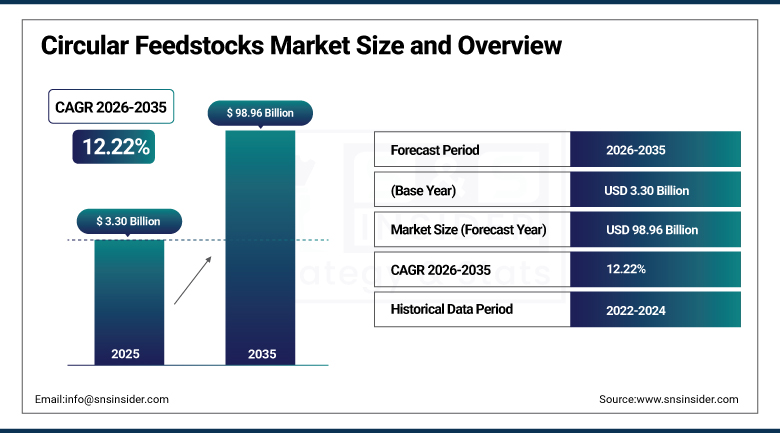
The Circular Feedstocks Market was valued at USD 3.30 Billion in 2025 and is expected to reach USD 98.96 Billion by 2035, growing at a CAGR of 12.22% from 2026–2035.
Some of the main factors contributing to the development of the global circular feedstocks market include the rising demand for sustainable and low-carbon raw materials, increasing adoption of circular economy practices, stringent environmental regulations, and growing investments in advanced recycling technologies. Manufacturers are increasingly utilizing recycled, bio-based, waste-derived, and carbon-captured feedstocks to reduce dependence on virgin fossil resources, improve resource efficiency, and achieve corporate sustainability and net-zero emission targets. Besides, advancements in mechanical recycling, chemical recycling, biomass conversion, and carbon capture & utilization (CCU) technologies are further accelerating market growth.
In October 2024, Neste and Braskem announced an agreement to supply renewable and recycled feedstocks for the production of circular polymers and chemicals. The collaboration enables Braskem to manufacture sustainable polymer resins and chemical products using Neste RE™, supporting reduced reliance on virgin fossil feedstocks and advancing circular economy initiatives across the plastics and chemicals industry.
To Get more information On Circular Feedstocks Market - Request Free Sample Report
Circular Feedstocks Market Trends
-
Rising demand for sustainable and low-carbon raw materials is driving the adoption of circular feedstocks across the chemicals, plastics, and manufacturing industries.
-
Increasing regulatory support for the circular economy, waste reduction, and carbon neutrality is accelerating the use of recycled, bio-based, and waste-derived feedstocks.
-
Circular feedstocks enable resource efficiency, reduced dependence on virgin fossil resources, lower greenhouse gas emissions, and improved material circularity.
-
Advancements in mechanical recycling, chemical recycling, biomass conversion, and carbon capture & utilization (CCU) technologies are driving innovation in the Circular Feedstocks Market.
-
Growing adoption across packaging, automotive, construction, consumer goods, and petrochemical industries is supporting sustained market growth.
The U.S. Circular Feedstocks Market Outlook
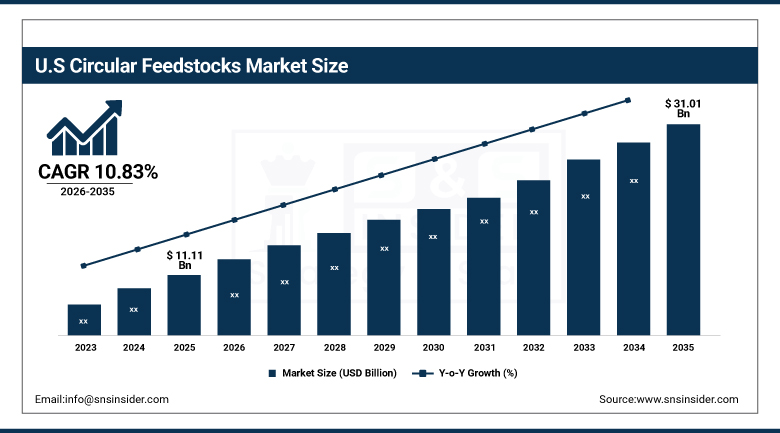
The U.S. Circular Feedstocks Market was valued at USD 11.11 Billion in 2025 and is expected to reach around USD 31.01 Billion by 2035, growing at a CAGR of 10.83% from 2026–2035.
The increasing demand for sustainable raw materials, stricter environmental regulations, and the transition toward a circular economy have fueled the growth of the circular feedstocks market in the United States. Manufacturers across the chemicals, plastics, packaging, and consumer goods industries are increasingly adopting recycled, bio-based, and waste-derived feedstocks to reduce dependence on virgin fossil resources, lower carbon emissions, and meet corporate sustainability targets.
Moreover, advancements in mechanical recycling, chemical recycling, biomass conversion, and carbon capture & utilization (CCU) technologies are accelerating the growth of the circular feedstocks market in the United States. Growing investments by chemical manufacturers, recycling companies, and technology providers in advanced recycling infrastructure and circular production processes are further supporting market expansion.
In October 2024, BASF SE expanded its portfolio of circular raw materials by increasing the use of recycled and renewable feedstocks through its mass balance approach, helping customers reduce product carbon footprints while advancing circular economy objectives.
Circular Feedstocks Market Market Segment Analysis
-
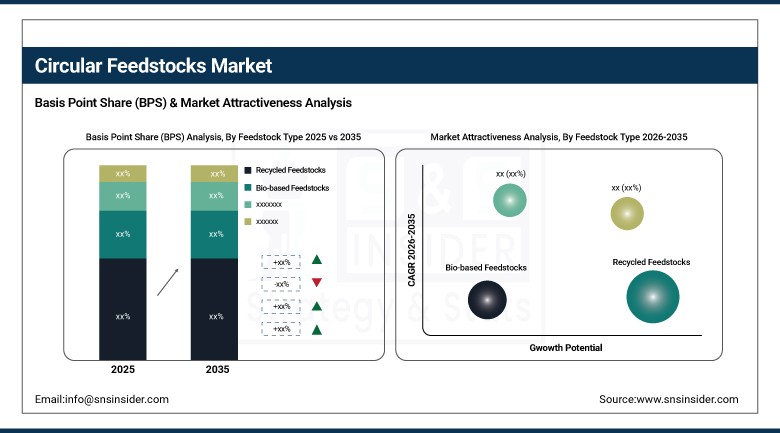
By Feedstock Type, recycled feedstocks dominated the circular feedstocks market with a 42.80% share in 2025, while bio-based feedstocks are projected to be the fastest-growing segment, registering a 14.11% CAGR during 2025–2035.
-
By Technology, mechanical recycling dominated the circular feedstocks market with a 48.60% share in 2025, while chemical recycling is projected to be the fastest-growing segment, registering a 15.92% CAGR during 2025–2035.
-
By Application, plastics & polymers dominated the circular feedstocks market with a 44.50% share in 2025, while chemicals & petrochemicals are projected to be the fastest-growing segment, registering a 14.19% CAGR during 2025–2035.
-
By End-use Industry, packaging dominated the circular feedstocks market with a 38.70% share in 2025, while automotive is projected to be the fastest-growing segment, registering a 14.51% CAGR during 2025–2035.
By Feedstock Type, recycled feedstocks dominated the circular feedstocks market, while bio-based feedstocks are expected to grow fastest.
Recycled Feedstocks accounted for the largest share of the circular feedstocks market in 2025 due to their widespread adoption across the plastics, chemicals, packaging, and manufacturing industries. Strong regulatory support for recycled content, extended producer responsibility (EPR) policies, and corporate sustainability commitments have encouraged manufacturers to replace virgin fossil-based raw materials with recycled alternatives. The availability of post-consumer and post-industrial waste streams, along with continuous improvements in mechanical and chemical recycling technologies, has further strengthened the market position of recycled feedstocks. Meanwhile, Bio-based Feedstocks are expected to register the fastest growth during the forecast period owing to increasing demand for renewable raw materials with lower carbon footprints.
Growing investments in bio-refineries, agricultural residue utilization, and biomass conversion technologies, coupled with favorable government incentives for renewable chemicals and sustainable materials, are accelerating their commercialization. Rising consumer preference for environmentally friendly products and expanding applications in bio-based polymers, specialty chemicals, and sustainable packaging are expected to further support the rapid growth of bio-based feedstocks.
By Technology, mechanical recycling dominated the circular feedstocks market, while chemical recycling is expected to grow fastest.
Mechanical Recycling held the largest share of the circular feedstocks market in 2025 because it is a well-established, commercially viable, and cost-effective process for converting plastic and other recyclable waste into secondary raw materials. The technology benefits from mature collection and sorting infrastructure, lower processing costs, and widespread industrial adoption, making it the preferred choice for producing circular feedstocks in packaging and consumer goods applications.
However, Chemical Recycling is expected to witness the fastest growth throughout the forecast period as industries seek solutions for processing mixed, contaminated, and difficult-to-recycle waste streams that cannot be effectively handled through mechanical recycling. Continuous advancements in pyrolysis, depolymerization, gasification, and solvent-based recycling technologies are improving feedstock quality and expanding end-use applications. Increasing investments by chemical manufacturers and strategic collaborations to produce high-quality recycled feedstocks suitable for food-grade packaging and advanced chemical production are expected to drive strong demand for chemical recycling technologies.
By Application, plastics & polymers dominated the circular feedstocks market, while chemicals & petrochemicals are expected to grow fastest.
Plastics & Polymers represented the largest application segment in the circular feedstocks market in 2025 due to increasing global demand for recycled and bio-based plastics across packaging, automotive, construction, and consumer goods industries. Regulatory mandates promoting recycled plastic content, corporate sustainability targets, and consumer demand for environmentally responsible products have significantly increased the use of circular feedstocks in polymer production. Manufacturers are increasingly integrating recycled polymers and renewable feedstocks into existing production processes to reduce carbon emissions and dependence on virgin petrochemical resources.
Meanwhile, the Chemicals & Petrochemicals segment is projected to record the fastest growth during the forecast period owing to rising adoption of circular raw materials in specialty chemicals, solvents, intermediates, and industrial chemicals. The commercialization of advanced recycling technologies and mass balance certification systems is enabling chemical producers to manufacture sustainable products without compromising quality or performance, creating substantial growth opportunities across global chemical value chains.
Regional Analysis
|
Region |
Major Country |
Share within Region, 2025(%) |
|---|---|---|
|
North America |
United States |
86.10% |
|
Europe |
Germany |
24.80% |
|
Asia Pacific |
China |
39.20% |
|
Middle East & Africa |
Saudi Arabia |
29.10% |
|
Latin America |
Brazil |
43.200% |
North America circular feedstocks market insights
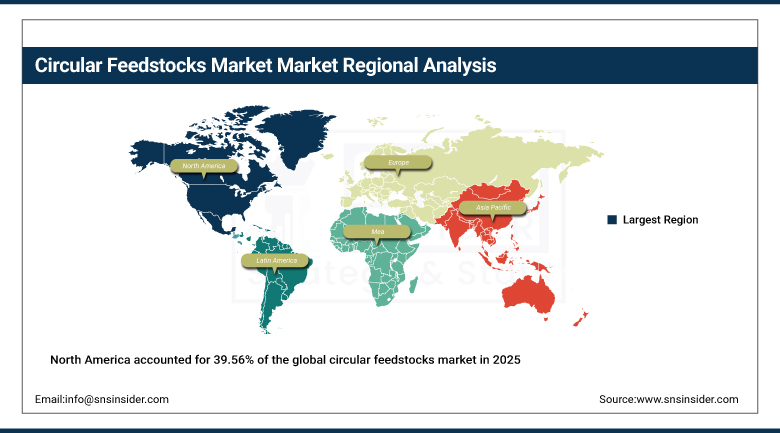
North America accounted for 39.56% of the global circular feedstocks market in 2025. Major factors driving market growth include stringent environmental regulations, increasing adoption of circular economy practices, rising demand for recycled and bio-based raw materials, and significant investments in advanced recycling infrastructure. Growing implementation of mechanical and chemical recycling technologies, along with strong corporate sustainability commitments, is accelerating the transition toward circular feedstocks across the chemicals, plastics, and packaging industries. In the same year, the United States accounted for 86.10% of the North America circular feedstocks market.
The major growth factors expected to influence the regional market include increasing investments in advanced recycling facilities, growing adoption of mass balance-certified products, rising demand for low-carbon chemicals, and supportive government policies promoting resource efficiency. In addition, technological advancements in chemical recycling, biomass conversion, and carbon capture & utilization (CCU) are expected to further strengthen market growth across the United States and North America.
Get Customized Report as per Your Business Requirement - Enquiry Now
Europe circular feedstocks market insights
The Europe circular feedstocks market is expanding due to ambitious circular economy initiatives, stringent sustainability regulations, and increasing investments in renewable and recycled raw materials. In 2025, Germany accounted for 24.80% of the Europe circular feedstocks market, supported by its strong chemical manufacturing industry, advanced recycling infrastructure, and continuous investments in sustainable production technologies.
Key factors driving market growth include increasing demand for recycled plastics and renewable chemicals, favorable regulatory frameworks, extended producer responsibility (EPR) policies, and rising adoption of advanced recycling technologies. Continued investments in industrial decarbonization and circular manufacturing are expected to support long-term market expansion across Europe.
Asia Pacific circular feedstocks market insights
Asia Pacific is projected to register the highest CAGR in the circular feedstocks market due to rapid industrialization, expanding manufacturing activities, supportive government initiatives for waste management, and increasing investments in recycling technologies. China accounted for 39.20% of the Asia Pacific circular feedstocks market in 2025 owing to its large manufacturing base, extensive plastics production, growing recycling capacity, and strong government support for circular economy initiatives.
The regional market is expected to benefit from increasing demand for sustainable materials, expanding bio-based chemical production, rising investments in advanced recycling facilities, and growing adoption of circular feedstocks across packaging, automotive, electronics, and consumer goods industries.
Middle East & Africa and Latin America insights
The Middle East & Africa circular feedstocks market is experiencing steady growth due to increasing investments in sustainable industrial development, waste management infrastructure, and low-carbon chemical production. Saudi Arabia accounted for 29.10% of the regional market in 2025, supported by investments in petrochemical diversification, circular economy initiatives, and advanced recycling projects.
The Latin America circular feedstocks market is expanding as governments and industries increasingly focus on sustainable resource management, recycling infrastructure, and renewable feedstocks. Brazil accounted for 43.20% of the Latin America circular feedstocks market in 2025, driven by its large bio-based industry, abundant biomass resources, growing recycling sector, and increasing adoption of circular economy practices across manufacturing and packaging industries.
Market Dynamics
Growth Driver: Rising demand for sustainable and low-carbon raw materials accelerating circular feedstocks market growth
The increasing demand for sustainable, low-carbon, and resource-efficient raw materials has become one of the primary drivers of the growth of the circular feedstocks market. Industries including chemicals, plastics, packaging, automotive, and consumer goods are increasingly replacing virgin fossil-based feedstocks with recycled, bio-based, waste-derived, and carbon-captured alternatives to reduce greenhouse gas emissions and achieve corporate sustainability targets. Governments worldwide are also implementing stringent environmental regulations and circular economy policies that encourage the use of renewable and recycled feedstocks across industrial value chains.
Growing investments in advanced recycling infrastructure, bio-refineries, and carbon capture technologies, along with rising demand for certified sustainable materials, are expected to further accelerate market growth throughout the forecast period.
Restraints: High processing costs and limited feedstock availability may restrain circular feedstocks market growth
The growth of the circular feedstocks market remains constrained by high processing costs, inconsistent quality of recycled materials, and limited availability of suitable waste feedstocks. Advanced recycling technologies such as chemical recycling and carbon capture & utilization require substantial capital investment and complex processing infrastructure, increasing production costs compared with conventional fossil-based feedstocks. Variability in waste collection systems, contamination of recyclable materials, and insufficient recycling infrastructure also affect feedstock availability and quality.
In addition, challenges related to supply chain integration, certification requirements, and scalability of advanced recycling technologies may slow market adoption. Addressing these challenges will require continued investments in waste management infrastructure, technological innovation, and supportive regulatory frameworks.
Opportunities: Expanding circular economy initiatives and advanced recycling technologies
The growing global transition toward a circular economy is creating significant opportunities for the circular feedstocks market. Increasing investments in mechanical recycling, chemical recycling, biomass conversion, and carbon capture & utilization (CCU) technologies are enabling manufacturers to produce high-quality sustainable feedstocks for chemicals, plastics, fuels, and specialty materials. Rising collaborations among chemical companies, recyclers, technology providers, and consumer brands are further accelerating commercialization of circular feedstock solutions.
Additionally, increasing regulatory mandates for recycled content, expanding bio-based chemical production, growing demand for low-carbon products, and continuous innovation in advanced recycling technologies are expected to create substantial growth opportunities. As industries continue to prioritize decarbonization and resource efficiency, demand for circular feedstocks is expected to increase significantly during the forecast period.
Recent Developments
-
2026: BASF SE expanded the use of renewable and recycled feedstocks through its mass balance approach, increasing the availability of circular products for the chemicals, plastics, and consumer goods industries.
-
2026: Neste Oyj expanded its renewable and recycled feedstock production capacity to meet growing demand for sustainable polymers, chemicals, and low-carbon industrial materials.
-
2025: Braskem S.A. and Neste Oyj strengthened their collaboration to supply renewable and recycled feedstocks for the production of circular polymers and chemicals, supporting the transition away from virgin fossil-based raw materials.
-
2025: LyondellBasell Industries expanded its advanced recycling initiatives and circular feedstock portfolio by increasing investments in chemical recycling technologies to produce high-quality recycled raw materials for plastic and chemical manufacturing.
Circular Feedstocks Market Key Players are:
-
BASF SE
-
Neste Oyj
-
LyondellBasell Industries N.V.
-
Dow Inc.
-
SABIC
-
Eastman Chemical Company
-
Covestro AG
-
Braskem S.A.
-
Borealis AG
-
TotalEnergies SE
-
Shell plc
-
Exxon Mobil Corporation
-
Chevron Phillips Chemical Company LLC
-
INEOS Group Holdings S.A.
-
OMV AG
-
Repsol S.A.
-
LG Chem Ltd.
-
Mitsubishi Chemical Group Corporation
-
Arkema S.A.
-
Berry Global Group, Inc.
Circular Feedstocks Market Report Scope:
| Report Attributes | Details |
|---|---|
| Market Size in 2025 | USD 31.30 Billion |
| Market Size by 2035 | USD 98.96 Billion |
| CAGR | CAGR of 12.22% From 2026 to 2035 |
| Base Year | 2025 |
| Forecast Period | 2026-2035 |
| Historical Data | 2022-2024 |
| Report Scope & Coverage | Market Size, Segments Analysis, Competitive Landscape, Regional Analysis, DROC & SWOT Analysis, Forecast Outlook |
| Key Segments | • By Feedstock Type (Recycled Feedstocks, Bio-based Feedstocks, Waste-derived Feedstocks, Carbon-captured Feedstocks) • By Technology (Mechanical Recycling, Chemical Recycling, Biomass Conversion, Carbon Capture & Utilization (CCU)) • By Application (Plastics & Polymers, Chemicals & Petrochemicals, Fuels & Energy, Packaging) • By End-use Industry (Packaging, Automotive, Construction, Consumer Goods) |
| Regional Analysis/Coverage | North America (US, Canada, Mexico), Europe (Eastern Europe [Poland, Romania, Hungary, Turkey, Rest of Eastern Europe] Western Europe] Germany, France, UK, Italy, Spain, Netherlands, Switzerland, Austria, Rest of Western Europe]), Asia Pacific (China, India, Japan, South Korea, Vietnam, Singapore, Australia, Rest of Asia Pacific), Middle East & Africa (Middle East [UAE, Egypt, Saudi Arabia, Qatar, Rest of Middle East], Africa [Nigeria, South Africa, Rest of Africa], Latin America (Brazil, Argentina, Colombia, Rest of Latin America) |
| Company Profiles | BASF SE, Neste Oyj, LyondellBasell Industries N.V., Dow Inc., SABIC, Eastman Chemical Company, Covestro AG, Braskem S.A., Borealis AG, TotalEnergies SE, Shell plc, Exxon Mobil Corporation, Chevron Phillips Chemical Company LLC, INEOS Group Holdings S.A., OMV AG, Repsol S.A., LG Chem Ltd., Mitsubishi Chemical Group Corporation, Arkema S.A., Berry Global Group, Inc. |
Frequently Asked Questions
The circular feedstocks market is expected to grow at a CAGR of 12.22% from 2026 to 2035.
The market is driven by increasing demand for sustainable and low-carbon raw materials, rising adoption of circular economy practices, stringent environmental regulations, and growing investments in advanced recycling technologies.
