
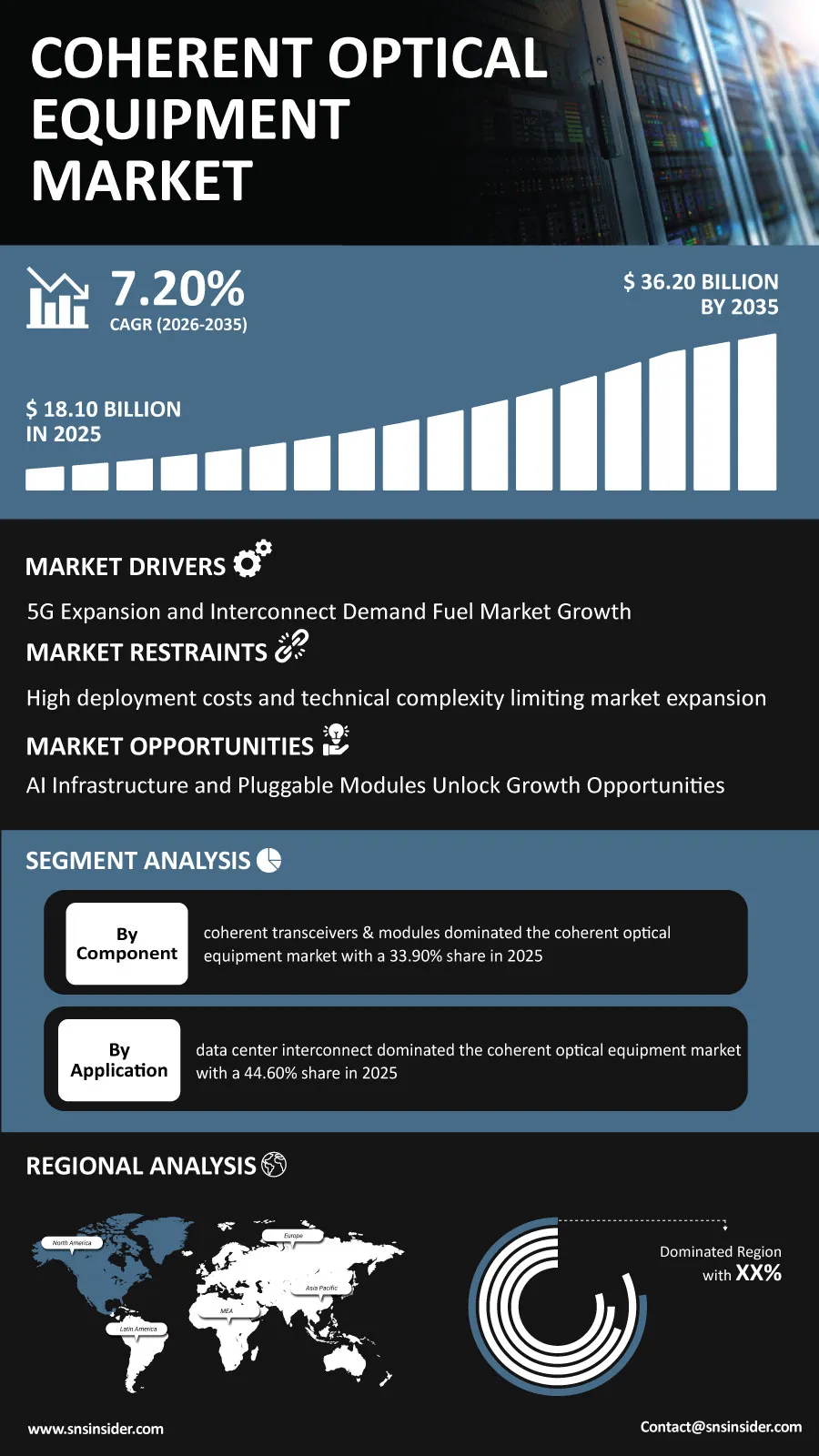
The global Coherent Optical Equipment Market is set for significant expansion as data center interconnect demand and AI-driven network capacity investment continue to reshape optical networking infrastructure worldwide. “According to a recent study by SNS Insider, the global Coherent Optical Equipment Market size valued at USD 18.10 billion in 2025, is anticipated to grow to USD 36.20 billion by 2035, registering a CAGR of 7.20% over the 2026–2035 forecast period.”
There have been tremendous changes within optical networking technology over time, due to which many carriers and data center operators who aim at improving network capacity can take advantage of this trend. This includes the need for more efficient, higher-capacity transmission equipment that will provide operators with the ability to manage exponentially growing data traffic across existing fiber infrastructure. This applies in situations where coherent optical equipment supports data center interconnect, metro networks, and long-haul transmission applications. Manufacturers are constantly working hard to ensure that their optical equipment performs better than before in order to meet various carrier and hyperscale operator needs.
To Get Detailed Insights on the Coherent Optical Equipment Market – Request a Sample Report
AI-Driven Data Center Capacity Creates New Demand
The coherent optical equipment market has evolved from basic long-haul transmission technology to an increasingly central pillar of AI and cloud computing infrastructure. The growing investment in higher data rate transceivers, pluggable module technology, and advanced digital signal processing across equipment manufacturers of all sizes has required the development of more efficient and higher-capacity optical transmission solutions.
New coherent optical technologies can increase transmission speed, improve power efficiency, and allow for expansion into increasingly demanding data center interconnect and long-haul network applications. This gives telecom carriers and hyperscale operators the possibility to manage exponentially growing data traffic while maintaining cost-effective network capacity expansion.
Optical equipment manufacturers, telecom carriers, and hyperscale data center operators are increasingly cooperating thanks to the growing interest in developing future solutions for efficient, high-capacity optical networking infrastructure.
Key Market Findings Highlight High-Growth Segments
The coherent transceivers and modules segment dominated all categories in the coherent optical equipment market share with a market revenue share of 33.90% in 2025 due to their essential role enabling high-speed data transmission. The fastest growing category is expected to be DSPs which will grow at a CAGR of 12.90% through 2035, owing to technological advancements improving performance and power efficiency.
By data rate, the 200G/400G segment held the largest share of total market revenue at 42.60% in 2025 due to widespread adoption as the industry standard for capacity upgrades. The 800G and above segment will see the fastest growth in revenue generation at a CAGR of 15.40%, driven by growing AI workload demand for maximum bandwidth capacity.
Based on application, data center interconnect generated a share of 44.60% of market revenue in 2025 thanks to rising demand for connectivity between distributed data center facilities. On the other hand, long-haul and submarine networks will be the segment recording the fastest revenue growth at a CAGR of 9.80%, supported by growing international data traffic and submarine cable investment.
Distributive end-user trends are changing as well. Telecom service providers accounted for a 46.80% revenue share in 2025 owing to extensive network infrastructure investment. But cloud and hyperscale data center operators will turn out to be the fastest-growing end-user category through 2035, on the back of rapid AI and cloud computing infrastructure expansion.
Capacity, Efficiency, and AI Infrastructure Readiness Gain Importance
In this regard, carriers and data center operators have been looking at coherent optical equipment that would deliver higher transmission capacity while requiring less power consumption and physical footprint.
Innovation in digital signal processing, pluggable module design, and advanced modulation techniques has been making it possible for companies to come up with equipment that can operate effectively across increasingly demanding AI and cloud computing network requirements. In addition to that, increasing emphasis on energy efficiency is also making it possible for manufacturers to find solutions that address growing data center power consumption concerns. Such trends are likely to become even more prominent in the future.
North America Emerges as the Largest Market with 85.00% Regional Revenue Share Amid Rising AI Infrastructure Investment
The North America region represented the largest share of regional market revenue in 2025, owing to extensive hyperscale data center construction, strong telecom infrastructure investment, and rapid AI workload growth driving substantial capacity expansion. On the other hand, Asia Pacific is expected to be the fastest-growing market during the forecast period through 2035, propelled by rapid data center construction expansion and extensive 5G network deployment across the region's major economies.
Leading Companies Drive Innovation and Competition
The environment continues to stay very dynamic since players continue innovating on transmission technology and power efficiency as well as forming partnerships in order to enhance their position in the industry. Some of the major companies that operate in the global coherent optical equipment market are Ciena, Huawei Technologies, Cisco Systems, Nokia, Infinera, Fujitsu, Ribbon Communications, ZTE, ADVA Optical Networking, and Ericsson.
An SNS Insider analyst Santosh Bhul commented, "The explosive growth of AI workloads is creating unprecedented demand for higher-capacity, more power-efficient coherent optical infrastructure. Manufacturers that successfully combine transmission speed innovation, power efficiency, and pluggable module technology will be best positioned to capitalize on emerging opportunities across data center interconnect, metro, and long-haul network applications."
About the Author

Get in touch




