
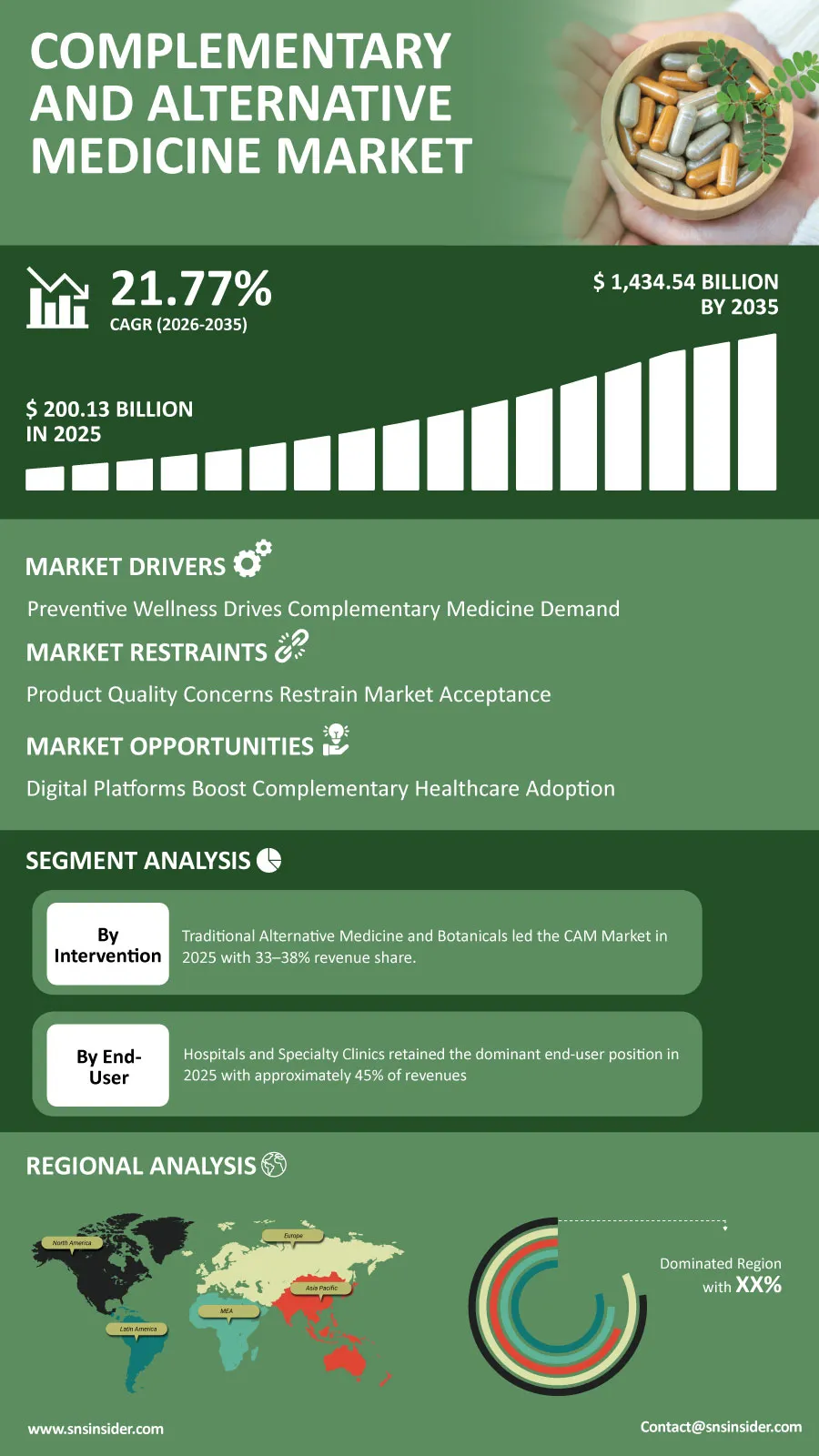
The global Complementary and Alternative Medicine (CAM) Market is entering a period of exceptional expansion as individuals, healthcare providers, and wellness organizations increasingly embrace holistic approaches to health management. “According to a recent study by SNS Insider, the global Complementary and Alternative Medicine Market size valued at USD 200.13 billion in 2025, is anticipated to grow to USD 1,434.54 billion by 2035, registering a CAGR of 21.77% over the 2026–2035 forecast period.”
Consumer behavior that is shifting towards wellness, prevention, and personalization has created several opportunities in the global complementary and alternative medicine market. Increasingly, consumers have started using mainstream medicine along with alternative medicines that focus on wellness, healthy living, stress reduction, and natural wellness practices.
The industry is also enjoying increased advantages due to greater accessibility of the internet, health awareness, and wellness product and service offerings that have become increasingly more available through both traditional and online channels.
To Get Detailed Insights on the Complementary and Alternative Medicine Market – Request a Sample Report
Digital Innovation and Personalized Wellness Accelerate Market Evolution
Consumers are increasingly accessing complementary and alternative health services through technological advancements. This includes mobile health apps, telemedicine health consultation, artificial intelligence-driven health recommendations, wearable technology, and health communities on the internet.
There is increasing adoption of digital health technology in combination with traditional methods of maintaining one’s health, thereby allowing greater personalization of experiences for clients and patients. Companies are making huge investments in technologies that combine education, lifestyle advice, nutritional advice, mindfulness, and personal health suggestions.
The increase in corporate investments in wellness programs of employees has also added on to the growth of the market due to the realization that there are long-term gains to be made from such programs.
Key Market Insights Highlight Strong Growth Opportunities
Among intervention categories, Traditional Alternative Medicine and Botanicals accounted for approximately 33%–38% of global market revenue in 2025, reflecting widespread consumer adoption of herbal and traditional wellness practices across multiple regions.
Meanwhile, Mind and Body Healing is projected to emerge as the fastest-growing intervention category, expanding at approximately 28% CAGR through 2035, supported by increasing awareness of stress management, emotional wellbeing, meditation, yoga, and mindfulness practices.
From a distribution perspective, Direct Sales represented approximately 57% of total market revenue in 2025, driven by practitioner consultations, wellness centers, pharmacies, and specialty retail outlets. However, E-Sales is expected to register the fastest growth, recording a CAGR of approximately 27.5%, reflecting continued expansion of e-commerce platforms and digital wellness services.
By end user, Hospitals and Specialty Clinics accounted for approximately 45% of global market revenue in 2025, demonstrating growing integration of complementary therapies into organized healthcare delivery. At the same time, Individual and Homecare is anticipated to remain the fastest-growing end-user segment, expanding at approximately 8.54% CAGR, supported by increasing adoption of home-based wellness solutions and digital healthcare platforms.
Preventive Healthcare Becomes a Global Priority
The global healthcare systems are showing increasing focus towards disease prevention and healthy living. The emerging scenario in the healthcare industry is leading to increased popularity of complementary therapies that help in maintaining overall physical health, emotional well-being, nutritional status, fitness levels, and chronic diseases.
The growing consumer knowledge about mental well-being, lifestyle diseases, and healthy aging is creating a lot of chances for those who provide healthcare services based on complementary medicines. Preventive healthcare is becoming one of the major objectives in the healthcare system, and complementary medicine is getting more attention.
Regional Insights:
North America is set to remain one of the largest regional markets owing to substantial consumer expenditure on wellness services, increased wellness programs by firms, adoption of digital health technology, and integration of complementary health care into the conventional medical environment.
The Asia-Pacific region is forecast to maintain its position as the fastest-growing regional market due to increased healthcare infrastructure, wellness tourism, supportive government policies for traditional healthcare, increased adoption of digital health technologies, and cultural acceptance of complementary medicine in several countries within the region.
Industry Leaders Expand Product Innovation and Digital Capabilities
The competitive landscape continues to evolve as companies invest in personalized wellness solutions, digital platforms, evidence-based natural products, strategic collaborations, and international expansion initiatives.
Key companies operating in the global Complementary and Alternative Medicine Market include Herbalife Nutrition, Nature's Bounty, Weleda, Gaia Herbs, Dr. Batra's Healthcare, Ayushakti Ayurved, Biogetica, YogaWorks, Nordic Naturals, and Garden of Life.
An SNS Insider analyst Parry Kardani commented, "The complementary and alternative medicine industry is undergoing a profound transformation as preventive healthcare, digital wellness, and personalized health management become increasingly important to consumers worldwide. Organizations that successfully combine scientific validation, technology, and consumer-centric wellness experiences are expected to lead the next phase of market expansion."
About the Author

Get in touch




