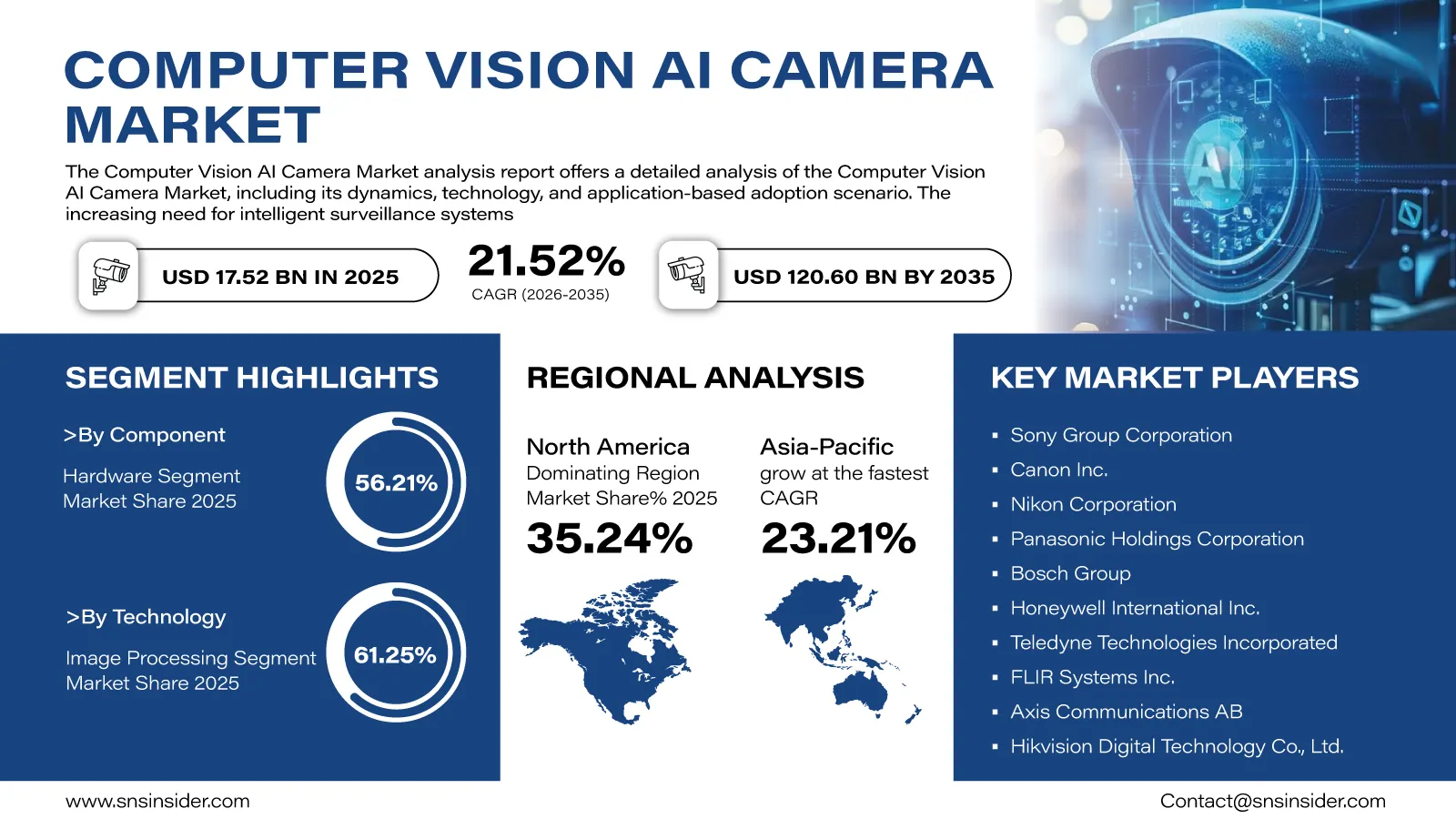
The global Computer Vision AI Camera Market is set to grow tremendously in the coming years owing to the increasing rate of investment being made by companies towards advanced imaging systems. According to a recent study by SNS Insider, the global Computer Vision AI Camera Market size valued at USD 17.52 billion in 2025, is anticipated to grow to USD 120.60 billion by 2035, registering a CAGR of 21.52% over the 2026–2035 forecast period.
The ongoing rapid digital transformation has been leading to the rise in the need for AI cameras that can analyze visual data in real time without any delay and offer useful insights. Enterprises have begun to deploy computer vision systems to increase efficiency, ensure worker safety, build up their security systems, and carry out inspections automatically.
To Get Detailed Insights on the Computer Vision AI Camera Market – Request a Free Sample Report
As the use of edge computing, cloud analytics, and deep learning algorithms becomes more common, smart camera systems become even more advanced. With the rising need for fast and efficient visual intelligence solutions, companies continue developing new devices and systems.
AI-Driven Automation Continues to Create Significant Growth Opportunities
Governments and corporations have been making significant investments in smart infrastructure, smart cities, and Industry 4.0 projects, resulting in increased demand for high-performance computer vision solutions. Computer vision-equipped devices powered by AI have started to become commonly used in manufacturing, logistics, diagnostics, and surveillance in critical infrastructure.
The rising trend towards decentralized computing will lead to a faster implementation of edge AI cameras able to analyze visual information on-site, which would ensure faster processing and increased system stability. This feature will be especially useful for tasks that require timely response, such as self-driving vehicles and public security.
Further innovation in image sensor technology, artificial neural networks, and AI software will improve the accuracy of object detection, predictive analytics, facial recognition, and anomaly detection, thus offering future possibilities to technology suppliers in several end-use sectors.
Key Market Insights Highlight Shifting Demand Patterns
Segmented by type, the Edge AI Camera category is estimated to contribute 57.25% of the overall global revenue share in 2025, owing to its ability to provide real-time image processing and inference capabilities on the device itself. The PC-Based Vision Systems type is projected to be the fastest growing category till 2035, owing to the rising adoption of high-end vision platforms that provide automation and precise inspection capabilities.
On the basis of component, Hardware is projected to hold 56.21% of the global revenue share in 2025, owing to rising demand for high-end performance image sensors, processors, camera modules, and optics. Software is projected to be the fastest growing segment, owing to investments in AI-based analytics, algorithms, and continuous software improvements.
Based on technology, Image Processing is expected to hold 61.25% of the global revenue share in 2025, owing to its wide-scale application in various computer vision applications. Deep Learning is projected to be the fastest growing segment till 2035, owing to the significant improvements in autonomous decision making and recognition abilities, using advanced neural networks.
By end-use industry, Government & Defense is projected to hold 37.12% of the global revenue share in 2025, owing to rising investments in smart surveillance, security in border and critical infrastructure. The healthcare industry is projected to be the fastest growing end-use industry segment, owing to increasing adoption of AI-powered imaging solutions at hospitals and diagnostic centers.
By application, Surveillance & Security is projected to hold 45.25% of the global revenue share in 2025, owing to wide-scale deployments of AI-based monitoring technologies. Traffic Monitoring is projected to be the fastest growing application till 2035, owing to increasing adoption of smart city initiatives.
An Infographic Representation of the Global Computer Vision AI Camera Market
Intelligent Vision Technologies Transform Enterprise Operations
AI cameras with computer vision AI have developed quickly from regular surveillance cameras to intelligent platforms that can enable organizations to use predictive analytics, automated inspection and decision-making without any manual interventions.
In addition, technology vendors are also working towards increasing the efficiency of their products in terms of energy consumption and processing power in order to ensure better security. This is done in order to support the deployment of these technologies across enterprise environments.
Regional Markets Demonstrate Strong Growth Potential
North America is forecast to represent 35.24% of the total market revenue worldwide by 2025 because of its advanced adoption of AI-based solutions, investments in intelligent infrastructure, and presence of top-notch technology organizations. Further deployments in industries such as manufacturing, transport, retail, and government will further consolidate its lead position.
Asia Pacific is expected to record the highest growth rate among all regional markets at a CAGR of 23.21% up till 2035. The region is experiencing rapid industrialization and growth in smart cities as well as expansion of manufacturing capabilities along with investments in intelligent infrastructure.
As governments and enterprises continue accelerating digital transformation initiatives, demand for intelligent vision systems capable of delivering real-time analytics is expected to rise substantially across global markets.
Industry Participants Focus on AI Innovation
The competitive landscape remains highly dynamic as leading technology companies continue investing in next-generation image sensors, AI processors, deep learning software, and edge computing platforms. Continuous innovation in computer vision algorithms, hardware miniaturization, and intelligent analytics remains central to long-term market competitiveness.
Key companies operating in the global Computer Vision AI Camera Market include Sony Group Corporation, Canon Inc., Nikon Corporation, Panasonic Holdings Corporation, Bosch Group, Honeywell International Inc., Teledyne Technologies Incorporated, FLIR Systems Inc., Axis Communications AB, Hikvision Digital Technology Co., Ltd., Dahua Technology Co., Ltd., Samsung Electronics Co., Ltd., LG Electronics Inc., Intel Corporation, NVIDIA Corporation, Qualcomm Incorporated, Omron Corporation, Cognex Corporation, Keyence Corporation, and Basler AG.
An SNS Insider analyst Sushant Kadam commented, “The convergence of artificial intelligence, edge computing, and advanced imaging technologies is redefining how organizations capture and interpret visual data. Companies that prioritize intelligent analytics, scalable AI platforms, and high-performance vision systems will be well positioned to capitalize on the rapidly expanding demand for computer vision applications across global industries.”
About the Author

Get in touch