
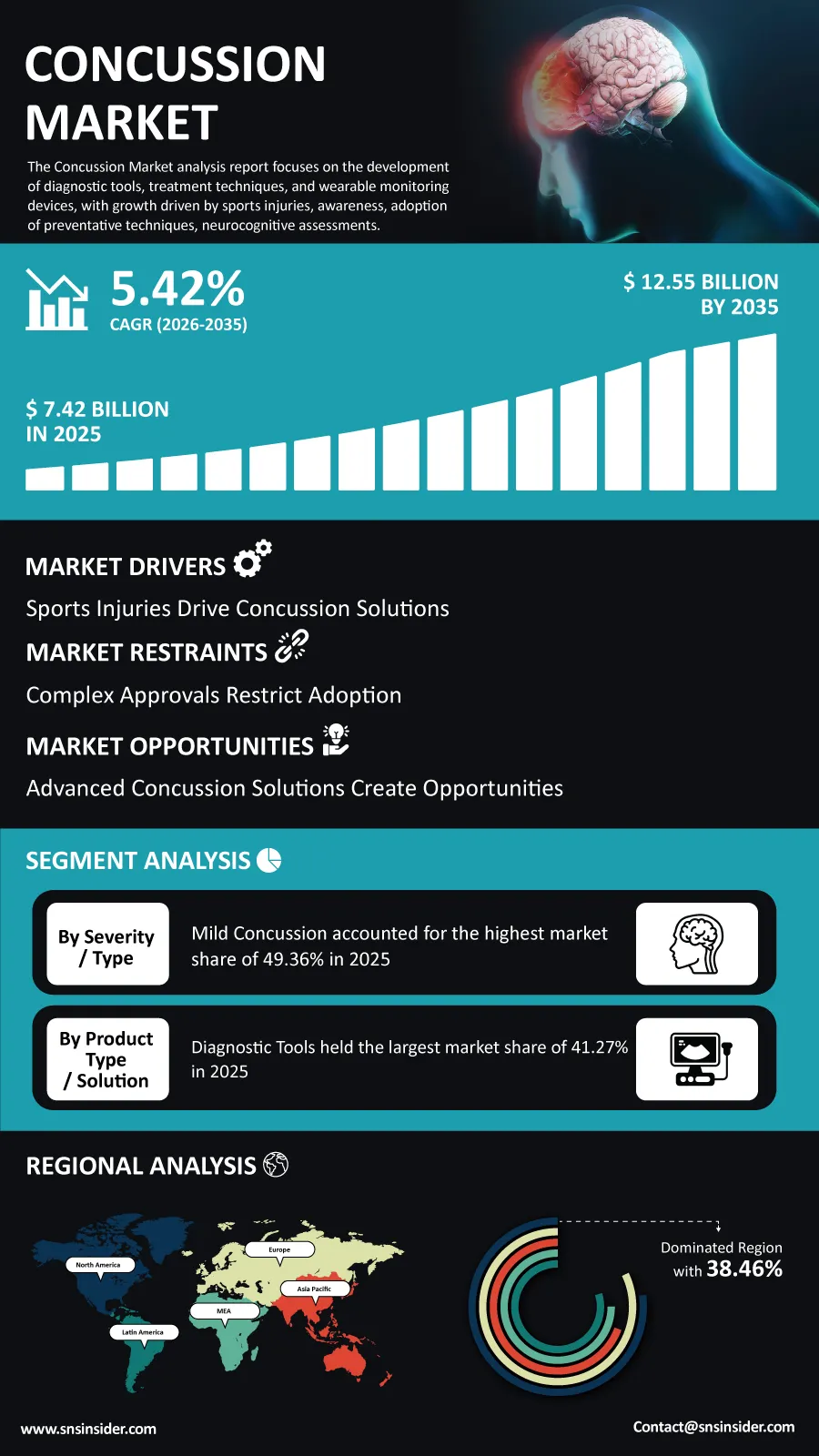
The global Concussion Market is projected to witness sustained growth over the next decade as healthcare systems strengthen their focus on early brain injury detection, patient monitoring, and rehabilitation. “According to a recent study by SNS Insider, the global Concussion Market size valued at USD 7.42 billion in 2025, is anticipated to grow to USD 12.55 billion by 2035, registering a CAGR of 5.42% over the 2026–2035 forecast period.”
Increasing recognition of brain trauma, growing involvement in organized sports activities, and ongoing advancements in neurological treatment are some of the favorable factors contributing to the growth potential of this market. Increasingly, there is a trend toward the adoption of comprehensive concussion management systems integrating modern diagnostic techniques, rehabilitation services, and continuous monitoring of patients.
Another positive aspect impacting the growth of this market is the increasing collaboration between different healthcare stakeholders in developing approaches aimed at injury prevention, diagnosis, and management.
To Get Detailed Insights on the Concussion Market – Request a Sample Report
Innovation Continues to Transform Brain Injury Management
The advancements in technology are changing the way concussions are diagnosed and treated through the use of faster and better clinical decision-making. The artificial intelligence, digital neurocognitive assessments, portable assessment tools, and intelligent monitoring technologies are all facilitating efficient assessment of brain function and personalized care for patients.
Digital health solutions have been increasingly adopted by healthcare organizations as part of concussion management programs, thereby facilitating effective monitoring of recovery processes and treatment planning in hospitals, specialized clinics, rehab centers, and sports medicine clinics.
Increased research into neuroscience and advancements in wearables technology will contribute more towards the acceleration of innovation during the forecast period.
Key Market Findings Highlight Emerging Growth Opportunities
Out of various solution categories, diagnostic tools held the highest share of 41.27% in global market revenue in 2025 owing to their importance in assessing potential brain injuries.
On the other hand, monitoring and wearable technologies will grow at the highest rate up until 2035 at a CAGR of 6.85% due to rising demand for detecting injuries, continuous monitoring, and recovery management.
In terms of treatment approaches, medical intervention held the highest market share of 47.13% in 2025 by being widely used in hospitals and neurology centers. Non-medical intervention and preventive measures will be growing at the fastest pace in coming years with a CAGR of 6.12% due to the increasing focus on prevention of injury, educational programs, and health care initiatives.
Healthcare providers remained the largest end user segment by contributing 44.78% towards total market revenue in 2025. Sports and athletic organizations were estimated to grow at the fastest rate at a CAGR of 6.47%.
With respect to severity of injury, mild concussion held the highest share of 49.36% in market revenue in 2025 while the management of severe concussion and traumatic brain injury is estimated to record the highest growth rate at 6.21%.
Preventive Healthcare and Athlete Safety Continue to Drive Demand
Increasing attention towards player safety, military preparedness, occupational health programs, and public awareness campaigns is making concussion management solutions more popular. Campaigns for education about the early symptoms of concussions are helping people recognize and diagnose concussions at an early stage and provide timely treatment.
Additionally, healthcare professionals are putting efforts into creating multidisciplinary rehabilitation programs. Such programs combine neurological evaluation, physiotherapy, cognitive rehabilitation, and even remote patient monitoring.
Regional Markets Continue to Expand
North America had a market share of 38.46% in 2025 owing to advanced neurological treatment facilities, high uptake of modern diagnostic methods, and increased investment in sports medicine and trauma care. Technological advancements and clinical expertise make this region one of the key drivers of global market growth.
On the other hand, Asia Pacific is expected to become the fastest-growing region in the forecast period with CAGR of 7.04%. Growing healthcare spending, participation in organized sports, development of neurology, and awareness of concussion will create a huge number of growth opportunities for this region, which includes China, India, Japan, and Southeast Asia.
Leading Companies Focus on Next-Generation Brain Health Solutions
The competitive environment is still fluid as players go on to invest in new diagnostic tools, neurological monitoring devices, rehabilitation devices, and digital health services. Strategic alliances, product development, and entry into new healthcare markets continue to be key components of the growth strategy.
Key companies operating in the global concussion market include Nihon Kohden Corporation, Compumedics Limited, Integra LifeSciences, Abbott, BrainScope Company, Koninklijke Philips, Siemens Healthineers, GE HealthCare, Medtronic, and SyncThink.
An SNS Insider analyst Parry Kardani commented, "Growing recognition of brain health, continued advances in neurodiagnostic technologies, and broader adoption of digital monitoring solutions are transforming concussion management worldwide. Organizations investing in intelligent diagnostic platforms and patient-centered rehabilitation solutions are expected to benefit from significant long-term market opportunities."
About the Author

Get in touch




