
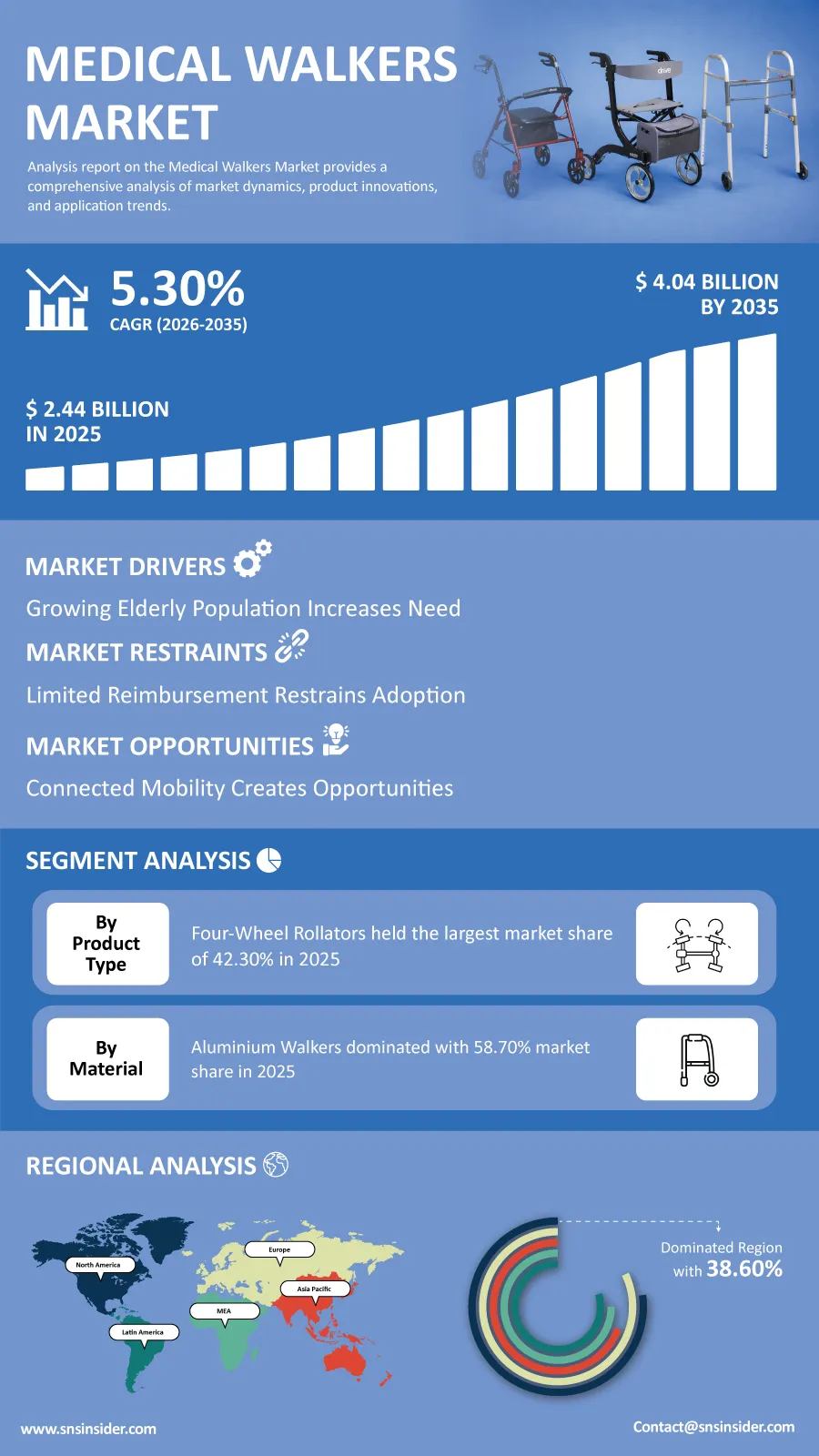
The global Medical Walkers Market is expected to register sustained growth over the next decade as healthcare systems increasingly focus on improving patient mobility, rehabilitation outcomes, and independent living. “According to a recent study by SNS Insider, the global Medical Walkers Market size valued at USD 2.44 billion in 2025, is anticipated to grow to USD 4.04 billion by 2035, registering a CAGR of 5.30% over the 2026–2035 forecast period.”
With increased longevity, mobility ailments, and the need for more rehabilitation, healthcare providers are being encouraged to ensure that more mobility aids are made available. Hospitals, rehabilitation centers, and other healthcare institutions have realized the need to adopt better mobility aids in order to make the lives of their patients easier and promote faster healing.
As a result, manufacturers have come up with ergonomic designs that make the products lightweight and easy to use, hence promoting mobility of the patient and enhancing his/her comfort and safety at the same time.
To Get Detailed Insights on the Medical Walkers Market – Request a Sample Report
Innovation in Mobility Solutions Enhances Patient Independence
However, the medical walkers market still experiences growth through the incorporation of new innovative technologies, which aim at making the medical walkers convenient, stable and easier to use. Portability, folding mechanisms, greater maneuverability and more advanced safety measures have become key features for the development of new products due to the changing needs of aging patients and those recovering after an injury or operation.
In addition, healthcare providers become interested in healthcare mobility solutions with digital capabilities for better supervision of the patients. It should be assumed that the process of innovation will continue being one of the driving factors behind the market growth.
Key Market Insights Highlight Emerging Growth Opportunities
In the product types category, four-wheel rollators made up 42.30% of global market revenue in 2025 due to the high demand for mobility devices that offer comfort, safety, and easy movement.
Knee walkers will be the most rapidly growing segment between 2025 and 2035, with a Compound Annual Growth Rate (CAGR) of 5.85% due to the rising demand for non-weight bearing mobility solutions after limb injuries and orthopedic surgeries.
With regard to materials, aluminium walkers made up 58.70% of global market revenue in 2025 due to their lightness, durability, and cost-effectiveness. On the other hand, composite and lightweight walkers will grow the fastest with a CAGR of 6.20%.
Trends in the application of mobility devices are still on the rise in the healthcare industry. Mobility assistance made up 46.80% of market revenue in 2025, and rehabilitation and post-surgical care segments are forecasted to experience the highest growth at a rate of 5.95% CAGR over the projected period owing to an increasing need for rehabilitation mobility assistance.
Among the end users, home healthcare made up 38.40% of the global market revenue in 2025. Rehabilitation centers are predicted to experience the fastest growth with a CAGR of 6.10% from 2026 to 2035 due to the growing provision of rehabilitation services worldwide.
Home-Based Care Continues to Transform Market Dynamics
The increasing trend towards seeking medical care at home has been influencing the demand for mobility aids. Service providers have been advocating for the adoption of more patient-centric care strategies that will allow patients to regain their health while maintaining their independence.
Increased rehabilitation services, additional caregiver support, and advanced technology have created an environment conducive to market development. Moreover, developments in engineering have been assisting in improving the durability, usability, and user experience of different mobility aid products.
Regional Markets Offer Strong Growth Potential
The North American region had a market share of 38.60% in terms of global revenue in 2025, driven by the presence of robust health care facilities, extensive use of assistive mobility devices, and substantial growth in investments in elder care facilities.
On the other hand, the Asia Pacific region is anticipated to be the fastest growing regional market, having a CAGR of 7.51% in the forecast period of 2035. Population aging, improved access to health care, and increased medical rehabilitation services along with increased awareness about mobility assistance devices are the driving factors.
Leading Companies Continue to Expand Product Portfolios
The competition within the medical walkers industry is still high with the producers concentrating on innovation in terms of development of new products, design, partnerships, and expansion into new regions. The firms are investing in the development of technology that will enhance the safety of patients and other aspects of healthcare.
Key companies operating in the global medical walkers market include Sunrise Medical, Invacare Corporation, Drive DeVilbiss Healthcare, GF Health Products, Medline Industries, Karman Healthcare, Human Care Group, TOPRO, NOVA Medical Products, and Bischoff & Bischoff.
An SNS Insider analyst Parry Kardani commented, "The growing emphasis on independent living, rehabilitation, and home-based healthcare is reshaping the medical walkers market. Manufacturers that continue to invest in ergonomic product design, lightweight materials, and smart mobility technologies are expected to strengthen their competitive position as global demand continues to expand."
About the Author

Get in touch




