
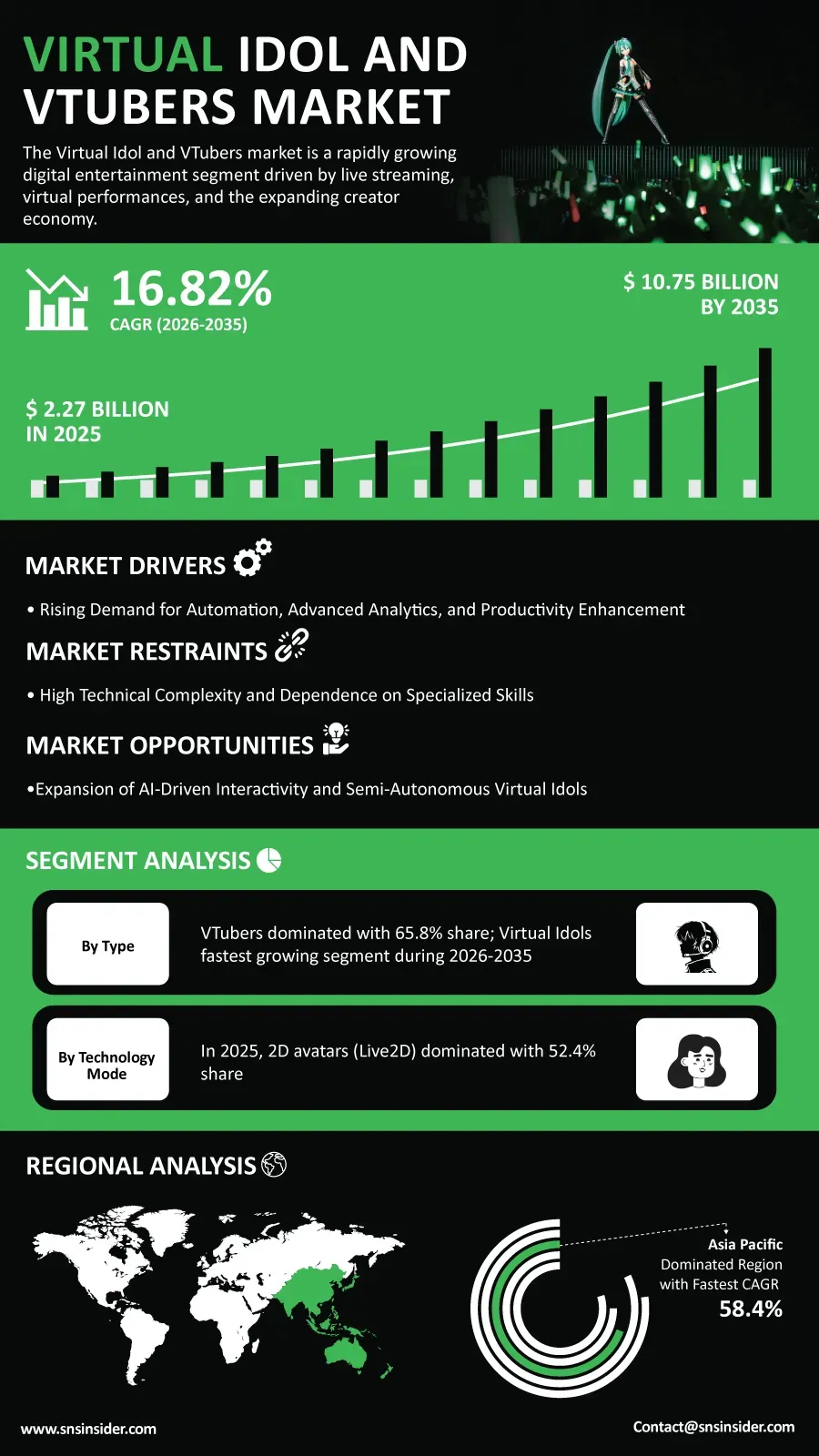
The global Virtual Idol and VTubers Market is witnessing remarkable expansion as digital entertainment continues evolving through immersive technologies, interactive content, and AI-enabled virtual personalities. “According to a recent study by SNS Insider, the global Virtual Idol and VTubers Market size valued at USD 2.27 billion in 2025, is anticipated to grow to USD 10.75 billion by 2035, registering a CAGR of 16.82% over the 2026–2035 forecast period.”
The trend toward live streaming, virtual concerts, and interactive entertainment is changing the way that audiences interact with digital entertainers around the globe. Digital entertainers are reaching millions of people by streaming games, music, talk shows, and other forms of media, which offers great business opportunities for entertainment firms, marketers, and tech companies.
Fast development of such technologies as AI, real-time rendering, facial tracking, and motion capture is making digital entertainers more and more lifelike and engaging. This is enabling creators and agencies to provide highly customized experiences to their audiences, along with generating more monetization opportunities.
To Get Detailed Insights on the Virtual Idol and VTubers Market – Request a Sample Report
AI Innovation and Creator Economy Expansion Unlock Long-Term Growth Opportunities
Investments from technology firms and entertainment agencies in intelligent avatar platforms that offer increased audience engagement and production of scalable content are significant at the moment. AI-enabled content creation and semi-autonomous virtual personalities have been helping creators communicate with their followers effectively by staying online consistently on different platforms.
Another source of income for technology firms and creators has been through brand collaborations where businesses collaborate with virtual influencers to target digitally-savvy consumers. Virtual influencers can give the brands great creative freedom along with consistency in their message delivery, but they do away with many logistics that traditional influencer marketing entails.
In addition, consumer interest in virtual experiences is driving investments in virtual concerts, the metaverse, and virtual fan clubs. These trends are creating new sources of income for various organizations including agencies, individual creators, technology firms, and media companies.
Key Market Insights Highlight Shifting Demand Patterns
Based on type, VTubers are projected to generate a market revenue share of 65.8% in 2025, owing to their extensive live-streaming activities, effective audience interaction, and diverse monetization methods like subscriptions, merchandise, sponsorships, and digital platform content. It is predicted that the Virtual Idols category will be the fastest-growing one until 2035 as a result of improved performance by AI characters, which are increasingly being developed autonomously with the ability to communicate with fans.
By technology mode, 2D avatars (Live2D) segment is projected to hold 52.4% of total market revenues in 2025, owing to the low cost of developing such characters and high efficiency in production. 3D avatars are predicted to have the fastest growth rate in the forecast period due to the demand for immersion in virtual concerts, realistic performance capabilities, metaverse integration, and full-body motion capture technology.
In terms of revenue stream, subscriptions and fan donations were responsible for 41.6% of total market revenues in 2025 because of recurring revenues created thanks to loyal fanbases and live-streaming platforms. The advertising and sponsorship are expected to grow at the fastest rate because of increasing use of virtual influencers in global brands' marketing efforts.
Among end users, VTuber agencies represented 63.2% of market revenue in 2025 through professional talent management and intellectual property commercialization, while individual creators are expected to expand at the fastest pace over the forecast period as accessible creator tools lower barriers to entry.
Advanced Avatar Technologies Accelerate Industry Transformation
Virtual entertainment is experiencing rapid changes as new technologies for avatars keep appearing, making the experience become more realistic and interactive. Artificial intelligence, voice synthesis, facial recognition, real-time rendering, and motion capturing allow producers to create immersive content that increases audience engagement on streaming services.
At the same time, entertainment firms have begun working on creating digital ecosystems that consist of live shows, virtual communities, games, digital collectibles, and other ways to increase interaction with fans. Such an approach helps both creators and audiences to get a better experience.
Asia Pacific Held 58.4% of the Virtual Idol and VTubers Market Share in 2025; North America Projected to Register the Fastest CAGR Through 2035
The Asia Pacific region is anticipated to capture a share of 58.4% of the total market revenue in 2025 because of the maturity of the virtual entertainment industry, robust anime and gaming culture, established VTuber agencies, and engaged digital audiences. Further investments in creator technology and virtual production technology are estimated to help the region maintain its market dominance during the forecasted period.
The North American region is projected to be the fastest-growing regional market through 2035. Growing awareness about virtual influencers, growing investment in creator technologies, growing live-streaming community, and high demand for immersive digital marketing campaigns are driving growth in the region.
The European region is slowly establishing itself in terms of market positioning owing to entertainment companies, brands, and content creators adopting virtual personalities for engaging younger audiences. On the other hand, the Latin American and the Middle East and Africa regions are witnessing steady growth of the market owing to improved internet infrastructure and increased content consumption via live streaming platforms.
Industry Participants Focus on Innovation and Global Audience Engagement
The competitive landscape remains highly dynamic as technology companies, entertainment agencies, and virtual talent organizations continue investing in AI-powered avatars, immersive content production, multilingual creator networks, and next-generation fan engagement platforms. Strategic partnerships, global talent expansion, and investments in virtual production technologies are enabling industry participants to strengthen their international presence while creating new monetization opportunities across digital entertainment ecosystems.
Key companies operating in the global Virtual Idol and VTubers Market include Cover Corp. (Hololive Production), ANYCOLOR Inc. (Nijisanji), Brave Group, VSHOJO, Inc., KAMITSUBAKI STUDIO, 774 Inc. (Nanashi Inc.), RIOT MUSIC, Sony Music Entertainment Japan, Bilibili, Tencent Music Entertainment, Douyin / ByteDance, NetEase, Meta Platforms, Inc., Epic Games, Live2D Inc., Reallusion Inc., HTC VIVE, Avex Group, LaRa Inc., and Activ8 Inc.
An SNS Insider analyst Sakshi Kale commented, “The convergence of artificial intelligence, immersive content creation, and the rapidly expanding creator economy is transforming the Virtual Idol and VTubers industry into one of digital entertainment's fastest-growing segments. Companies investing in advanced avatar technologies, interactive fan experiences, and global content ecosystems will be well positioned to capitalize on accelerating demand over the coming decade.”
About the Author

Get in touch




