
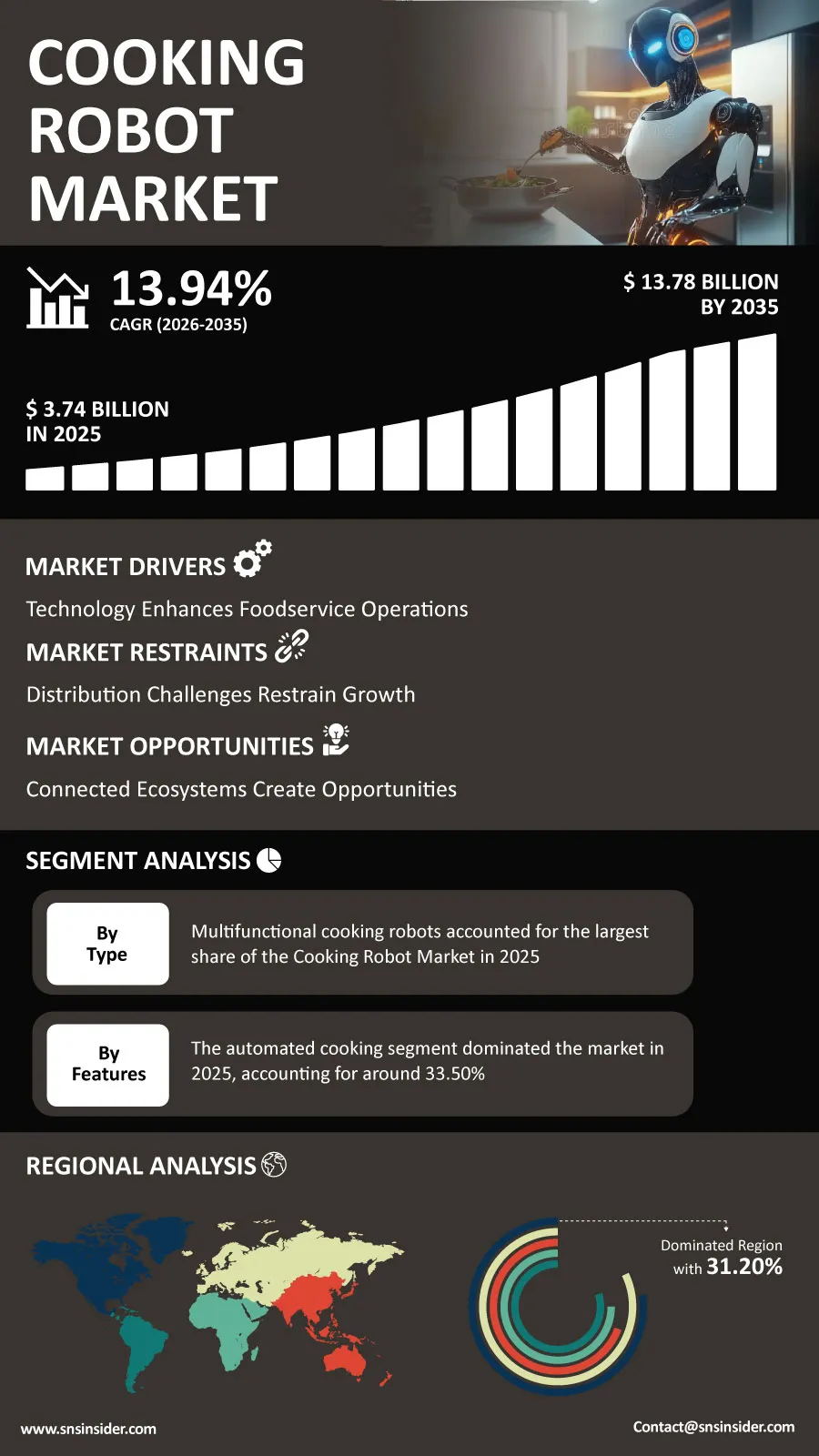
The global Cooking Robot Market is witnessing robust growth as consumers and commercial foodservice operators increasingly embrace intelligent kitchen automation to improve convenience, efficiency, and meal consistency. According to a recent study by SNS Insider, the global Cooking Robot Market size valued at USD 3.74 billion in 2025, is anticipated to grow to USD 13.78 billion by 2035, registering a CAGR of 13.94% over the 2026–2035 forecast period.
Fast-paced urbanization, changes in the lifestyles of consumers, and increasing usage of smart home technology are speeding up the adoption of automation in the kitchen as well. Hospitality businesses are also focusing on automated cooking machines due to labor shortage problems and the need for high-quality food at peak times.
With the development of AI, machine learning, and connected devices, the modern kitchen is getting more efficient because of intelligent recipe preparation, ingredient handling, and custom cooking experience. These developments have extended the scope of the cooking robot beyond just being a convenience tool.
To Get Detailed Insights on the Cooking Robot Market – Request a Sample Report
Smart Kitchen Innovation Opens New Growth Opportunities
Integration of cooking robots with IoT, voice assistants, and apps is creating exciting business opportunities for manufacturing companies and technology vendors. Increasingly, customers become interested in appliances that can prepare personalized meals helping them adopt healthy life styles thanks to portion control and meal planning based on nutrition information.
At the same time, catering companies continue implementing automation initiatives to increase efficiency, keep hygiene level high, and minimize cost. Cloud kitchens, fast-food outlets, and hotels are increasingly using robotic cooking appliances that make their operations more efficient and guarantee the consistency of food preparation at different locations.
Constant development of robotic vision and cooking algorithms along with regular updates of cloud-based software are enhancing the business value of future cooking robots.
Key Market Insights Highlight Shifting Demand Patterns
By type, multifunctional cooking robots are expected to account for approximately 63.80% of global market revenue in 2025 due to their ability to perform multiple kitchen tasks including chopping, stirring, cooking, and cleaning. This segment is also projected to record the fastest growth, expanding at a CAGR of 14.26% through 2035.
Based on features, automated cooking systems are anticipated to contribute 33.50% of market revenue in 2025 as consumers increasingly seek hands-free meal preparation solutions. Voice-controlled cooking robots are forecast to witness the highest growth at a CAGR of 16.42%, driven by expanding smart home integration and demand for intuitive user experiences.
By price range, mid-range cooking robots priced between $500 and $1,000 are expected to represent 41.30% of market revenue in 2025, supported by growing affordability and feature-rich product offerings. Premium models are projected to register the fastest growth at a CAGR of 14.41% as commercial operators and technology enthusiasts invest in advanced AI-powered kitchen automation.
In terms of end users, the residential segment is anticipated to account for 58.90% of global revenue in 2025, reflecting rising household adoption of intelligent kitchen appliances. The commercial segment is expected to experience the fastest growth at a CAGR of 14.13% as restaurants, hotels, and cloud kitchens continue expanding automation initiatives.
AI-Powered Automation Reshapes Modern Food Preparation
AI has led to rapid innovations of robots used in cooking, making them smart enough to learn and improve their cooking abilities by learning about the preferences of users. Today, customers have high expectations of cooking appliances that make the process of cooking meals easier while allowing them to customize their nutritional needs.
The same applies to commercial kitchens where robots reduce food wastage, ensure adherence to hygiene standards, and consistency in quality of products. With limited availability of labor within the hospitality industry, robotic cookers will become even more essential in the future.
North America Accounts for 31.20% Revenue Share in 2025 as Asia Pacific Records a 14.64% CAGR
North America is estimated to capture about 31.20% of worldwide market revenue in 2025 on the back of large-scale adoption of smart homes, consumer spending on connected appliances, and robust capital investments made for kitchen technology solutions driven by artificial intelligence. North America remains the leader among regions on the strength of increasing use of robotic kitchen appliances in residential as well as commercial settings.
Asia-Pacific is estimated to be the fastest growing region at a CAGR of 14.64% between 2025 and 2035 due to increasing rates of urbanization, disposable income growth, and the emergence of middle class in countries such as China, Japan, South Korea, and other parts of Asia-Pacific.
Industry Participants Focus on AI Innovation and Product Development
The competitive landscape remains dynamic as manufacturers continue investing in artificial intelligence, robotic automation, and smart connectivity to deliver increasingly versatile cooking solutions. Companies are enhancing product functionality through cloud-based software, voice-enabled controls, advanced sensors, and personalized cooking capabilities designed to improve user experience across residential and commercial applications.
Key companies operating in the global Cooking Robot Market include Miso Robotics Inc., Moley Robotics Ltd., Dexai Robotics Inc., Karakuri Ltd., Zimplistic Pte. Ltd. (Rotimatic), Creator Inc., Cafe X Technologies, Bear Robotics Inc., Picnic Works Inc., Mechanical Chef, RoboChef, Chowbotics (DoorDash), Samsung Electronics, Panasonic Corporation, KUKA AG, Yaskawa Electric Corporation, Stäubli International AG, Epson Corporation, Mayekawa Mfg. Co. Ltd., and Cecilia AI Ltd.
An SNS Insider analyst Sushant Kadam commented, “Growing consumer acceptance of smart kitchen technologies, combined with advances in artificial intelligence and robotics, is accelerating the evolution of automated food preparation. Companies delivering intelligent, user-friendly, and highly connected cooking solutions will be well positioned to capitalize on expanding opportunities across both household and commercial kitchen environments.”
About the Author

Get in touch




