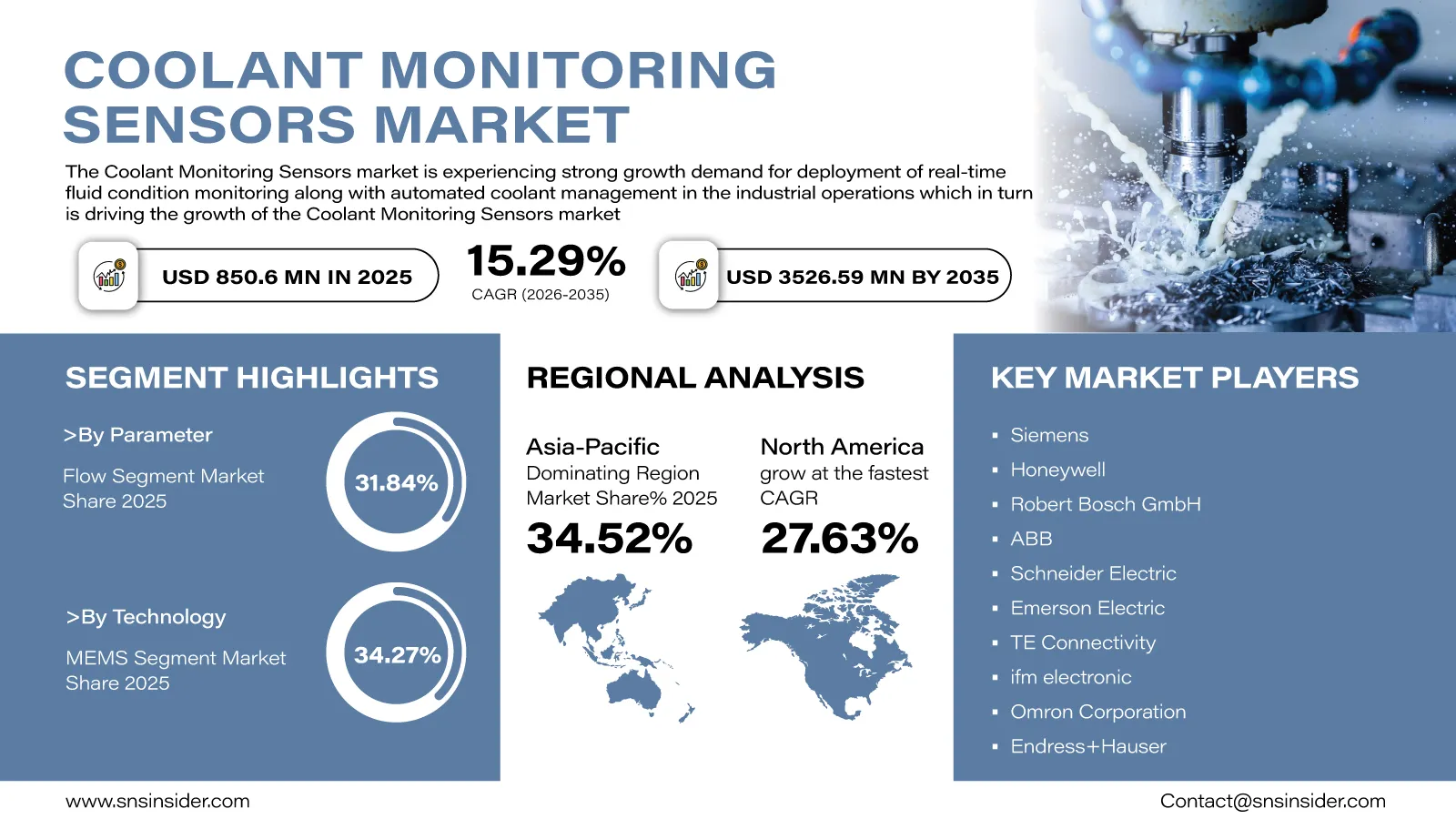
The global Coolant Monitoring Sensors Market is projected to register healthy growth in the coming years due to increasing investment in predictive maintenance and intelligent automation. According to a recent study by SNS Insider, the global Coolant Monitoring Sensors Market size valued at USD 850.6 million in 2025, is anticipated to grow to USD 3.53 billion by 2035, registering a CAGR of 15.29% over the 2026–2035 forecast period.
With the increasing automation of manufacturing plants, real-time coolant monitoring systems have emerged as an integral part of efficient operations. There are increasing usages of smart sensors for the continuous monitoring of coolant quality, temperature, flow, and chemical properties, thus helping take decisions in time and preventing machine breakdowns.
To Get Detailed Insights on the Coolant Monitoring Sensors Market – Request a Free Sample Report
Increasing digitization in manufacturing units, automotive sectors, electronics industry, and even in high-performance computing is making the market demand stronger. Increasing adoption of sensor-based monitoring solutions for predicting maintenance needs, extending machine life, and efficient resource utilization is being witnessed.
Industrial Digitalization Creates New Growth Opportunities
The fast-changing nature of Industry 4.0 is changing the face of industrial coolant monitoring systems through the use of Internet of Things-based sensors, cloud computing, and artificial intelligence within monitoring platforms. These systems make it possible to constantly monitor the coolant system, enabling operators to detect any deviations that could pose a problem in the future.
Increased density of data centers, semiconductor fabrication processes, and electric car production facilities is leading to new possibilities in terms of technological advancements in coolant monitoring systems. With the increase in complexity of the cooling systems, there is a greater need for accurate sensors.
In addition, organizations are placing greater emphasis on sustainability and energy efficiency, encouraging deployment of intelligent monitoring systems that reduce coolant waste, optimize fluid replacement schedules, and improve overall system performance.
Key Market Insights Highlight Shifting Demand Patterns
On the basis of monitored parameters, flow sensors are predicted to make up 31.84% of total market revenue by 2025 because of the usage of these sensors in coolant circulation maintenance and industrial equipment protection. Temperature monitoring is set to be the most rapidly growing market segment up to 2035 because of the need for precise thermal control in more complicated industrial processes.
By technology, MEMS sensors are estimated to produce 34.27% of total market revenue by 2025 because of their small size, reliability, and wide use in the industrial automation industry. The optical sensing technologies are projected to grow the fastest as companies require precision monitoring of coolant in contactless manner.
Depending on the integration level, standalone sensors are estimated to make up 38.46% of total market revenue by 2025 because of their flexible installation and compatibility with already existing industrial facilities. Integrated coolant units are projected to grow at the fastest rate as more organizations tend to implement the fully automated monitoring systems in their business operations.
By end user, industrial cooling application are estimated to produce 33.17% of total market revenue by 2025 because of the wide use of these sensors in manufacturing, heavy equipment, and other processes. Data centers are set to grow the fastest up to 2035 as the need for the cloud infrastructure and artificial intelligence development increases.
An Infographic Representation of the Global Coolant Monitoring Sensors Market
Smart Thermal Management Becomes an Operational Priority
Modern industrial processes rely more and more on intelligent thermal management solutions that offer the ability to monitor continuous performance and optimize the process automatically. The coolant monitoring sensors have evolved into digital devices, providing valuable information about equipment condition for predictive maintenance practices.
The development of analytical techniques, edge computing and industrial Internet of Things (IoT) platforms based on AI is making sensor monitoring even more useful through predictive diagnostics, remote monitoring of systems and automated maintenance scheduling. This is allowing manufacturers to increase resilience, while saving energy and avoiding unplanned downtime.
Regional Markets Demonstrate Strong Investment Potential
The Asia-Pacific region is anticipated to contribute 34.52% to the global market revenue in 2025 due to rapid industrialization, growth in automotive manufacturing industry, electronics manufacturing capabilities, and high automation of factories in China, Japan, South Korea, and India. Continuous modernization of manufacturing facilities is set to solidify the position of the region throughout the forecast period.
The North American region is projected to become the highest growing regional market, posting a CAGR of 16.04% through 2035. Rising uptake of predictive maintenance systems, Industry 4.0 solutions, data center infrastructures, and advanced manufacturing are some of the factors fuelling the market growth.
As industries prioritize operational efficiency, digital transformation, and sustainable manufacturing practices, demand for intelligent coolant monitoring technologies is expected to strengthen across both developed and emerging industrial economies.
Industry Participants Focus on Intelligent Monitoring Solutions
The competitive landscape continues to evolve as leading technology companies invest in advanced sensing platforms, AI-powered diagnostics, industrial connectivity, and predictive maintenance software. Product innovation, strategic partnerships, and integration with digital manufacturing ecosystems remain central to strengthening market competitiveness.
Key companies operating in the global Coolant Monitoring Sensors Market include Siemens, Honeywell, Robert Bosch GmbH, ABB, Schneider Electric, Emerson Electric, TE Connectivity, ifm electronic, Balluff, Omron Corporation, Endress+Hauser, Yokogawa Electric, SICK AG, Sensata Technologies, Danfoss, Parker Hannifin, SKF, Fluke Corporation, Keysight Technologies, and Pepperl+Fuchs.
An SNS Insider analyst Sushant Kadam commented, “Industrial automation, predictive maintenance, and next-generation cooling technologies are transforming the coolant monitoring sensors landscape. Manufacturers delivering intelligent sensing platforms with real-time analytics, seamless connectivity, and high operational reliability will be well-positioned to capture long-term growth opportunities across global industrial markets.”
About the Author

Get in touch