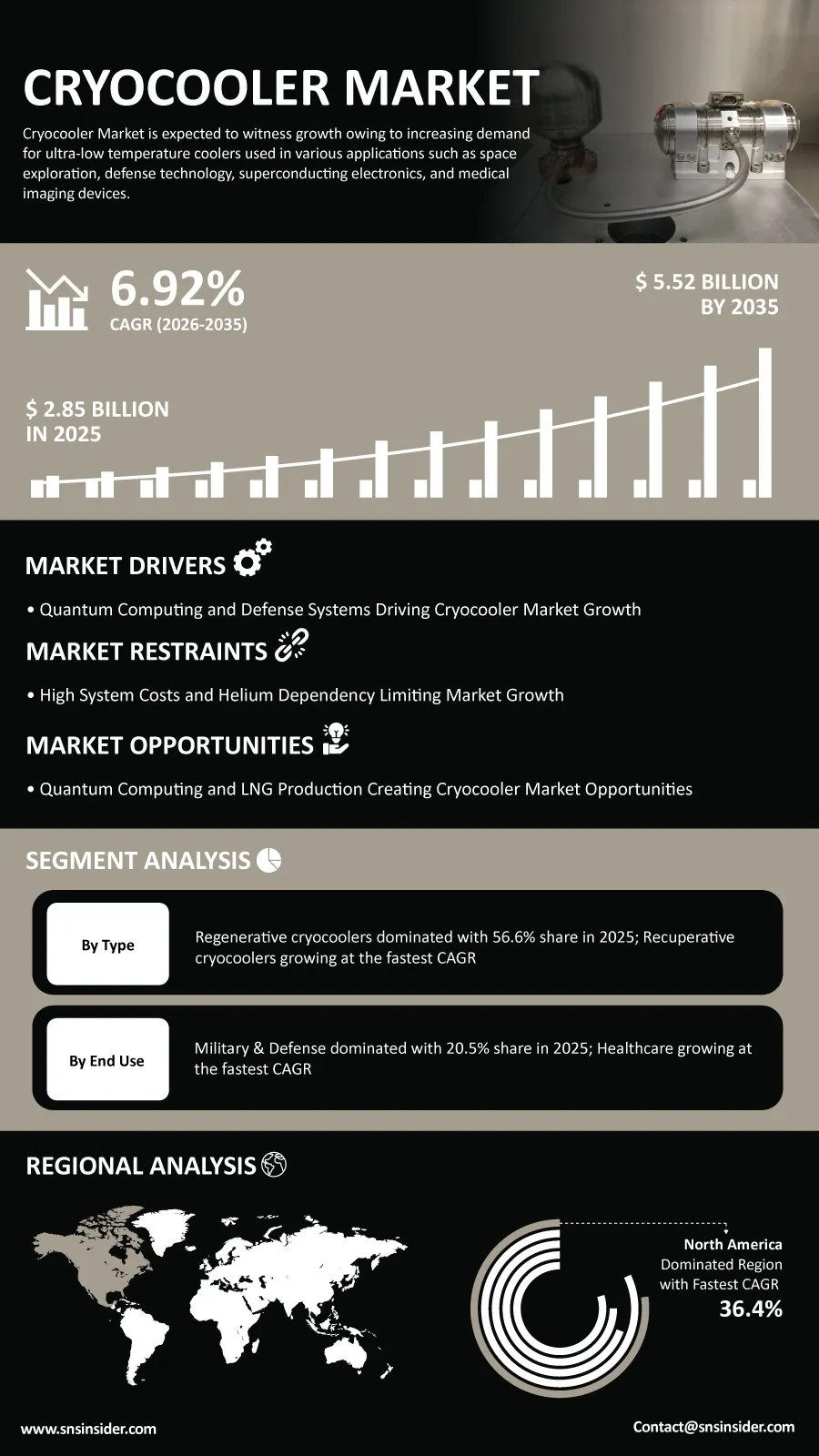
The global Cryocooler Market is gaining momentum as demand rises for precision cooling systems across aerospace, defense, healthcare, quantum technologies, and advanced electronics. According to a recent study by SNS Insider, the global Cryocooler Market size valued at USD 2.85 billion in 2025, is anticipated to grow to USD 5.52 billion by 2035, registering a CAGR of 6.92% over the 2026–2035 forecast period.
With the growing use of satellites, infrared sensing devices, superconductors, and MRI machines, there is an increased need for reliable cooling at low temperatures. In addition to that, there is a new field being opened due to the invention of quantum computers, and it requires refrigeration systems that can provide very low temperatures.
Manufacturers are developing small, efficient, and vibration-free cooling techniques that can withstand harsh conditions. This has resulted in the application of cryocoolers not only in laboratories and military industries but also in commercial infrastructure technology.
To Get Detailed Insights on the Cryocooler Market – Request a Sample Report
Quantum Technology and Advanced Electronics Create New Growth Opportunities
With the worldwide emphasis on next generation computing, there have emerged new opportunities for the cryogenic companies. The next generation of superconducting computers is dependent on cooling mechanisms and hence there will be greater emphasis on dilution fridges and other cryogenic technologies with the development of quantum computing in larger scales for commercial use.
Space programs and defense initiatives will further aid in the development of the cryogenic industry. Satellite payloads, missiles detecting machines, thermal sensors, and surveillance vehicles need cryogenic refrigeration to keep their sensors sensitive and accurate in measurements. Hence, increased activities in space explorations and national defense will aid in the demand for such machines.
Healthcare segment too has emerged with new opportunities for the cryocooler manufacturers. With growing installations of MRI systems and with the increased efforts towards helium management, there have emerged more opportunities for cryocoolers.
Key Market Insights Highlight Shifting Demand Patterns
By type, regenerative cryocoolers are expected to account for approximately 56.6% of global market revenue in 2025, supported by widespread use of Stirling, Gifford-McMahon, and pulse tube technologies across defense, space, scientific, and industrial applications. Recuperative cryocoolers are projected to record the fastest growth as demand increases for low-vibration cooling and specialized continuous-flow systems.
Based on end use, military and defense applications are anticipated to contribute 20.5% of market revenue in 2025. Cryogenic cooling remains essential for infrared detectors, targeting equipment, surveillance platforms, and other defense electronics requiring stable low-temperature operation. Healthcare is forecast to be the fastest-growing end-use segment as MRI installations expand and medical cryosurgery adoption increases.
Miniaturization and Low-Vibration Designs Reshape the Market
In the development of new technologies, there is an emphasis on minimizing size while maximizing performance and energy efficiency. Miniature Stirling engines are being explored in portable infrared technology equipment, aerospace applications, and some specialized medical devices, as well as the need for portability and small footprint.
In situations where mechanical vibrations could cause problems with sensitive measuring devices, pulse tubes are becoming more applicable and commercially viable for use in satellites, precise measurement devices, and scientific laboratory devices.
The trend of reducing helium gas usage is making the development of closed-loop and helium recovery systems very useful. They have become very significant for research laboratories, hospitals, and other specialized industries where liquid helium supplies are limited and costly.
North America Captures 36.4% of Global Revenue Through Strong Defense and MRI Infrastructure Investments
The share of North America in terms of total market revenue is estimated to be around 36.4% in 2025 due to heavy defense spending, advanced aerospace systems, developed MRI systems, and quantum computing. The USA will continue to dominate in terms of regional demand due to its well-developed ecosystem comprising defense contractors, technology firms, research firms, and cryogenics firms.
The Asia Pacific region is predicted to experience the highest growth rate of all regions due to increasing space programs, defense upgradation, sophisticated electronics manufacturing, and development of healthcare infrastructure. The investments in satellite technology and regional research in China, Japan, South Korea, and other countries will drive the demand for cryogenic cooling systems.
Industry Participants Focus on Efficiency and Specialized Applications
The competitive landscape remains active as manufacturers concentrate on improving thermal efficiency, reducing vibration, miniaturizing equipment, and developing application-specific cooling platforms. Companies are also expanding their capabilities in quantum computing, space instrumentation, defense sensing, medical imaging, and industrial gas applications to capture emerging sources of demand.
Key companies operating in the global Cryocooler Market include Sunpower Inc. (Ametek), Thales Cryogenics BV, Raytheon Technologies Corporation, Northrop Grumman Corporation (MESO), FLIR Systems (Teledyne), Leonardo DRS Inc., Cobham Advanced Electronic Systems, Chart Industries Inc., Stirling Cryogenics BV, Bluefors Oy, Oxford Instruments NanoScience, Sumitomo Heavy Industries Ltd. (SHI Cryogenics), Air Liquide Advanced Technologies, Ricor-USA Inc., AIM Infrarot-Module GmbH, Global Cooling Inc., Cryomech Inc., RIX Industries, Advanced Research Systems Inc., and Infrared Focal Plane Array Inc.
An SNS Insider analyst Sushant Kadam commented, “The expansion of quantum computing, space exploration, advanced defense sensing, and medical imaging is creating a broader and more diversified demand base for cryocooling technologies. Manufacturers that deliver compact, energy-efficient, reliable, and low-vibration systems will be well positioned to benefit from the next wave of investment in advanced temperature-control infrastructure.”
About the Author

Get in touch