
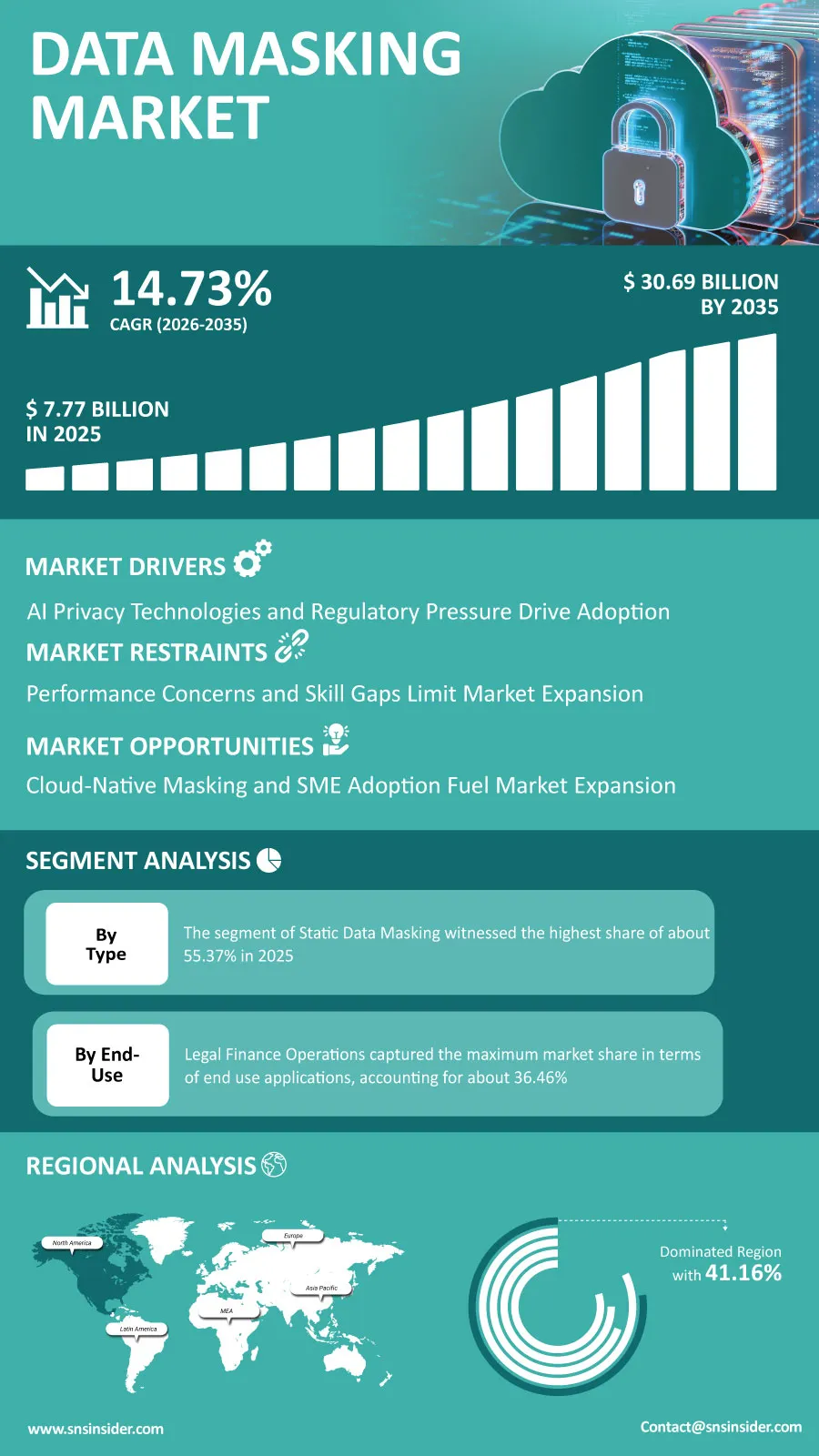
The global market of Data Masking is set to witness considerable growth on account of an increased need for data privacy and compliance with regulations among companies across the globe. “According to a recent study by SNS Insider, the global Data Masking Market size valued at USD 7.77 billion in 2025, is anticipated to grow to USD 30.69 billion by 2035, registering a CAGR of 14.73% over the 2026–2035 forecast period.”
The increasing reliance of organizations on cloud infrastructure, enterprise analytics, and AI-driven business applications has led to a massive increase in the amount of sensitive data being handled within various sectors. In a bid to gain more insight from enterprise data without putting confidential records at risk, data masking technology is fast becoming an indispensable part of today’s cybersecurity and governance initiatives.
The quick advancements in digital services, the introduction of stringent privacy laws, and growing cyber-attacks are prompting companies to embrace advanced methods that protect sensitive data and facilitate business processes. Companies in banking, healthcare, retail, government, and telecommunications sectors are increasingly using masking technology in software development, test environments, analytics systems, and cloud databases.
To Get Detailed Insights on the Data Masking Market – Request a Sample Report
AI Innovation and Cloud Security Investments Create New Market Opportunities
Accelerated adoption of artificial intelligence is driving new opportunities for data masking providers. Exposing sensitive customer details is a no-no for enterprises building AI models, but they also need realistic datasets to properly train and test their adaptive AI algorithms. Using modern masking technologies, organizations can create privacy-safe datasets that facilitate innovation while retaining critical sensitive records.
In addition, Cloud migration is changing the way security van be implemented in enterprises. With the growth of hybrid and multi-cloud deployments, data protection across distributed environments - both structured and unstructured – has now become a strategic requirement for organizations. Vendors continue to bring intelligent masking capabilities that automate policy management, classifying sensitive information and extending security across cloud-native data ecosystems.
At the same time, enterprises are integrating data masking into broader governance, DevSecOps and data management projects. The shift-left automated security controls allow organizations to accelerate building applications while also reducing the operational risk of data being exposed.
Key Market Insights Highlight Changing Enterprise Adoption
On the basis of component, the software segment held a dominant share of revenue in 2025 and will also exhibit fastest growth over the period through 2035 as organizations continue to adopt integrated security platforms.
On the basis of type, in 2025, static was the largest segment for data masking since it is widely used for software testing and quality assurance in non-production environments. Dynamic data masking is projected to have the highest growth over this period as organizations move towards real-time access controls and zero-trust security architectures.
Enterprise size: Large enterprises were the leading adopters, due to more complex compliance requirements and larger digital infrastructure. As cloud-based security platforms grow more accessible, the small and medium-sized business sector is expected to grow at a rapid rate.
By end-use application, legal and finance operations were the largest market share in 2025 however, sales and marketing are likely to exhibit the fastest growth due to growing interest among organizations toward privacy-preserving customer analytics and AI-based personalization capabilities.
Intelligent Data Protection Technologies Reshape Enterprise Security
Technology vendors are still investing their efforts in automation, artificial intelligence, and enhanced encryption technologies to secure enterprise data. Discovery capabilities powered by AI are streamlining the process of finding sensitive data within increasingly complex database holdings and intelligent policy automation engines are driving down manual administrative workloads as well as improving governance consistency.
There is also increasing adoption within the cloud-native masking platforms, tokenization and format-preserving encryption that allow organizations to protect information without affecting their business applications. These innovations enable secure collaboration among development teams, analytics platforms and enterprise ecosystems while enhancing operational efficiency.
Identity and access management will be realized to protect the workflows of an organization, and intelligent data protection capabilities will become core components of enterprise cybersecurity frameworks as organizations continue to expand digital services onto cloud infrastructure.
North America Held 41.16% of the Data Masking Market Share in 2025; Asia Pacific Projected to Register the Fastest CAGR Through 2035
Great news For example, you have a North America accounting for 41.16% of the global market revenue in 2025 due to mature enterprise cybersecurity programs, increased prevalence of cloud adoption and comprehensive privacy regulations across highly regulated industries. North America stays at the forefront of regional growth space thanks to robust technology spend, mature data governance processes and ongoing levels of innovation driven by major software publishers.
The fastest growth through 2035 is expected in Asia Pacific, where organizations accelerate their digital transformation across China, India, Japan & Southeast Asia. As cloud adoption, digital banking and e-commerce continue to grow and with changing national privacy regulations, organizations across the region are compelled to enhance their data protection abilities.
Europe continues to be a strong market, with organizations making investments in privacy-related technologies that enable them to comply with the new and evolving regulatory environment. On the other hand, Latin America & Middle East & Africa is progressing at a steady rate guided by rising cybersecurity awareness along with developing digital economies and strengthening national data protection frameworks.
Industry Participants Focus on AI-Driven Security Innovation
Increased competition in the global Data Masking Market is expected to continue due to growing efforts on the part of technological vendors to introduce cloud native, artificial intelligence, automation for compliance management, and governance solutions. Technological vendors are making increased efforts on research and development activities to enable secure data masking solutions.
Key companies operating in the global Data Masking Market include Informatica Inc., IBM Corporation, Oracle Corporation, Delphix Corp., Broadcom Inc., Solix Technologies Inc., Microsoft Corporation, Mentis Inc., Innovative Routines International, Red Gate Software Ltd., Imperva, Inc., Thales Group, Protegrity, comforte AG, DataSunrise Inc., K2View Ltd., Accutive Data, ARCAD Software, Micro Focus, and SNP Group.
An SNS Insider analyst Sakshi Kale commented, "As organizations accelerate AI adoption, cloud modernization, and enterprise-wide digital transformation, protecting sensitive information without limiting data accessibility has become a strategic priority. Companies investing in intelligent data masking, automated governance, and cloud-native security technologies are expected to strengthen their competitive position over the coming decade."
About the Author

Get in touch




