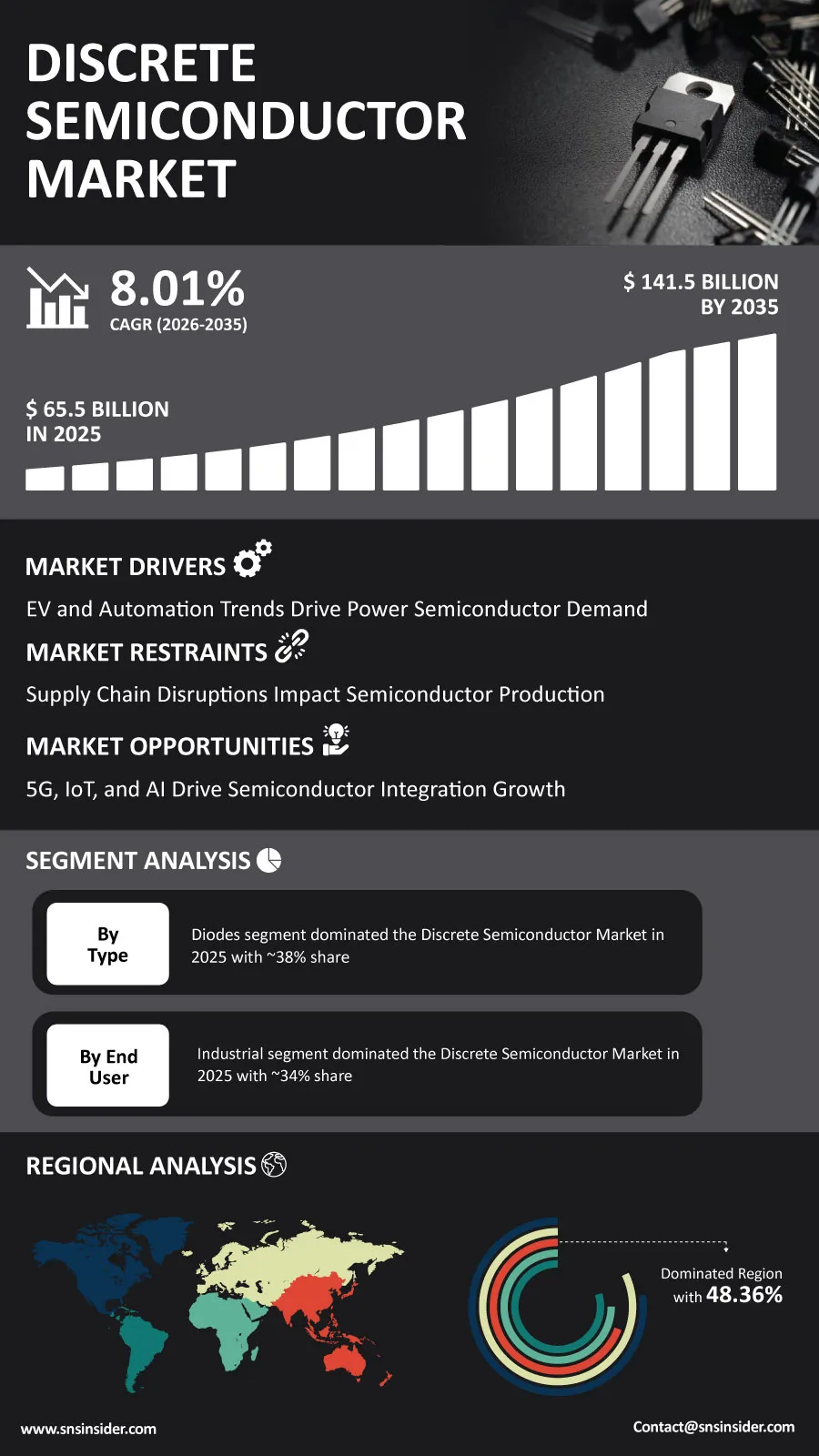
The global Discrete Semiconductor Market is entering a sustained growth phase as electrification, energy transition, and industrial digitalization reshape demand for efficient power management technologies. According to a recent study by SNS Insider, the global Discrete Semiconductor Market size valued at USD 65.5 billion in 2025, is anticipated to grow to USD 141.5 billion by 2035, registering a CAGR of 8.01% over the 2026–2035 forecast period.
With the fast growth in demand for electric mobility, renewables, smart manufacturing, and smart infrastructure, there is an increased demand for semiconductor products that can control, convert, and switch electrical energy. Auto manufacturers, industrial equipment makers, and energy companies are increasingly incorporating advanced power semiconductors into their future systems.
However, advancements in SiC and GaN have made it possible for the discrete semiconductor suppliers to expand their offerings. Wide bandgap semiconductors are helping in improving efficiency and performance in high-demand applications such as electric cars and chargers, telecommunication infrastructure, and renewables.
To Get Detailed Insights on the Discrete Semiconductor Market – Request a Sample Report
Electrification and Energy Efficiency Create New Growth Opportunities
The global shift towards electric mobility represents a significant new opportunity for discrete semiconductor manufacturers. In order to meet the needs of electric cars, hybrids, battery management, power converters, and traction inverters, advanced electronic components are required.
In addition, the growth in renewable energy systems represents yet another opportunity for growth. Semiconductors are used to control power conversion and make such systems more efficient in their operation. Also, the use of semiconductors in industry and robotics to achieve higher performance and motor control capabilities has been increasing.
The growing deployment of 5G networks, data centers, and connected devices is also expanding the addressable market. As digital infrastructure becomes more energy-intensive, efficient power management is becoming increasingly important across communication and computing applications.
Key Market Insights Highlight Shifting Demand Patterns
By type, diodes held around 38% of global market revenue in 2025, supported by their widespread use in power supplies, rectification, voltage regulation, and electronic protection systems. The IGBT segment is projected to record the fastest growth through 2035 as demand increases for high-power switching applications in electric vehicles, renewable energy systems, and industrial equipment.
Based on end user, the industrial segment led with approximately 34% of market revenue in 2025. Increasing automation, robotics deployment, motor control requirements, and smart manufacturing investments are supporting sustained demand. Meanwhile, automotive is forecast to be the fastest-growing end-user segment, driven by rising electric vehicle production and the growing electronic content of modern vehicles.
Wide-Bandgap Technologies Accelerate Power Electronics Innovation
SiC and GaN products are developing into a significant trend in the world of discrete semiconductors. The use of SiC transistors has been seen in high voltage electric vehicle power trains and other renewable energy applications, while GaN components have been incorporated in smaller power supplies, chargers, and communications devices that require high frequencies.
Additionally, companies have expanded their production capabilities and have grown their product lines to aid in the move towards wide bandgap power semiconductors. Larger wafers and improved processes are likely to help lower the costs of these technologies, which will make them available for a larger number of applications.
Asia Pacific Leads with 48.36% Revenue Share While North America Accelerates Semiconductor Growth
Asia Pacific will dominate and hold the largest share in terms of regional revenues in 2025 at 48.36%. Asia Pacific is aided by high electronics manufacturing capacities, increasing production of electric vehicles, increasing penetration of renewables, and growing industrial automation and telecom infrastructure investments.
North America will show the highest growth rate until 2035 among all the regions. High investments in electric mobility, renewables, data centers, and advanced semiconductor manufacturing have been driving the regional growth. Higher growth in investments towards SiC and GaN technologies and the domestic production of semiconductors is further boosting the market.
Europe is also experiencing rising demand as automakers and industrial manufacturers accelerate electrification and energy-efficiency initiatives.
Industry Participants Focus on Advanced Power Technologies
The competitive landscape remains highly dynamic as semiconductor manufacturers expand production capacity, develop next-generation materials, and strengthen relationships with automotive and industrial customers. Companies are focusing on SiC and GaN innovation, high-voltage device development, manufacturing scale, and application-specific solutions to capture emerging demand.
Key companies operating in the global Discrete Semiconductor Market include Infineon Technologies AG, ON Semiconductor Corporation, STMicroelectronics N.V., NXP Semiconductors N.V., Vishay Intertechnology Inc., Diodes Incorporated, ROHM Co., Ltd., Littelfuse Inc., Microchip Technology Inc., Toshiba Electronic Devices & Storage Corporation, Mitsubishi Electric Corporation, Fuji Electric Co., Ltd., Nexperia B.V., Renesas Electronics Corporation, Texas Instruments Inc., Wolfspeed Inc., Semikron Danfoss, GeneSiC Semiconductor Inc., and ABB Ltd.
An SNS Insider analyst Sushant Kadam commented, “The accelerating electrification of transportation, industrial systems, and energy infrastructure is creating sustained demand for advanced discrete semiconductor technologies. As SiC and GaN devices become more commercially accessible, manufacturers that combine efficient production, strong application expertise, and reliable supply capabilities will be well positioned to benefit from the next wave of power electronics growth.”
About the Author

Get in touch