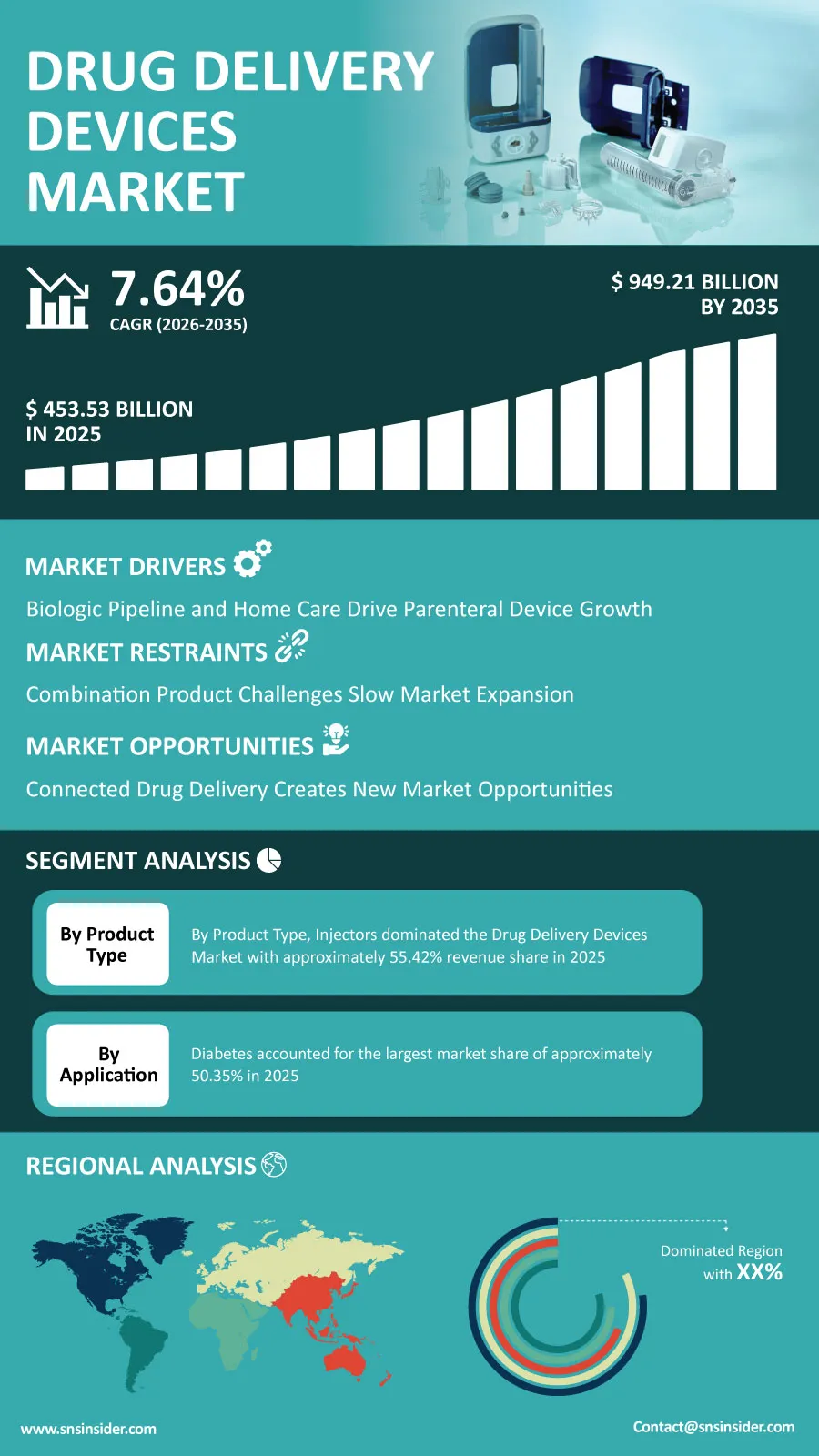
The global Drug Delivery Devices Market is witnessing robust expansion as healthcare systems increasingly adopt advanced technologies that improve medication accuracy, patient convenience, and long-term treatment adherence. “According to a recent study by SNS Insider, the global Drug Delivery Devices Market size valued at USD 453.53 Billion in 2025, is anticipated to grow to USD 949.21 Billion by 2035, registering a CAGR of 7.64% over the 2026–2035 forecast period.” Rising use of biologic medicines, the growing prevalence of chronic diseases, and the shift toward self-administered therapies are accelerating investments in innovative drug delivery platforms worldwide.
Providers of medical care as well as the manufacturers of pharmaceutical drugs are paying great attention to those solutions which make the process of medication delivery more user-friendly and help to enhance clinical results. Nowadays, such devices as smart injectors, wearable infusion devices, connected inhalers, and prefilled drug delivery systems play an important role, as more and more patients look for easier options for their treatment outside hospitals.
To Get Detailed Insights on the Drug Delivery Devices Market – Request a Sample Report
Smart Drug Administration Technologies Transform Patient Care
The swift development of connected healthcare is bringing about changes in medicine delivery in a number of therapeutic fields. Devices designed with Bluetooth technology and capable of automatic dosing recording make it easier for healthcare providers to control patient adherence to treatment and lower drug errors.
Another trend driving the industry towards designing more convenient and portable delivery systems is the increasing need for home healthcare that would assist in long-term management of diabetes, oncological conditions, autoimmune and respiratory diseases. With biologics gaining momentum in healthcare markets worldwide, the delivery technology is getting increasingly important.
Key Market Findings Highlight High-Growth Opportunities
By product type, Injectors dominated the Drug Delivery Devices Market with approximately 55.42% of revenue in 2025, reflecting widespread use across diabetes, cardiovascular care, and oncology. Infusion Pumps are projected to register the fastest growth, expanding at a CAGR of approximately 8.85% through 2035 as home infusion therapy gains momentum.
By application, Diabetes accounted for approximately 50.35% of total market revenue in 2025, supported by increasing insulin delivery requirements and broader adoption of advanced glucose management technologies. Oncology is expected to become the fastest-growing application segment as immunotherapies, targeted medicines, and biologic treatments continue expanding globally.
Among end users, Hospitals maintained the leading market share in 2025 due to high patient volumes and sophisticated treatment infrastructure. Meanwhile, Home Care Settings are anticipated to experience the strongest growth throughout the forecast period, reflecting rising patient preference for self-administered therapies.
By distribution channel, Direct Sales remained the dominant segment during 2025, while Online Platforms are forecast to achieve the highest growth rate as digital healthcare purchasing and home-use medical device demand continue increasing.
Innovation and Digital Integration Accelerate Market Development
There are significant investments by manufacturers in technology devices to enhance the process of administering drugs and digitalizing healthcare. Technology solutions that include AI-powered monitoring, injectors, infusion pumps, and delivery systems are making patients more compliant and providing insight into their treatment.
There is also an increasing level of collaboration between the pharmaceutical and the medical device companies in order to produce drug-device combinations. Such products not only help in improving safety but also aid in improving the accuracy of treatments.
Regional Markets Continue Expanding Worldwide
The North American region continued to lead as the largest regional market by virtue of its well-developed healthcare infrastructure, extensive use of biologics, and investment in the development of advanced medical technologies. The USA constituted nearly 87.4% of North American revenue and recorded approximately USD 141.47 Billion in 2025. The market is forecasted to rise up to nearly USD 246.85 Billion by 2035, growing at a CAGR of 7.23%.
The Asia-Pacific region would continue to be the fastest-growing market owing to its growing healthcare infrastructure, increased pharmaceutical production, and growing adoption of advanced treatment techniques. China comprised nearly 61.7% of the revenue share owing to its rapidly growing pharmaceutical industry.
Within Europe, the German market constituted approximately 22.3% of regional revenues owing to its well-established medical devices production facilities. The developing regions of Brazil and Saudi Arabia constituted 44.2% and 38.4% of the revenue share of Latin America and the Middle East & Africa regions, respectively.
Leading Companies Strengthen Innovation Pipeline
Competition continues to intensify as global manufacturers invest in connected devices, wearable technologies, precision drug administration systems, and expanded manufacturing capacity to support the growing biologics market.
Major companies operating in the global Drug Delivery Devices Market include Becton, Dickinson and Company, Medtronic plc, Baxter International Inc., Johnson & Johnson, Abbott Laboratories, Novartis AG, AbbVie Inc., Roche Holding AG, GlaxoSmithKline plc, AptarGroup, Inc., Gerresheimer AG, Owen Mumford Limited, Kindeva Drug Delivery L.P., Enable Injections, Inc., Credence MedSystems, Inc., 3M Company, Bayer AG, Insulet Corporation, Tandem Diabetes Care, and Dexcom, Inc.
An SNS Insider analyst Parry Kardani commented, "The continued expansion of biologic therapies, digital healthcare integration, and patient-centered treatment models is redefining the future of drug delivery. Companies combining connected technologies with precision delivery solutions will be well positioned to capitalize on growing demand across hospitals, home healthcare, and specialty pharmaceutical applications.
About the Author

Get in touch