
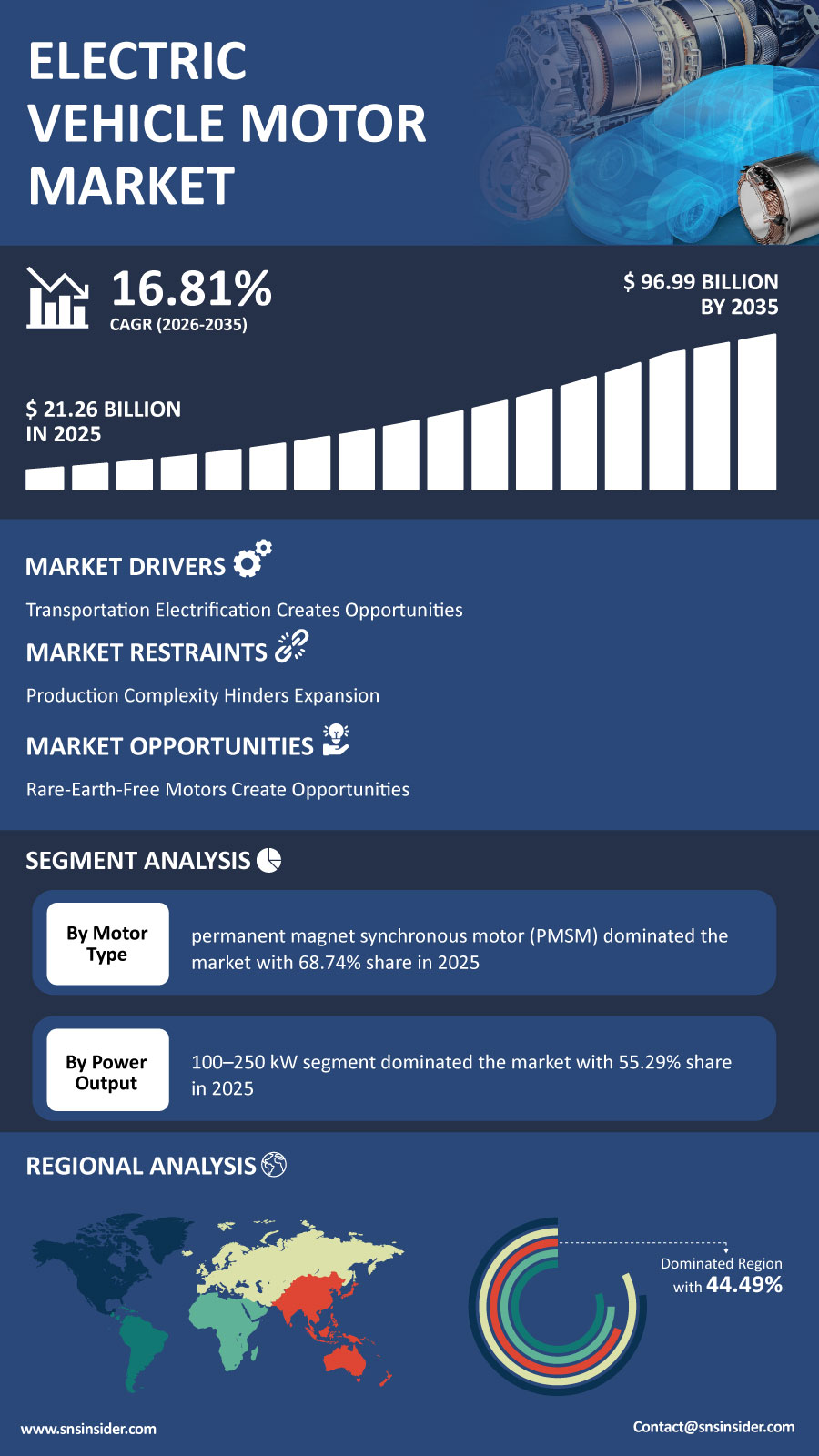
The global Electric Vehicle Motor Market is expected to witness remarkable expansion over the coming decade as automotive manufacturers accelerate electrification strategies and governments worldwide strengthen policies supporting zero-emission transportation. “According to a recent study by SNS Insider, the global Electric Vehicle Motor Market size valued at USD 21.26 billion in 2025, is anticipated to grow to USD 96.99 billion by 2035, registering a CAGR of 16.81% over the 2026–2035 forecast period.”
The developments related to electric mobility, improvements in propulsion systems, and the increased interest of customers in fast-moving electric vehicles are influencing the automotive world. Modern manufacturers are concentrating on creating small-sized and light-weight engines that increase the efficiency and performance of electric cars as well as reduce production costs.
Moreover, automotive engineering is profiting from constant innovations related to drive-train technologies. The leading automakers are implementing state-of-the-art motor technologies together with intelligent power electronics and new vehicle platforms.
To Get Detailed Insights on the Electric Vehicle Motor Market – Request a Sample Report
Next-Generation Drivetrain Technologies Open New Growth Opportunities
Globally, initiatives to lower emissions from the transport sector keep spurring investments throughout the electric mobility ecosystem. The manufacturing capacity of governments, car manufacturers, and technology companies is continuously being upgraded to enhance regional supply chains of key components for electric vehicles.
The increasing use of the integrated electric drive systems is helping car makers streamline their vehicle design while increasing efficiency. At the same time, innovations in alternative motor technology to minimize reliance on rare earth metals are opening new avenues of possibilities for future success.
Increasing deployment of electric buses, commercial fleets, urban mobility solutions, and premium electric vehicles is further broadening the addressable market for advanced electric traction motors.
Key Market Insights Highlight Rapid Technology Evolution
Permanent Magnet Synchronous Motors (PMSM) remained the dominant motor technology in 2025, accounting for 68.74% of global market revenue owing to their superior efficiency, high torque density, and widespread adoption across modern electric vehicle platforms.
Axial flux motors are anticipated to emerge as the fastest-growing motor category throughout the forecast period as manufacturers increasingly adopt compact, lightweight designs capable of delivering greater power density for next-generation electric vehicles.
By power output, the 100–250 kW segment generated 55.29% of market revenue in 2025 due to its extensive application across passenger sedans, SUVs, and crossover electric vehicles. Meanwhile, motors below 100 kW are projected to record the fastest expansion, supported by rising demand for compact urban mobility solutions and affordable electric transportation.
Passenger electric vehicles represented the largest vehicle segment with 56.41% market share during 2025 as global EV adoption continued accelerating. Commercial electric vehicles, however, are expected to register the highest growth rate through 2035 as logistics operators, public transportation providers, and fleet owners continue electrifying their operations.
Front-wheel-drive systems accounted for 46.15% of market revenue in 2025, while all-wheel-drive configurations are forecast to experience the strongest growth due to increasing consumer demand for premium performance-oriented electric vehicles.
Innovation and Manufacturing Expansion Strengthen Industry Outlook
Continued development and implementation of new motors in the automotive industry is still receiving substantial investment by automotive companies, as they develop more efficient and durable motors that can increase the performance of the car, while being able to manufacture on a larger scale.
The development of artificial intelligence technology, as well as advanced thermal management systems, motor drive control systems, and intelligent power electronics is helping to improve drivetrains and optimize energy usage in the electric vehicles.
In the coming years, with production rates growing continuously around the world, it is expected that the focus of manufacturers will be put on scaling the motor design for multiple vehicle platforms.
Asia Pacific Accounted for 44.49% Market Share in 2025; Forecast to Expand at a 17.18% CAGR by 2035
The Asia Pacific region accounted for 44.49% of the global revenue generated by the Electric Vehicle Motor Market in 2025 and is forecasted to be the biggest and fastest-growing regional market with a CAGR of 17.18% through 2035. Regional dominance will continue owing to robust manufacturing facilities, extensive electric vehicle manufacturing, government support, and a well-developed supply chain network. Continued focus on electric vehicle motor manufacturing from China, Japan, South Korea, and India will aid in ensuring future growth in the global electric vehicle motor market.
Strong performance from the North American market will be supported by robust manufacturing facilities and innovations in technology. The European region is an important contributor owing to strict emission norms, engineering expertise, and investments in sustainable transport technologies.
Industry Leaders Accelerate Product Innovation
Competition across the Electric Vehicle Motor Market continues to intensify as manufacturers focus on improving motor efficiency, reducing vehicle weight, enhancing power density, and expanding production capacity to meet rapidly growing global demand.
Key companies operating in the global Electric Vehicle Motor Market include BYD, Tesla, Nidec Corporation, Bosch Mobility, Continental AG, ZF Friedrichshafen AG, Siemens AG, Denso Corporation, Hitachi Astemo, Magna International, BorgWarner Inc., GKN Automotive (Dana Incorporated), Schaeffler AG, Valeo SA, Mitsubishi Electric Corporation, Toshiba Corporation, Hyundai Mobis, LG Magna e-Powertrain, UQM Technologies (Cummins Inc.), Dana TM4 (Dana Incorporated), and Nexter Group (KNDS).
An SNS Insider analyst Santosh Bhul commented, "Rapid advances in electric propulsion technologies, increasing investment in manufacturing capacity, and continued expansion of global electric vehicle production are transforming the competitive landscape. Companies that prioritize motor efficiency, scalable production, and next-generation drivetrain innovation will be well positioned to capitalize on the industry's long-term growth trajectory."
About the Author

Get in touch




