
Electrochemical Sensors Market is seeing rising investments owing to the increasing dependence of healthcare facilities, industries, and governments on real-time sensor technology for decision making and safe operations. The evolution of biosensors, environmental sensors, and IoT sensors has widened the scope of electrochemical sensors in various sectors.
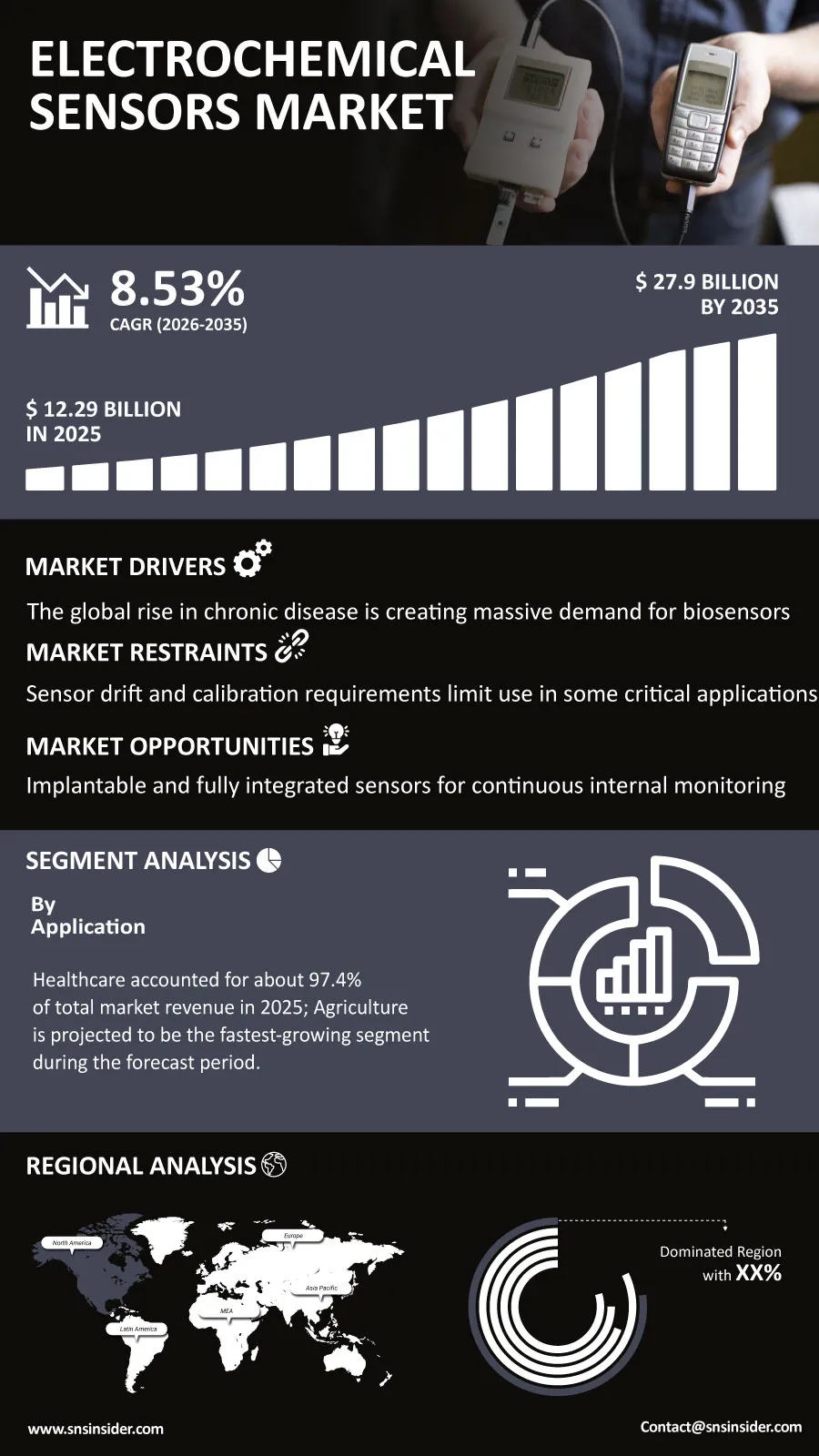
According to a recent study by SNS Insider, the global Electrochemical Sensors Market size valued at USD 12.29 billion in 2025, is anticipated to grow to USD 27.9 billion by 2035, registering a CAGR of 8.53% over the 2026–2035 forecast period. The growth of the market is driven by rising demand for health monitoring, increased compliance standards related to the environment, and greater use of intelligent sensors in healthcare, manufacturing, agriculture, and infrastructure.
However, healthcare remains the area with the highest rate of adoption since medical practitioners are adopting fast diagnosis and monitoring systems for their patients. Simultaneously, the government as well as industrial firms are making investments in sophisticated sensor systems in order to improve environmental monitoring and regulation compliance.
To Get Detailed Insights on the Electrochemical Sensors Market – Request a Sample Report
Healthcare and Digital Monitoring Expand Sensor Applications
Constant miniaturization and increasing functionality of wearable medical technologies leads to an era of electrochemical sensing platforms that provide individual continuous physiological data. Meanwhile, sensor makers are launching small energy-efficient consumer- wearables, point-of-care diagnostics and implantable medical devices that may support new kinds of preventive healthcare strategies.
AI and IoT are disrupting the market yet also as they facilitate automated data analysis, automagically remote monitoring, predictive maintenance etc. These capabilities are aimed at providing healthcare providers, industrial facilities, and environmental agencies with improved responses to changing conditions with enhanced operational efficiency.
Market Segments Reflect Emerging Growth Areas
By application, healthcare estimated to account approximately 97.4% of overall market revenue in 2025 owing to increase in demand for glucose monitoring systems, diagnostics biosensors and point-of-care testing devices. This sustained domination of the healthcare market is illustrated by the growing presence of electrochemical sensing technologies in chronic disease management.
At the same time, due to increasing interest in precision farming, agriculture is anticipated as an application segment with high growth during the forecast period. Increasing soil nutrient monitoring, irrigation optimization, and water quality analysis technologies are prompting agricultural producers to deploy advanced sensor solutions for modern farming practices.
Innovation Supports Next Generation of Connected Sensors
Across both healthcare and industrial segments, miniaturization advances, improved sensitivity, and longer operating life are driving manufacturers to invest heavily in improving. The research is required more and more on implantable biosensors, established calibration technologies and highly selective sensing materials that can provide the much expected confirmation of accuracy under extreme operating conditions.
The increasing integration with cloud platforms and connected healthcare ecosystems is providing additional commercial opportunities as well. These developments enable both real-time transmission of sensor data and support remote diagnostics, predictive analytics, and automated decision-making in many industry verticals.
Regional Markets Continue to Diversify
U.S.A. claimed the largest share of this regional market in 2025, a trend bolstered by well-established healthcare infrastructure and substantial assimilation of continuous glucose monitoring technologies along with proactive capital investment to comply with environmental regulatory measures. The United States was responsible for an estimated 71% of regional revenue throughout the continent. The U.S. Electrochemical Sensors Market was valued at USD 3.50 billion in the year 2025 and is projected to reach USD 7.55 billion by2035.,these targeting are done efficiently based on their respective marketshare different customer segments
Asia Pacific is expected to register the highest regional growth through 2035, based on growing healthcare access and rapidly developing industrial sectors in a number of nations, along with governmental governmental support for environmental monitoring programs. China accounted for nearly half of regional revenue, driven by massive investments in healthcare technology and environmental sensing infrastructure.
Germany contributed around 27% of the regional revenue in Europe, due to strong dominance in medical technology and industrial manufacturing. Brazil accounted for around 52% of Latin America's Revenue and the United Arab Emirates represented approximately 35% of Middle East & Africa revenue, gaining by increasing investment in healthcare infrastructure and industrial safety.
Industry Participants Expand Technology Capabilities
The competition further heats up as the industry's leading players continue to launch increasingly intelligent, multi-modal sensing platforms for healthcare, industrial safety and environmental applications. Recent product shipments emphasize sensor optimization, enhanced lifecycle, and significant digital connectivity to support ongoing tracking.
In 2025, Abbott released a next-generation FreeStyle Libre continuous glucose monitoring sensor with more extended wear time and better performance. Dexcom added the G7 continuous glucose monitoring system to its diabetes technology portfolio in 2024, while 2023 brought FDA clearance for integrated FreeStyle Libre 2 and Libre 3 sensors suitable for automated insulin delivery systems.
Major companies operating in the global electrochemical sensors market include Abbott Laboratories, Thermo Fisher Scientific Inc., AMETEK Inc., MSA Safety Incorporated, Emerson Electric Co., Drägerwerk AG & Co. KGaA, Honeywell International Inc., Siemens Healthineers AG, Metrohm AG, Nova Biomedical Corporation, Endress+Hauser Group, Sensirion AG, Mettler-Toledo International Inc., Figaro Engineering Inc., SGX Sensortech Ltd., Alphasense Ltd., Membrapor AG, Conductive Technologies Inc., Delphian Corporation, and Zimmer and Peacock AS.
An SNS Insider analyst Parry Kardani commented, "Electrochemical sensing technology is becoming increasingly important as healthcare, industrial automation, and environmental monitoring continue to converge around real-time data. Companies that combine sensor innovation with digital connectivity and scalable manufacturing capabilities are expected to strengthen their competitive position as adoption expands across diverse end-use industries.
About the Author

Get in touch




