
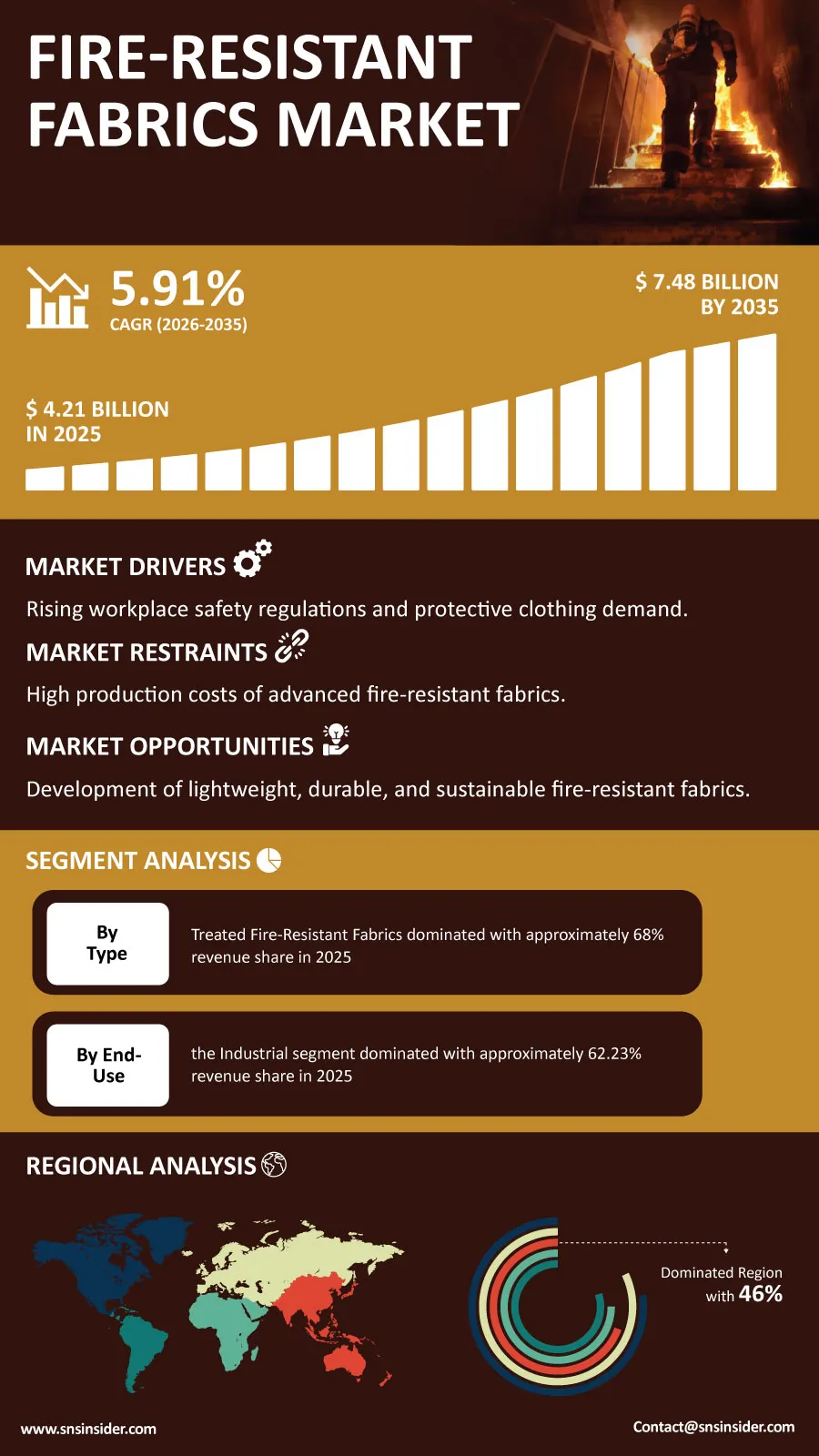
The Fire-Resistant Fabrics Market will witness consistent growth due to increasing regulations for industry safety and rising demands for high-quality protective fabrics from different sectors such as the energy sector, manufacturing sector, defence sector, and emergency response sector. “According to a recent study by SNS Insider, the global Fire-Resistant Fabrics Market size valued at USD 4.21 Billion in 2025, is anticipated to grow to USD 7.48 Billion by 2035, registering a CAGR of 5.91% over the 2026–2035 forecast period.”
The increasing industrialization, the growing emphasis on workplace safety, and stringent compliance with international protective equipment standards are stimulating businesses to purchase high-performance flame-resistant garments. Industries in safety critical fields (oil&gas, electrical utilities, chemical processing, mining and construction) continue to invest in most advanced apparel solutions that assure risk mitigation for thermal injuries achieving better levels of comfort and by the way productivity.
Technological advancement has also been transforming the industry by offering lightweight, robust as well as multi-hazard protection textiles that can provide better protection against heat, electric arc-flash, molten metal and chemical hazards without compromising the mobility of the wearer.
To Get Detailed Insights on the Fire-Resistant Fabrics Market – Request a Sample Report
Advanced Protective Textile Innovation Creates Long-Term Market Opportunities
Emerging trends toward sustainable industrial processes is opening new avenues for manufacturing next-generation flame-resistant fabrics. Demand for eco-friendly materials is prompting investments to develop halogen-free flame-retardant chemistries, recyclable fibers and bio-based textile technologies that meet global sustainability goals.
Meanwhile, manufacturers are launching multi-protective fabrics that combine flame resistance with moisture management, anti-static performance and UV protection along with water repellency. These combined solutions assist in weight reduction while ensuring full protection to industrial workers at risk.
Another potential growth area is smart textile technologies. Wearable sensors to monitor worker temperature, physiological stress, and environmental exposure will be integrated with protective clothing so as to create smart personal protective equipment (PPE) for industrial and emergency response workers.
Key Market Insights Highlight Evolving Demand Across End Users
On the basis of type, Treated Fire-Retardant Fabrics held roughly 68% share of total market revenue worldwide in 2025 on account of heavy cost-effectiveness and acceptance as a part of different industrial safety programs. The Inherent Fire-Resistant Fabrics segment is expected to exhibit the fastest growth through 2035 as various industrial clients establish a demand for long-term flame protection with exceptional durability and wash resistance.
Based on application, the Apparel segment accounted for about 62.23% of revenues in 2025, due to high demand for certified garments with protection against hazardous work places. Due to the wider usage of flame-resistant materials in transportation, construction and industrial insulation, and infrastructure protection brochures, non-apparel applications will be growing exponentially.
By end use, the Industrial segment continued to be the leading contributor in 2025 due to extensive usage across energy & utilities, manufacturing and chemicals sectors. The highest growth over the forecast period is anticipated for Defense and Public Safety Services as military modernization initiatives will continue to drive demand for advanced protective equipment in this space, including firefighters and first responders.
Smart Materials and Sustainable Chemistry Accelerate Industry Transformation
The continued investment in textile engineering is making it possible for manufacturers to enhance the safety performance of technical clothing while also being more comfortable for the wearer. Such as high-performance fibres like aramid, modacrylic and polybenzimidazole (PBI), which not only improve thermal protection but also decrease the mass of clothing per prolonged period of functional use.
Research for new coatings, nanotechnology, phase-change materials and environmentally friendly flame-retardant chemistries is broadening the capabilities of products. They are enabling manufacturers to adhere to continuously more stringent industrial safety standards while bolstering international initiatives aimed at reducing hazardous chemical use over the entire textile production cycle.
Regional Markets Continue Expanding Through Industrial Safety Investments
In 2025, Asia Pacific generated around 46% of the global revenue bolstered by rapid industrial growth, increased infrastructure spending and rising manufacturing activity along with strict implementation of workplace safety regulations in China, India and Southeast Asia. Investments across the energy, chemicals, construction and heavy industry Continue to be supported in this region.
Heavy innovative presence of global textile companies and stringent occupation safety regulations alerting the use of fire-resistant clothing coupled with high demand from oil & gas operations, contractors for electrical utilities, and defense also reinforces North America as one of the most matured markets for fire resistant fabrics globally.
Europe continues to gain market share with various protective clothing in use due to strict environmental regulations, sustainable textile manufacturing practices, and widespread adoption of high-performance protective clothing for industrial and public safety applications.
Industry Participants Focus on High-Performance and Sustainable Protective Solutions
The competitive environment is still very much innovation-oriented with manufacturers focusing on fiber innovations, green chemistry in flame retardants, and smart protective textiles. Investments in increased production, R&D, and green manufacturing help the companies to comply with the regulations and improve performance of their products.
Key companies operating in the global Fire-Resistant Fabrics Market include DuPont, Teijin Limited, Milliken & Company, TenCate Protective Fabrics, Lenzing AG, PBI Performance Products, W. L. Gore & Associates, Kaneka Corporation, Huntsman Corporation, Indorama Ventures, Gun Ei Chemical Industry Co., Ltd., Newtex Industries, Trevira GmbH, Banswara Syntex Limited, Solvay S.A., XM FireLine, Apex Mills Corp., Suzhou Top Safety Protection Technology Co., Nam Liong Enterprise Co., Ltd., and Royal TenCate.
An SNS Insider analyst Himanshu Sharma commented, "Global emphasis on occupational safety, industrial modernization, and advanced protective equipment continues to strengthen long-term demand for fire-resistant fabrics. Companies investing in sustainable flame-retardant technologies, multifunctional protective textiles, and next-generation smart fabric innovation are expected to secure significant competitive advantages as industrial safety standards continue to evolve worldwide."
About the Author

Get in touch




