
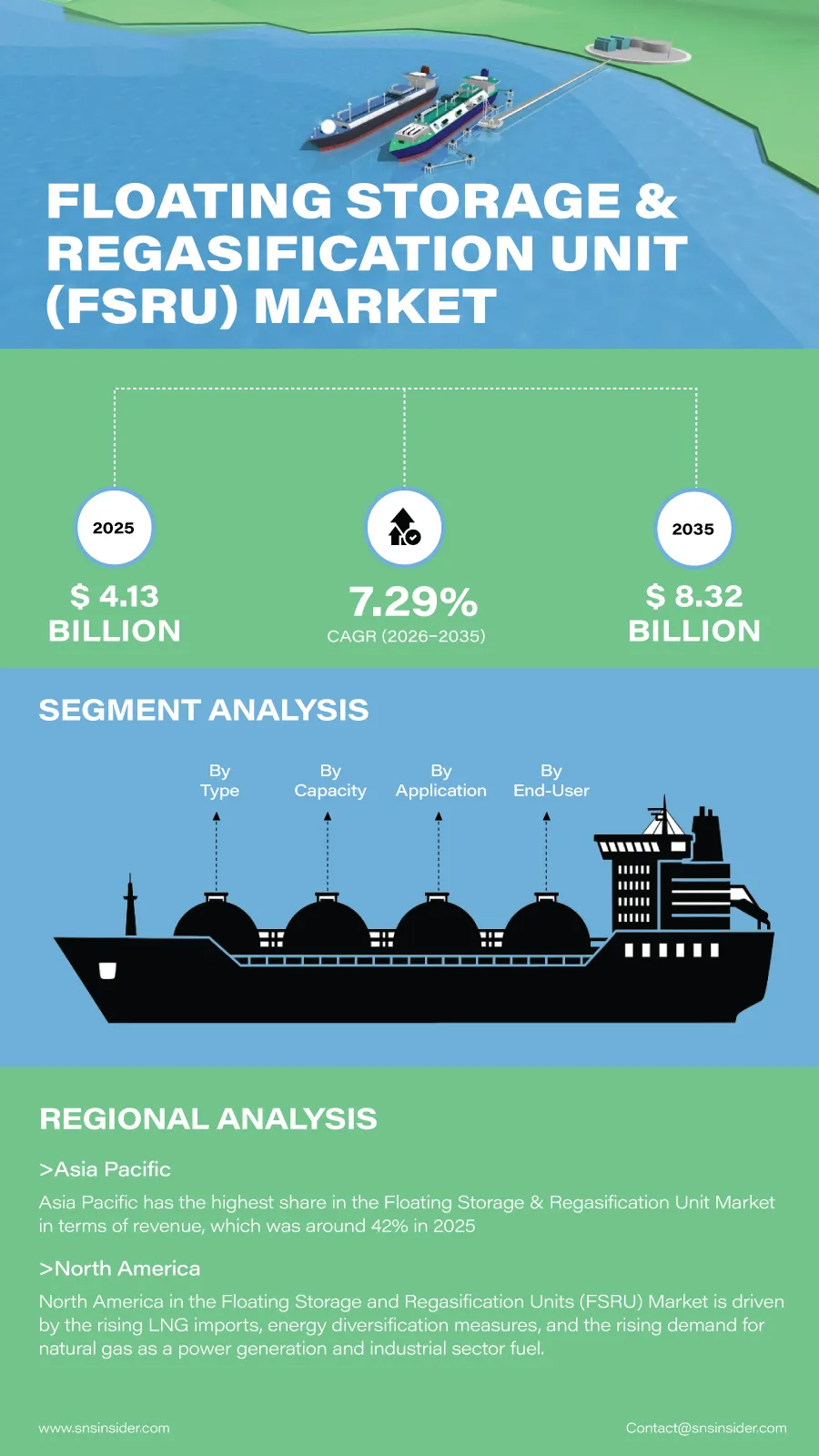
The global Floating Storage and Regasification Unit Market is poised for sustained expansion as countries strengthen energy security strategies and accelerate investments in flexible liquefied natural gas (LNG) infrastructure. According to a recent study by SNS Insider, the global FSRU (Floating Storage Regasification Unit) Market was valued at USD 4.13 billion in 2025 and is anticipated to reach USD 8.32 billion by 2035, registering a CAGR of 7.29% over the 2026–2035 forecast period.
Growing tendency of using environmentally friendly fuel sources, along with growing usage of natural gas as fuel in power plants and industries, stimulates government authorities to seek the opportunities for importing natural gas by using floating LNG terminals, which are easier to implement in comparison with onshore facilities. FSRU vessels appear to be a promising option, allowing increasing regasification capacity without substantial investments in infrastructure.
Continuous processes of industrialization, population growth, and increased energy demand in developing countries also ensure the necessity of importing natural gas for the future. In addition, improvements in technology of regasification equipment, shipbuilding, digital control systems, and ecological characteristics of vessels are making it even more profitable to use floating facilities.
Energy Security Initiatives Continue to Create New Growth Opportunities
Energy diversification has now emerged as an essential strategy for several countries looking to achieve greater freedom from being reliant on a single type of fuel or pipelines. FSUs can help nations and energy firms in gaining flexibility in terms of their supplies by giving them fast access to international markets for LNG while meeting the changing requirements of the energy transition process.
The current geopolitical situation has stressed the need for robust LNG infrastructure. Disturbances in the supply chain for major shipping routes have made it necessary to have flexible regasification facilities that are able to ensure uninterrupted flow of fuels even amid uncertainties in the market. Governments are making efforts to build their capacity in terms of offshore LNG terminal and floating storage infrastructure.
Technological progress in automation, predictive maintenance, artificial intelligence, and modular storage solutions is offering new opportunities in terms of cost savings and improved vessel performance.
Key Market Insights Highlight Shifting Demand Patterns
Based on capacity, FSRUs with storage capacities ranging from 100,000–150,000 m³ are projected to account for approximately 45% of global market revenue in 2025 due to their balance of operational flexibility, storage efficiency, and cost-effectiveness. Units exceeding 150,000 m³ are expected to register the fastest growth through 2035 as countries expand long-term LNG import programs and large-scale energy security initiatives.
By mode of transportation, marine and sea transportation is anticipated to dominate the global market with nearly 88% revenue share in 2025 owing to its efficiency in supporting international LNG trade and large-volume cargo movement. Pipeline integration is forecast to experience the fastest growth during the forecast period as investments increase in connecting floating regasification terminals with domestic gas distribution networks.
In terms of application, base-load regasification is expected to contribute approximately 64% of market revenue in 2025 because of its critical role in providing continuous LNG supply for industrial and utility customers. Peak-shaving and short-term regasification applications are projected to witness the fastest expansion as seasonal demand fluctuations and emergency energy requirements continue to rise.
By type, newly built FSRUs are expected to account for approximately 61% of market revenue in 2025 due to their advanced engineering, higher efficiency, and long-term deployment capabilities. Converted FSRUs are anticipated to record the fastest growth as operators increasingly seek faster and more economical deployment options by repurposing existing LNG carriers.
Flexible LNG Infrastructure Strengthens Global Energy Networks
Global energy markets are increasingly placing focus on infrastructure that can adjust quickly to any changes in the demand patterns. The use of floating regasification allows companies to quickly increase import capacity without long construction periods needed for conventional land-based LNG plants.
Digital control systems, automation, new regasification technologies, and environmental solutions are being used by industry players to increase reliability. It is expected that the use of such innovations will increase due to the critical role of LNG in the balancing of renewable energy production and power supply stability.
Regional Markets Demonstrate Strong Growth Potential
The Asia Pacific region is estimated to hold around 42% share in global market revenue in 2025, driven by growing LNG imports, industrialization, and policies from governments that encourage use of cleaner energy sources. Large investments made in LNG facilities in China, India, Japan, and South Korea further help in leading in installation of FSRUs.
The North America region is also witnessing consistent growth due to growing demands for natural gas, infrastructure investments in the offshore sector, and favorable energy policies. The European region will witness increasing installations of FSRUs as the countries look for diverse supply of natural gas and cut reliance on pipeline gas imports, whereas Latin America and Middle East and Africa are making gradual investments in floating LNG facilities.
Industry Participants Focus on Expanding Flexible LNG Solutions
Competition across the Floating Storage & Regasification Unit market continues to intensify with firms venturing into large capacity ships, sophisticated regasification equipment, digital asset management software, and partnerships in LNG infrastructure facilities. Firms are also forming long term leasing programs and floating terminal schemes in order to meet the growing needs for LNG globally.
Key companies operating in the global Floating Storage & Regasification Unit (FSRU) Market include Excelerate Energy Inc., Höegh LNG Holdings Ltd., Golar LNG Limited, BW Gas Limited, Exmar NV, Mitsui O.S.K. Lines (MOL), Samsung Heavy Industries Co., Ltd., Hyundai Heavy Industries Co., Ltd., Daewoo Shipbuilding & Marine Engineering (DSME), Gazprom, Royal Dutch Shell plc, TotalEnergies SE, Bumi Armada Berhad, Teekay LNG Partners L.P., FLEX LNG Ltd., Maran Gas Maritime Inc., Offshore LNG Toscana SpA (OLT), Gazprom FLEX LNG, MISC Berhad, and Kawasaki Kisen Kaisha Ltd.
An SNS Insider analyst Santosh Bhul commented, “Growing LNG trade, rising energy diversification efforts, and increasing demand for rapidly deployable import infrastructure are strengthening the outlook for Floating Storage & Regasification Units worldwide. Companies that continue investing in operational efficiency, digital technologies, and flexible deployment capabilities will be well positioned to capitalize on evolving global energy requirements.”
An Infographic Representation of the Global FSRU (Floating Storage Regasification Unit) Market
About the Author

Get in touch




