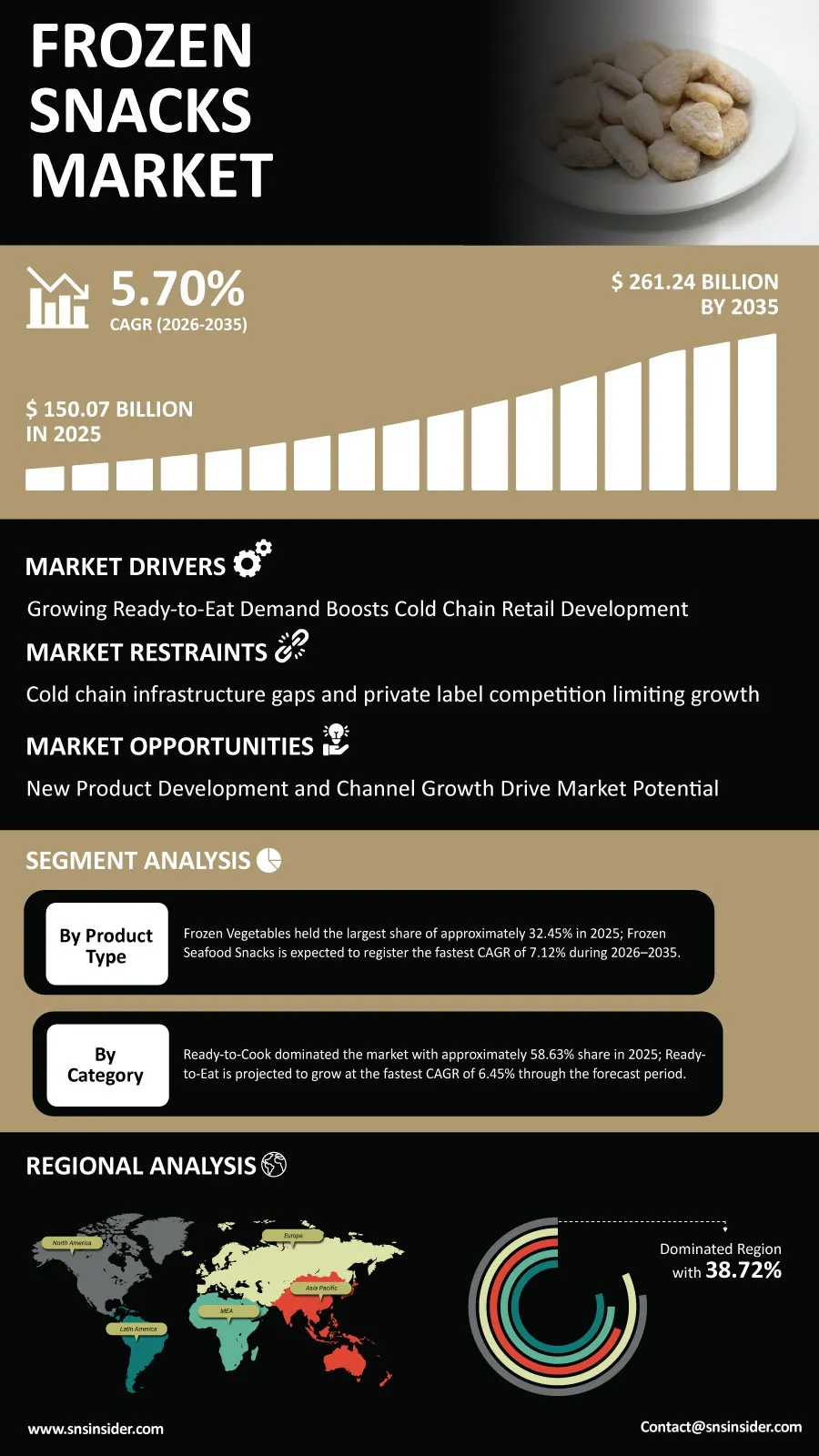
The global market for Frozen Snacks is gaining momentum, driven by the evolution in the food habits of consumers, advances in the cold chain infrastructure, and ongoing innovations in the food industry. “According to a recent study by SNS Insider, the global Frozen Snacks Market size valued at USD 150.07 billion in 2025, is anticipated to grow to USD 261.24 billion by 2035, registering a CAGR of 5.70% over the 2026–2035 forecast period.”
An increase in the demand for quick and convenient foods has turned frozen foods into an everyday purchase rather than just something people would buy occasionally. People today desire products that deliver not only efficiency but also high quality and high nutritional value, motivating companies to develop a wide range of premium, plant-based, protein-rich, and exotic products. On top of this, the development of refrigerated facilities and online grocery stores facilitates wider access to frozen products around the globe.
Another advantage that the food industry benefits from is the improvement of food preservation technologies that not only keep the taste, texture, and nutritional value of products but also increase their shelf life.
To Get Detailed Insights on the Frozen Snacks Market – Request a Sample Report
Convenience-Driven Consumption Creates New Growth Opportunities
Growing the frozen snack market as busy lifestyles drive demand for food which cuts down on prep time whilst preserving quality Long-term support in terms of consumption along the strata between residential and commercial channels continue to rise across urban landscapes, driven by urbanisation, growing workforce participation and changing family structures.
In response, manufacturers are launching products designed specifically for health-focused consumers like clean-label recipes, vegetable-based snacks, high-protein alternatives and gluten-free options. Simultaneously, the quick commerce delivery platforms in addition to other online grocery services are providing more distribution channels for frozen food companies through temperature-controlled distribution networks.
Demand is also being fortified by incorporating frozen food products in restaurant, institutional and catering operations as a means to improve efficiencies, reduce food waste and promote consistent product quality across multiple locations.
Key Market Insights Reflect Changing Consumer Preferences
According to product type, Frozen Vegetables made up 32.45% of total market revenue in 2025 owing to the wide acceptance among households and their year-round availability. Frozen Seafood Snacks are expected to record the highest growth rate through 2035 owing to increasing consumer preferences for convenient and protein-rich snacks.
Ready-to-Cook products contributed 58.63% towards market revenue in 2025 backed by the preference for fresh and heated food items at home. On the other hand, the Ready-to-Eat category is expected to witness the highest growth owing to rising consumer demand for convenient and minimum cooking meal solutions.
Among end users, Households contributed 67.28% towards total market revenue in 2025 owing to wide spread use of freezers and the practice of consuming meals at home. The Foodservice category is expected to witness the highest growth through the forecast period owing to rising frozen product consumption in restaurants, hotels and institutional kitchens.
Among distribution channels, Supermarkets & Hypermarkets held the top position in terms of market share with 52.91% market share in 2025 while Online Retail is expected to post the highest growth through 2035.
Product Innovation and Digital Retail Accelerate Market Transformation
The frozen snacking segment is experiencing a fast-paced change, as manufacturers leverage the integration of culinary innovation and modern food technology to distinguish themselves from their competition in terms of their offerings. Air fryer-friendly versions, high-quality recipes, and exotic flavors are growing in popularity due to changing cooking trends and preferences.
Digital retail channels will continue to change consumers' purchase behavior, as manufacturers can distribute their products beyond brick-and-mortar grocery stores through such platforms. Cold chain logistics, automation of product fulfillment, and sustainable packaging options are some ways companies can enhance their delivery process while minimizing their environmental footprint.
Ingredient innovation, recyclable packaging materials, and healthy product formulations will continue to be key strategies that manufacturers will use to stand out from their competitors.
North America Accounted for 38.72% Market Share in 2025; Asia Pacific Forecast to Expand at a 7.02% CAGR by 2035
In North America, market revenue accounted for 38.72% of the global market value due to the presence of developed retail system, higher penetration rate of household freezers, and the demand for ready-to-cook meals among consumers. The market dominance of North America is further reinforced by the continuous launch of innovative frozen food products.
The Asia-Pacific region is expected to witness a CAGR of 7.02% during the forecast period due to increasing disposable income, increasing urban population, and investments in cold-chain logistics to boost frozen food consumption in the major economies of the region including China, India, Japan, and Southeast Asian nations.
The presence of supermarket chains and growing demand for premium frozen foods are key factors that make Europe one of the important contributors to the global market revenue. Latin America and Middle East & Africa are developing regions with steady growth potential in the coming years.
Industry Participants Focus on Premiumization and Portfolio Expansion
However, competition is set to become more intense within the frozen snacks industry as major brands engage in diversification and the development of healthy products, sustainable packaging and innovative manufacturing processes. Strategic investments by leading firms in high-end products, online retail channels and global markets have been used to enhance their brands' positioning.
Key companies operating in the global Frozen Snacks Market include Nestlé S.A., General Mills, Inc., Conagra Brands, Inc., McCain Foods Limited, The Kraft Heinz Company, Tyson Foods, Inc., Nomad Foods Limited, Ajinomoto Co., Inc., Dr. Oetker GmbH, Hormel Foods Corporation, Rich Products Corporation, Pinnacle Foods, Inc., Bellisio Foods, Inc., Amy's Kitchen, Inc., Saffron Road Foods, Maple Leaf Foods Inc., JBS S.A., Greencore Group plc, Iceland Foods Ltd., and Goya Foods, Inc.
An SNS Insider analyst Santosh Bhul commented, "The frozen snacks industry is benefiting from the convergence of convenience, product innovation, and modern retail expansion. Companies investing in healthier formulations, advanced cold-chain capabilities, and premium product experiences are expected to strengthen their competitive position as consumer demand continues to evolve across global markets."
About the Author

Get in touch