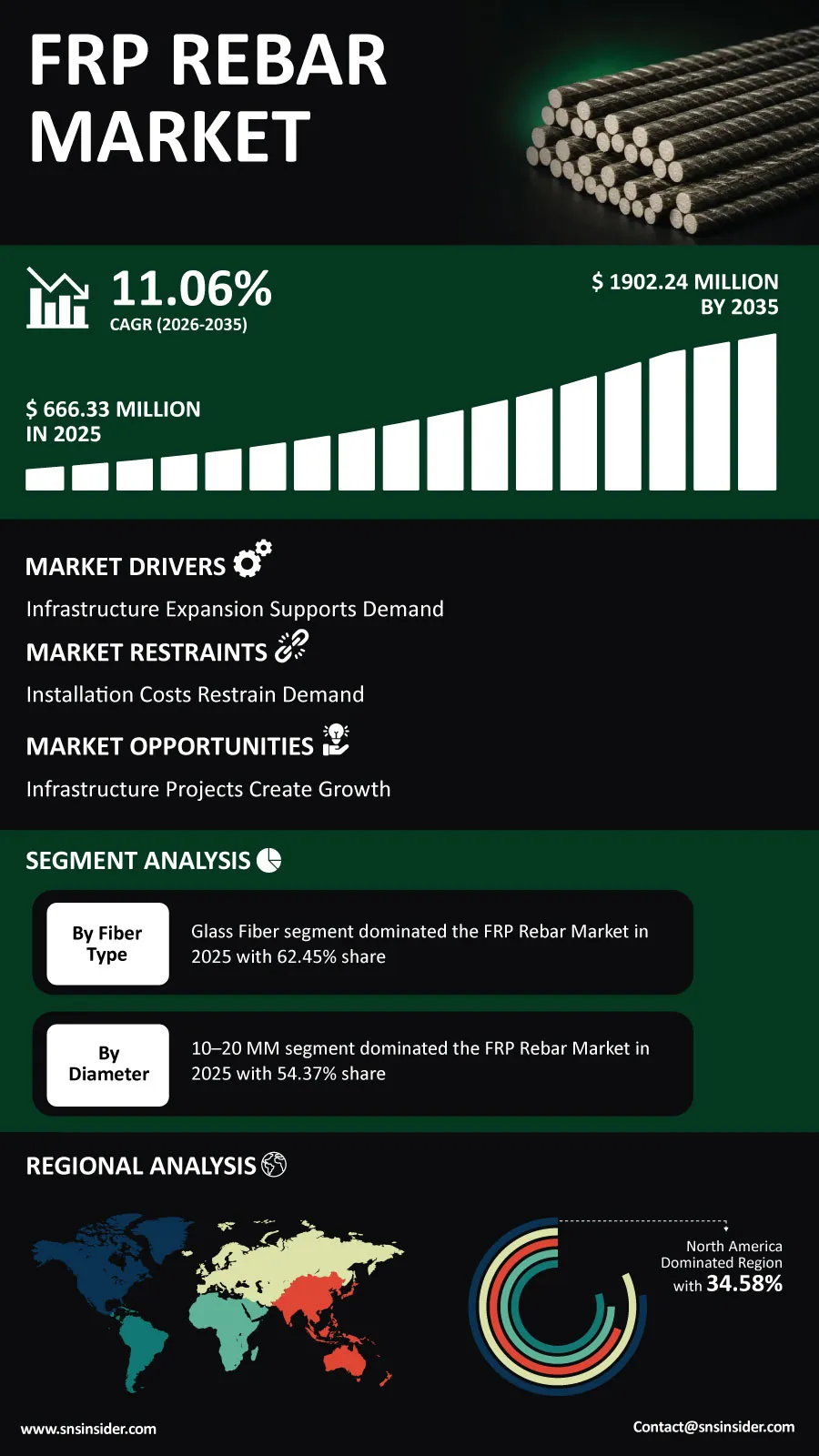
The global FRP Rebar Market is gaining strong momentum as the governments and private developer give increasing importance for long lasting, low-maintenance reinforcement solutions when it comes to crucial civils projects across industrial sectors. “According to a recent study by SNS Insider, the global FRP Rebar Market size valued at USD 666.33 Million in 2025, is anticipated to grow to USD 1902.24 Million by 2035, registering a CAGR of 11.06% over the 2026–2035 forecast period.”
Fiber-Reinforced Polymer (FRP) Rebar Market Demand for fiber-reinforced polymer (FRP) rebar is increasing as construction companies are looking for alternatives to conventional steel reinforcement in areas of high moisture content, chemicals, and saltwater. The superior corrosion resistance, lightweight design and high tensile strength of FRP rebar are making its use widely in transportation infrastructure such as highways, bridges, marine engineering, industrial facilities and municipal utilities. Increased awareness of lifecycle cost savings is galvanising a wider uptake across both mature and emerging construction markets.
The manufacturers are also expanding their capabilities and developing advanced composite technologies that identify two-layer performance layers for better installability. The industry is driven by continued investment in research and composite engineering to meet the increasing demand of high-performance reinforcements for modern infrastructure needs.
To Get Detailed Insights on the FRP Rebar Market – Request a Sample Report
Infrastructure Modernization and Sustainable Construction Create Long-Term Opportunities
FRP rebar has been increasingly used worldwide due to large investments held in highways, bridges, tunnels, ports, desalination plants and wastewater treatment facilities. With increasing financial allocation to resilient infrastructure, engineers increasingly choose reinforcement materials, which require lower maintenance but with a greater service life.
Marine construction is another significant growth opportunity where traditional steel reinforcement has the risks of corrosion due to its exposure to saltwater. The increasing adoption of FRP rebar in offshore installations, seawalls, docks and coastal infrastructure is anticipated to bolster long-term industry outlook. Ongoing improvements in resin chemistry and composite manufacturing technologies are ensuring improved product durability, promoting wider adoption across challenging construction applications.
Key Market Insights Highlight Evolving Demand Trends
By fiber type, Glass Fiber segment garnered 62.45% market share of global revenue in 2025 as it provides a good balance between strength and corrosion resistance at low cost. Carbon FiberÉwill register the highest growth through 2035 buoyed by strong demand for premium reinforcement solutions in high-performance infrastructure.
The 10–20 MM segment accounted for 54.37% of the total market revenue by diameter in 2025, as a result of applications over residential/commercial and transportation projects. As the use in specific reinforcement applications increases, the below 10 MM category is expected to grow at a rapid pace during the forecast period.
By resin type, Vinyl Ester led with a 55.62% share of revenue in 2025 as they both have excellent chemical resistance properties along with structural reliability The segment is expected to register rapid growth due to the strength bonding and mechanical performance, required from 2018 in advanced construction projects.
Highways, Bridges and Buildings captured 58.24 % of the global revenue share in 2025 among applications, while Marine Infrastructure is anticipated to be the fastest-growing application segment through 2035.
Composite Technology Innovation Accelerates Market Development
Innovation continues to characterize the FRP rebar industry as manufacturers seek to enhance material performance, sustainability, and production efficiencies. New advancements in pultrusion technology, next-generation resin formulations and even recyclable composite materials are producing tougher reinforcement products designed to withstand aggressive environments.
Companies have implemented also automated manufacturing systems and product certifications programm to promote wider industrial adoption. These developments are anticipated to increase the efficiency of installations while also aiding infrastructure owners in reducing operational disturbances and long-term upkeep costs.
North America Captured 34.58% of the FRP Rebar Market in 2025, Asia Pacific to Record Fastest Growth Through 2035
Geographically, North America dominated the FRP rebar market and was responsible for generating over 34.58% revenue of the global market in 2025. Ongoing investment in bridge rehabilitation, transportation modernization, marine infrastructure and water treatment projects is supporting enduring demand for corrosion-resistant reinforcement solutions across the region.
Asia Pacific is projected to witness the fastest growth until 2035 due to rapid urbanization, new transportation networks, smart city developments and higher government expenditure on resilient infrastructure. Increasing industrialization and development activities in coastal areas of major regional economies are continuously creating substantial opportunities for the manufacturers of composite reinforcement.
Industry Participants Expand Capacity and Advance Composite Solutions
Competition throughout the global FRP rebar market is primarily based on manufacturing expansion, technology improvement and product customization. With surging infrastructure demand across various transportation, marine, industrial, and utility sectors, leading companies are increasing production capacity, developing new recyclable composite materials with strategic partners.
Key companies operating in the global FRP Rebar Market include Dextra Group, Pultron Composites, Pultrall Inc., Schöck Bauteile GmbH, Sireg Geotech S.r.l., Hughes Brothers, Inc., Neuvokas Corporation, Kodiak Fiberglass Rebar LLC, Marshall Composite Technologies LLC, Armastek, TUF-Bar Inc., Owens Corning, ARC Insulations & Insulator Ltd., Jindal Advanced Materials, FiReP Group, Fibrolux GmbH, BP Composites Ltd., Röchling Group, Hebei Yulong Composite Material Co., Ltd., and SKD Composites.
An SNS Insider analyst Himanshu Sharma commented, "Growing emphasis on resilient infrastructure, lower maintenance costs, and longer asset lifecycles is accelerating global adoption of FRP rebar. Manufacturers investing in advanced composite technologies, scalable production capabilities, and sustainable reinforcement solutions are well positioned to benefit from the next generation of infrastructure development worldwide."
About the Author

Get in touch