
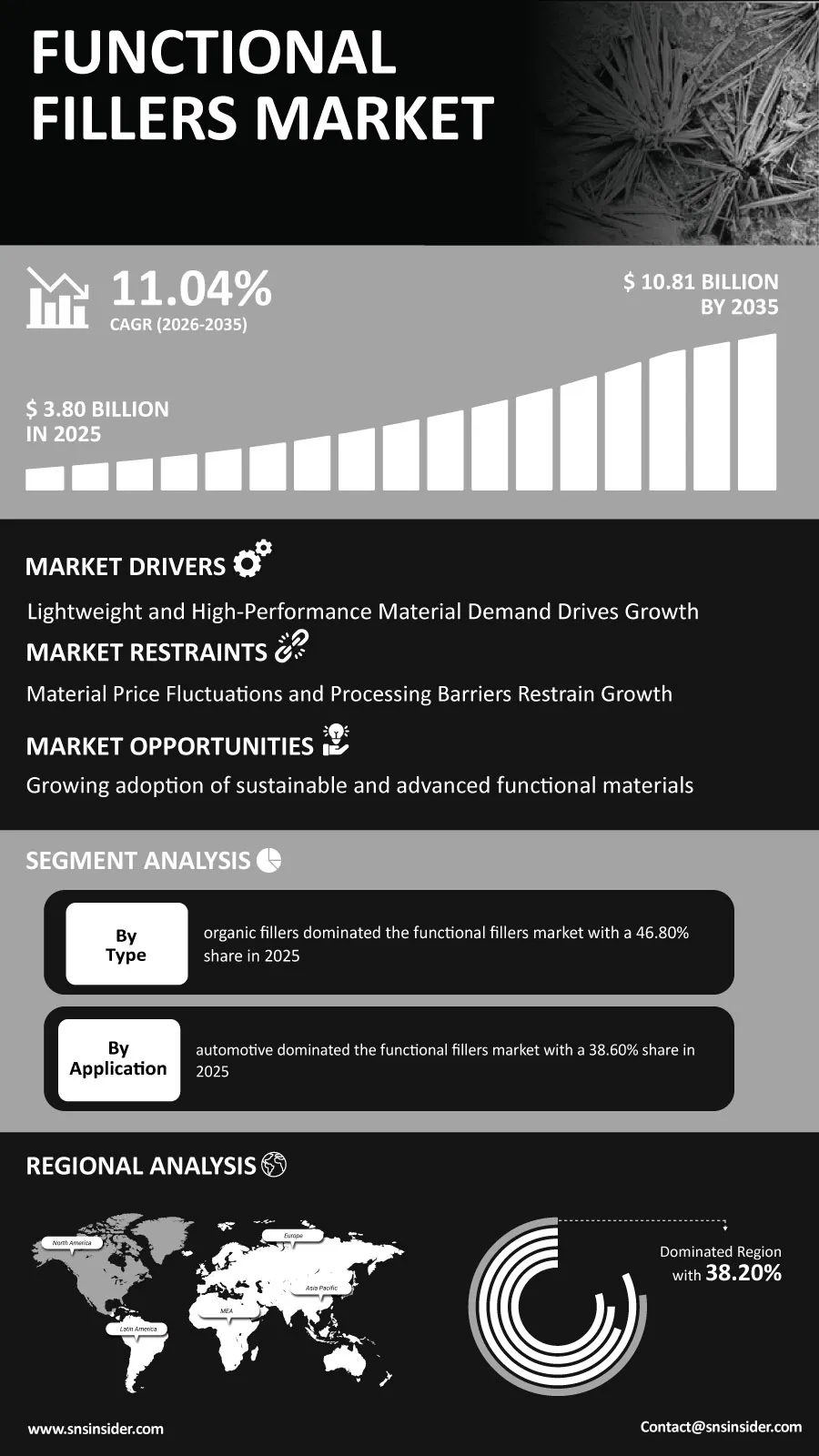
It is anticipated that the worldwide Functional Fillers market will enter an era of rapid growth due to the demand for performance-oriented materials without compromising on cost and weight. “According to a recent study by SNS Insider, the global Functional Fillers Market size valued at 3.80 Billion in 2025, is anticipated to grow to USD 10.81 Billion by 2035, registering a CAGR of 11.04% over the 2026–2035 forecast period.”
The demand for fillers is rising owing to the role that they play as additives in polymer compounds, coating systems, adhesives, engineering plastics, and composite systems. The role played by functional fillers in increasing the strength, thermal properties, conductivity, dimensional stability, and barrier properties of materials has contributed to their rising use.
Electric mobility, lighter vehicle parts, enhanced electronics, and energy-saving architecture are creating even more addressable markets for companies. Simultaneously, automobile companies are producing materials which are conducive to recycling, reduced carbon content, and use of biodegradable materials.
To Get Detailed Insights on the Functional Fillers Market – Request a Sample Report
Lightweighting and Sustainable Materials Create New Growth Opportunities
With the growing trend of lightweight parts, a lot of opportunities are emerging for functional filler manufacturers. Car makers have started using advanced polymer composites for lightening vehicles without affecting their mechanical properties, especially when electric car manufacturers are aiming for more fuel-efficient cars.
The concept of sustainability is also playing an important role in technological innovations. Firms are now using technology based on the development of bio-fillers, recycled products, hybrids, and advanced silicas to comply with environmental regulations without compromising the performance level of the filler. Through nanotechnology, there is room for fillers that can deliver several functionalities within one composite system.
Key Market Insights Highlight Emerging Applications
Organic fillers were 46.80% of global revenues generated by the filler market in 2025 due to their compatibility with polymer matrices, ease of processability, and growing use of eco-friendly materials. Hybrid fillers will grow the fastest, posting a 14.80% CAGR because manufacturers look for multi-purpose fillers with complementary properties.
As per applications, automotive was the biggest in 2025 with 38.60% share because of lightweight parts used in this sector, EV development, and increased demands on parts' performance. Electronics is set to be the biggest gainer of all applications with 14.41% CAGR due to its need for thermal management, advanced and high-performance parts and components.
By material, polymers composites will account for 37.50% of the total revenues in 2025, while engineering plastics will show the fastest growth rate of 14.81%. In terms of functionality, mechanical strength enhancement was 35.80% in 2025, while electrical conductivity will be the biggest gainer posting 15.23% CAGR. The biggest end user segment in the market in 2025 was material manufacturers with 56.40%, while research institutes showed the fastest growth.
Advanced Filler Technologies Accelerate Material Innovation
The development of functional fillers is getting to be more focused on dispersion, compatibility, and multifunctional performance. The modern surface treatment and hybrid technology are assisting companies in developing interaction between the fillers and the polymer matrix with high-efficiency processing.
The new generation of silica, carbon-containing materials, specialty minerals, and nanofillers are assisting in applications which need thermal stability, electrical conductivity, reinforcement, and barrier properties. Formulation and processing technology have been automated in order to overcome complexity issues related to special fillers' applications.
Regional Markets Demonstrate Strong Growth Potential
North America had the highest share of the Functional Fillers Market at 38.20% in terms of revenue in 2025. It was due to the presence of well-established industries including the automotive industry, construction sector, electronics industry, and chemical manufacturing in the region.
It is estimated that Asia Pacific will be the fastest growing regional market till 2035 owing to factors such as rapid industrialization in the region, expansion of the automotive and electronics industry, infrastructure development, and investment in polymer technology. China contributed 41.20% to the regional market in 2025.
Industry Participants Focus on High-Performance and Sustainable Solutions
The competitiveness of the global Functional Fillers Market revolves around advanced material research, sustainability, application-oriented formulations, and production efficiency. The top firms are developing portfolios of specialty fillers along with making investments in nanotechnology, sustainable materials, recycled materials, and high-performance composites.
Key companies operating in the global Functional Fillers Market include BASF SE, Dow Inc., Evonik Industries AG, Clariant AG, Wacker Chemie AG, Arkema S.A., Solvay S.A., Cabot Corporation, Imerys S.A., Omya AG, Minerals Technologies Inc., Sibelco Group, Huber Engineered Materials, Birla Carbon, Orion S.A., Nippon Aerosil Co., Ltd., Tokuyama Corporation, 3M Company, Huntsman Corporation, and Asahi Kasei Corporation.
An SNS Insider analyst Himanshu Sharma commented, “The rapid transition toward lightweight, high-performance, and sustainable materials is strengthening the strategic importance of functional fillers across major manufacturing industries. Continued innovation in hybrid systems, nanomaterials, and bio-based formulations will create new opportunities as manufacturers pursue greater product performance alongside environmental efficiency.”About the Author

Get in touch




