
Functional Fillers Market Report Scope & Overview:
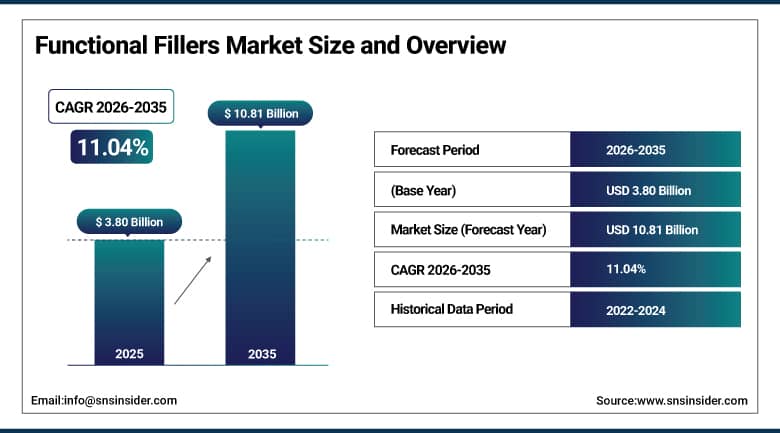
The Functional Fillers Market was valued at USD 3.80 Billion in 2025 and is expected to reach USD 10.81 Billion by 2035, growing at a CAGR of 11.04% from 2026–2035.
The major drivers fueling the expansion of the global functional fillers market are the increasing demand for lightweight and high-performance materials, growing adoption of advanced polymer composites across automotive and construction industries, rising focus on sustainable and bio-based filler technologies, and the need to enhance mechanical strength, thermal stability, electrical conductivity, and barrier properties of end products. Manufacturers are increasingly incorporating functional fillers into polymers, coatings, adhesives, and engineering plastics to improve product performance, reduce material weight, extend durability, and meet stringent environmental and regulatory requirements. Additionally, ongoing advancements in nanotechnology, hybrid filler systems, recyclable materials, and bio-based formulations are further supporting market growth.
In March 2025, BASF expanded its portfolio of sustainable functional fillers by advancing bio-based and low-carbon silica solutions for automotive, construction, and industrial applications. These innovations enable manufacturers to improve mechanical strength, reduce product weight, enhance thermal stability, and support sustainability goals while meeting increasing demand for high-performance and environmentally friendly materials.
Market Size and Forecast:
-
Market Size 2026E: USD 4.21 Billion
-
Market Size 2035: USD 10.81 Billion
-
CAGR: 11.04% from 2026 to 2035
-
Fastest Growing Region: Asia-Pacific
-
Largest Region: North America
To Get More Information On Functional Fillers Market - Request Free Sample Report
Functional Fillers Market Trends:
-
Rising demand for lightweight, high-performance materials is driving the adoption of functional fillers across multiple industries.
-
Increasing use of polymer composites in automotive, construction, and electronics applications is accelerating the demand for advanced functional fillers.
-
Functional fillers improve mechanical strength, thermal stability, electrical conductivity, barrier properties, and overall material performance.
-
Advancements in bio-based fillers, nanotechnology, and hybrid filler systems are driving innovation in the functional fillers market.
-
Growing adoption across automotive, construction, electronics, packaging, and industrial manufacturing sectors is supporting the sustained growth of the functional fillers market.
U.S. Functional Fillers Market Outlook:
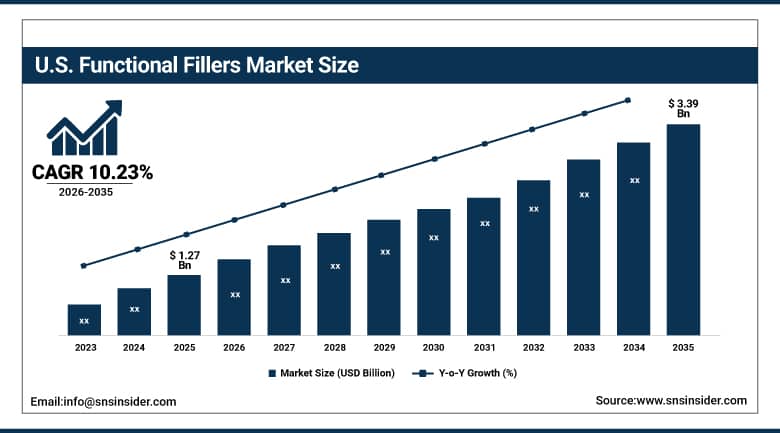
The U.S. Functional Fillers Market was valued at USD 1.27 Billion in 2025 and is expected to reach around USD 3.39 Billion by 2035, growing at a CAGR of 10.23% from 2026–2035.
There is a surge in the growth of the functional fillers market in the United States due to the increasing demand for lightweight, high-performance materials, rapid adoption of advanced polymer composites, and rising focus on sustainable and bio-based filler technologies. Manufacturers across automotive, construction, electronics, and industrial sectors are increasingly incorporating functional fillers to enhance mechanical strength, thermal stability, electrical conductivity, and barrier properties while reducing material weight and improving product durability.
Additionally, ongoing advancements in nanotechnology, hybrid filler systems, recyclable materials, and bio-based formulations, along with continued investments in advanced manufacturing and sustainable material development, are further accelerating the growth of the functional fillers market in the United States.
In February 2025, Evonik expanded its advanced functional fillers portfolio by introducing next-generation high-performance silica and specialty filler solutions for engineering plastics, coatings, and composite applications. The new solutions enhance mechanical strength, thermal stability, and processing efficiency while supporting lightweight material development, improved product durability, and sustainability objectives across automotive, construction, and industrial applications.
Process Intensification Market Segment Analysis:
-
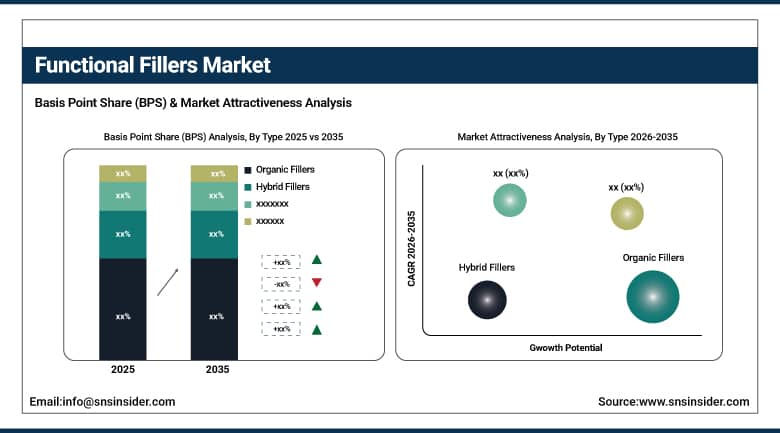
By Type, organic fillers dominated the functional fillers market with a 46.80% share in 2025, while hybrid fillers are projected to be the fastest-growing segment, registering a CAGR of 14.80% during 2025–2035.
-
By Application, automotive dominated the functional fillers market with a 38.60% share in 2025, while electronics are projected to be the fastest-growing segment, registering a CAGR of 14.41% during 2025–2035.
-
By Material, polymer composites dominated the functional fillers market with a 37.50% share in 2025, while engineering plastics are projected to be the fastest-growing segment, registering a CAGR of 14.81% during 2025–2035.
-
By Function, mechanical strength enhancement dominated the functional fillers market with a 35.80% share in 2025, while electrical conductivity is projected to be the fastest-growing segment, registering a CAGR of 15.23% during 2025–2035.
-
By End User, material manufacturers dominated the functional fillers market with a 56.40% share in 2025, while research institutions are projected to be the fastest-growing segment, registering a CAGR of 15.23% during 2025–2035.
By type, organic fillers dominated the functional fillers market, while hybrid fillers are expected to grow fastest.
For the year 2025, the segment of organic fillers dominated the global market for functional fillers due to their better compatibility with polymer matrix, improved processability, increased moisture resistance, and increasing usage in the sustainable material formulation. The use of organic fillers was increasing in order to enhance the mechanical properties and reduce the weight of the products along with the increased demand for sustainable materials.
Hybrid fillers sub-segment is projected to experience the highest CAGR during the forecast period due to the increasing demand for multifunctional materials that integrate the functionalities of both organic and inorganic fillers. Advances in nanotechnology, lightweight materials, and high-performance engineering materials will increase the adoption of hybrid fillers in several industrial applications.
By application, automotive dominated the functional fillers market, while electronics is expected to grow fastest.
On the basis of application, the automotive end-use industry occupied the largest market share in the global functional fillers market, while the electronics industry is likely to show the fastest growth rate in the coming years. The dominance of the automotive industry can be attributed to the rising usage of lightweight polymer composites, stricter fuel economy and emissions standards, and growing demand for highly robust and high-performance parts in traditional as well as electric cars.
The electronics industry is expected to exhibit the fastest CAGR in the coming years because of the growing demand for electronic components, semiconductors, electric vehicles, and superior thermal management materials.
By end user, material manufacturers dominated the functional fillers market, while research institutions are expected to grow fastest.
According to end user, the material manufacturer segment had the largest share in the functional fillers market, whereas the research institutions segment is anticipated to have the highest growth rate during the forecast period. The material manufacturer segment was the leading segment in the functional fillers market in 2025 on account of their extensive application of functional fillers for developing advanced polymer compounds, composites, coatings, and specialty materials.
The research institution segment is likely to show the highest CAGR during the forecast period owing to rising investments in advanced material research, nanotechnology, sustainable filler development, and bio-based materials.
Regional Analysis:
|
Region |
Major Country |
Share within Region, 2025(%) |
|---|---|---|
|
North America |
United States |
87.30% |
|
Europe |
Germany |
22.80% |
|
Asia Pacific |
China |
41.20% |
|
Middle East & Africa |
Saudi Arabia |
31.40% |
|
Latin America |
Brazil |
39.60% |
North America functional fillers market insights
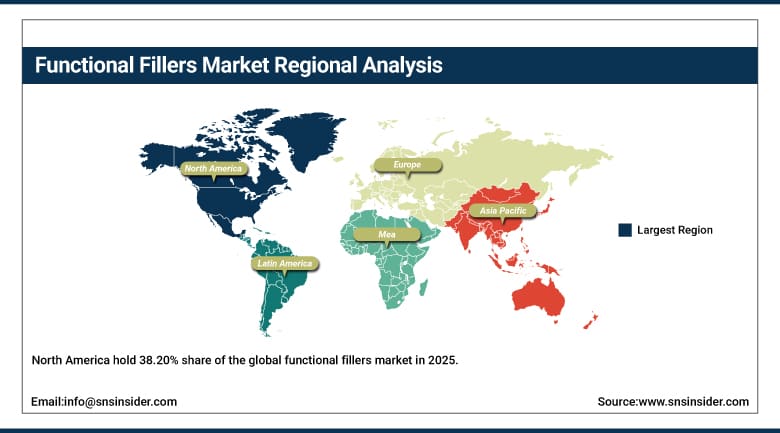
North America hold 38.20% share of the global functional fillers market in 2025 owing to the rising demand for lightweight and high-performance materials in the automobile, construction, electronics, and industrial applications. Functional fillers have gained much traction owing to their ability to improve mechanical strength, thermal resistance, electrical conductivity, and barrier performance while contributing to sustainability and lightweighting efforts. Also, the US held 87.30% share of the North America functional fillers market in 2025, driven by its robust manufacturing infrastructure, presence of prominent chemical players in the region, and continuous investments in advanced materials R&D.
Rising demand for electric vehicles, sustainable construction materials, and high-performance polymer composites is likely to drive the market growth in North America. Growing investments in bio-based fillers, nanomaterials, and advanced composite technologies coupled with strict environmental regulations favoring lightweight and recyclable materials will drive the functional fillers market growth in the US and North America.
Get Customized Report as Per Your Business Requirement - Enquiry Now
Europe functional fillers market insights
The European functional fillers market continues to be an important one because of growing demand for eco-friendly materials, stringent environment regulation policies, and advancements in high-tech polymers and composites. In 2025, the Germany functional fillers market share was recorded to be at 22.80%. This is attributed to the country's developed automotive, chemicals, and industrial manufacturing industries along with the growing investments in lightweight materials and engineering innovations.
Factors contributing to the rise in the functional fillers market in Europe include growing use of recyclable materials, bio-filler products, and high-performance composites in the automotive, construction, and industrial segments. The continued investments in sustainable manufacturing, circular economy models, and material technology innovations are anticipated to drive consistent growth during the forecast period.
Asia Pacific functional fillers market insights
The Asia-Pacific functional fillers market will have the highest CAGR among all regions over the forecast period due to the rapid industrialization, increased manufacturing operations, construction of infrastructure, and demand from automotive and electronics industries. China dominated the Asia-Pacific functional fillers market with a share of 41.20% in 2025, which can be attributed to its large manufacturing sector, chemical production, construction sector, and increasing demand for advanced polymers.
Increased investment in electric vehicles, consumer electronics, renewable energy, and high-performance composites is providing many growth opportunities to the market in the region. In addition, growing use of sustainable materials and bio-based fillers, along with advances in nanotechnology, will drive the functional fillers market.
Middle East & Africa and Latin America insights
The Middle East and Africa functional fillers market is experiencing steady growth owing to the rising investments in the development of the construction sector, infrastructure, industrial manufacturing, and advanced materials. In 2025, Saudi Arabia was leading the regional market and contributed to about 31.40% of the market. It can be attributed to the country's industrial diversification program, increased production of petrochemicals, and increasing demands for advanced construction materials.
The Latin America functional fillers market is growing owing to rising industrialization, increased production of automobiles, and increasing demand for sustainable construction and packaging materials. In 2025, Brazil was leading the market and contributed about 39.60% of the regional market. The country is experiencing growth owing to its well-established manufacturing sector, increasing chemical industry, and use of advanced polymer composites.
Market Dynamics:
Growth Driver: Increasing demand for lightweight and high-performance materials accelerating functional fillers market growth
The growing requirement for light weight, strong, and high-performance materials has become one of the key factors driving the growth of the functional fillers market. Functional fillers are being used by various manufacturers of industries including the automotive industry, construction industry, electronics industry, and industrial industry to improve the mechanical strength, thermal stability, electrical conductivity, barrier properties, and dimensional stability of polymers and composites. As various industries are concentrating on the development of products that can perform well and be lighter as well, the usage of functional fillers is gaining popularity.
The increasing use of electric vehicles, advanced engineering plastics, high-performance coatings, and polymer composites is expected to drive the functional fillers market in future. Apart from this, continuous innovations in material science, nanotechnology, and sustainable manufacturing are also anticipated to propel the functional fillers market during the forecast period.
Restraints: Raw material price volatility and processing complexity may restrain functional fillers market growth
The market growth is still affected by the price variations of the raw materials as well as the complicated processing requirements. Price variations of the raw materials like silica, carbon black, metal oxides, and specialty minerals have been identified as some of the factors that make production costly. Moreover, the processes that help ensure uniform distribution of the filler, surface modification, and compatibility of the different fillers with various polymers are complex.
Apart from these challenges, the manufacturers also face pressure of adhering to the environmental laws while ensuring quality performance of their products. Consequently, high production costs, complexities involved in advanced formulation of the fillers, and process optimization are expected to act as restraints in the functional fillers market during the forecast period.
Opportunities: Growing adoption of sustainable and advanced functional materials
The growing demand for sustainable and advanced functional materials has created immense opportunities for the functional fillers market. The manufacturers are making significant investments in biodegradable fillers, nanomaterials, recyclable mineral fillers, and hybrid fillers to enhance the efficiency of products by minimizing the adverse environmental impacts. Increasing demand for light-weight materials in electric vehicles, renewable energy systems, sustainable construction, and electronics has generated further opportunities for functional fillers.
In addition, increasing investments in circular economy, advanced polymer composites, and engineering materials are likely to generate opportunities for market players. Innovations in nanotechnology, biodegradable materials, and multifunctional fillers, coupled with the growing industrialization in both developed and developing nations, is likely to drive the functional fillers market in the coming years.
Recent Developments:
-
2026: BASF expanded its portfolio of sustainable functional fillers by introducing advanced silica and specialty filler solutions designed to improve mechanical strength, lightweighting, and thermal performance for automotive, construction, and industrial applications.
-
2026: Evonik introduced next-generation high-performance silica technologies for engineering plastics and composites, enhancing durability, processability, and thermal stability while supporting sustainable material development.
-
2025: Arkema expanded its advanced materials portfolio with innovative bio-based and hybrid functional filler technologies, enabling manufacturers to improve product performance while reducing environmental impact across multiple end-use industries.
-
2025: Wacker Chemie enhanced its specialty filler portfolio by introducing advanced bio-based and recycled filler solutions for high-performance polymers and sustainable construction materials, supporting circular economy initiatives and lightweight material applications.
Functional Fillers Market Key Players are:
-
BASF SE
-
Dow Inc.
-
Evonik Industries AG
-
Clariant AG
-
Wacker Chemie AG
-
Arkema S.A.
-
Solvay S.A.
-
Cabot Corporation
-
Imerys S.A.
-
Omya AG
-
Minerals Technologies Inc.
-
Sibelco Group
-
Huber Engineered Materials
-
Birla Carbon
-
Orion S.A.
-
Nippon Aerosil Co., Ltd.
-
Tokuyama Corporation
-
3M Company
-
Huntsman Corporation
-
Asahi Kasei Corporation.
Functional Fillers Market Report Scope:
| Report Attributes | Details |
|---|---|
| Market Size in 2025 | USD 3.80 Billion |
| Market Size by 2035 | USD 10.81 Billion |
| CAGR | CAGR of 11.04% From 2026 to 2035 |
| Base Year | 2025 |
| Forecast Period | 2026-2035 |
| Historical Data | 2022-2024 |
| Report Scope & Coverage | Market Size, Segments Analysis, Competitive Landscape, Regional Analysis, DROC & SWOT Analysis, Forecast Outlook |
| Key Segments | • By Type (Organic Fillers, Inorganic Fillers, Hybrid Fillers) • By Application (Automotive, Construction, Electronics, Others) • By Material (Polymer Composites, Construction Materials, Engineering Plastics, Coatings & Adhesives) • By Function (Mechanical Strength Enhancement, Thermal Stability, Electrical Conductivity, Barrier Properties, Lightweighting) • By End User (Material Manufacturers, Component Assemblers, Research Institutions) |
| Regional Analysis/Coverage | North America (US, Canada, Mexico), Europe (Eastern Europe [Poland, Romania, Hungary, Turkey, Rest of Eastern Europe] Western Europe] Germany, France, UK, Italy, Spain, Netherlands, Switzerland, Austria, Rest of Western Europe]), Asia Pacific (China, India, Japan, South Korea, Vietnam, Singapore, Australia, Rest of Asia Pacific), Middle East & Africa (Middle East [UAE, Egypt, Saudi Arabia, Qatar, Rest of Middle East], Africa [Nigeria, South Africa, Rest of Africa], Latin America (Brazil, Argentina, Colombia, Rest of Latin America) |
| Company Profiles | BASF SE, Dow Inc., Evonik Industries AG, Clariant AG, Wacker Chemie AG, Arkema S.A., Solvay S.A., Cabot Corporation, Imerys S.A., Omya AG, Minerals Technologies Inc., Sibelco Group, Huber Engineered Materials, Birla Carbon, Orion S.A., Nippon Aerosil Co., Ltd., Tokuyama Corporation, 3M Company, Huntsman Corporation, Asahi Kasei Corporation. |
Frequently Asked Questions
The functional fillers market is expected to grow at a CAGR of 12.40% from 2025 to 2035.
The functional fillers market was valued at USD 3.80 billion in 2025.
The market is driven by increasing demand for lightweight, high-performance, and sustainable materials.
The organic fillers segment dominated the functional fillers market in 2025 with a 46.80% share.
North America dominated the functional fillers market in 2025 with a 38.20% share.
