
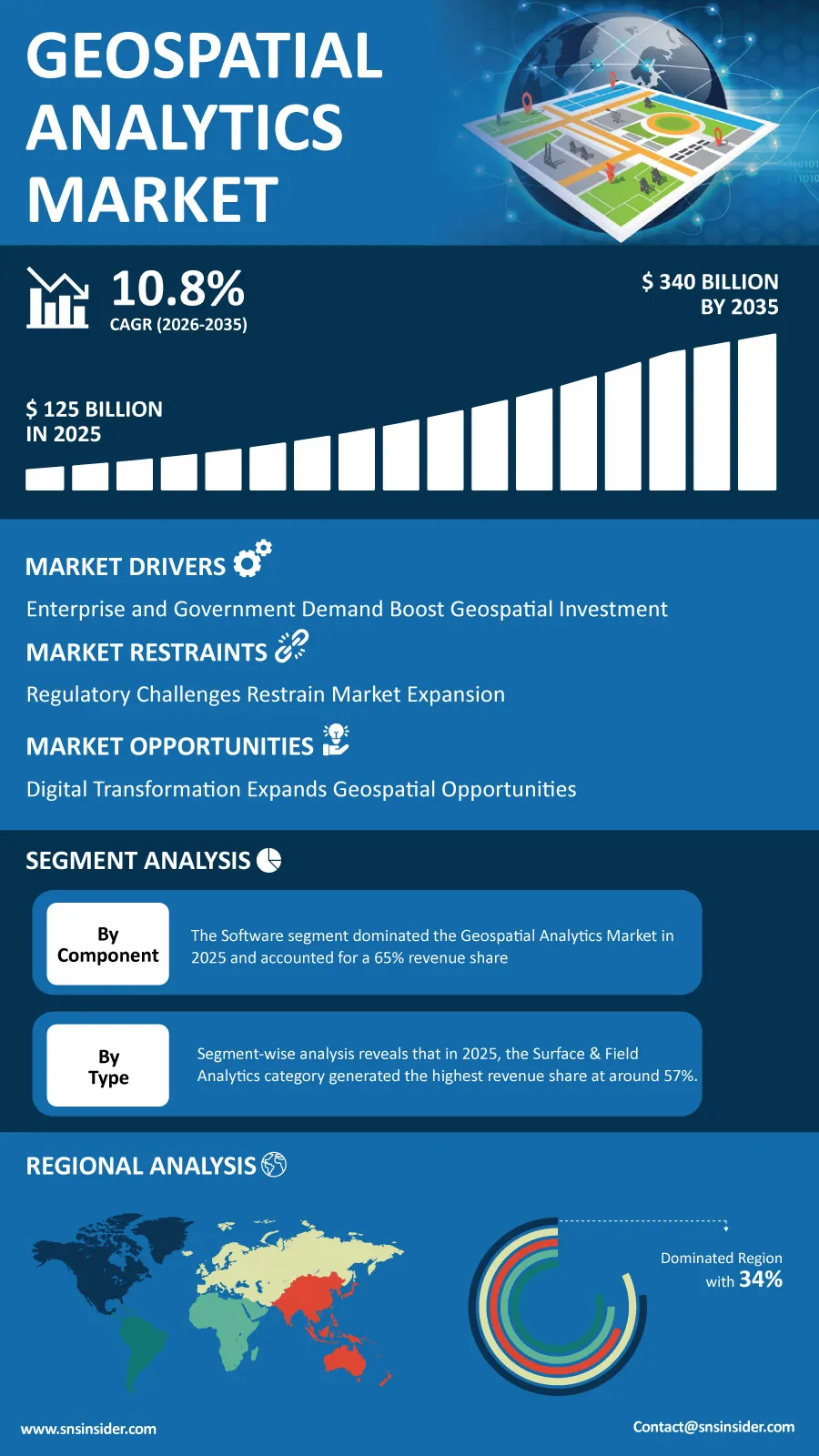
The global Geospatial Analytics Market is entering a new phase of growth as organizations increasingly rely on location intelligence to improve operational planning, infrastructure management, environmental monitoring, and public safety. “According to a recent study by SNS Insider, the global Geospatial Analytics Market size valued at USD 125 billion in 2025, is anticipated to grow to USD 340 billion by 2035, registering a CAGR of 10.8% over the 2026–2035 forecast period.”
As a result of increasing digital transformation programs, accelerated urban development, and increased investment in satellite imaging, GIS, and AI-powered analytics, momentum in the market is increasing across the globe. Spatial technology is being utilized by both governments and enterprises to enhance decision making, resource allocation, and creation of infrastructure that can support future growth.
Increasing accessibility to cloud computing technology, internet-of-things (IoT) devices, and high-resolution Earth observation data has made it possible for organizations to derive actionable geographic insights in record time. As industries focus on real-time monitoring and predictive analytics, geospatial analytics becomes an integral part of digital operations.
To Get Detailed Insights on the Geospatial Analytics Market – Request a Sample Report
AI and Digital Infrastructure Investments Create New Growth Opportunities
Funding and investments made towards intelligent infrastructure are continuously creating opportunities for providers of geospatial intelligence. The needs of smart transport systems, connected utility networks, precision agriculture, and digital twin solutions will make a market for complex spatial analytics tools that are able to work with enormous amounts of geographical information.
Furthermore, artificial intelligence helps automate processes related to imagery analysis, land use change detection, and infrastructure assessment. The combination of these technologies and cloud-native platforms enables companies to gain access to scalable geospatial intelligence without building complex infrastructure on-premise.
An increasing focus on climate resiliency, disaster readiness, and sustainable city planning will create even more adoption opportunities as the authorities require correct geographical data to build their environmental and infrastructure strategy.
Key Market Insights Highlight Evolving Industry Demand
Based on component, the software segment accounted for nearly 65% of global revenue in 2025 due to increasing adoption of advanced GIS platforms, mapping applications, and spatial intelligence software across commercial and government sectors. Meanwhile, the services segment is projected to register the fastest growth through 2035 as organizations increasingly require implementation, consulting, and data management expertise.
By deployment, cloud-based solutions are anticipated to witness the strongest expansion throughout the forecast period because of their flexibility, scalability, and lower infrastructure costs. On-premises deployments continue to maintain an important presence among defense agencies, intelligence organizations, and industries handling highly sensitive spatial information.
In terms of type, Surface & Field Analytics generated approximately 57% of market revenue in 2025, supported by extensive use across agriculture, mining, environmental monitoring, and land management applications. Network & Location Analytics is expected to grow steadily as organizations enhance logistics optimization, telecommunications planning, and urban mobility management.
For applications, Surveying remained the leading revenue contributor in 2025 owing to rising investments in infrastructure development, land mapping, and construction projects. Military Intelligence and Disaster Risk Reduction & Management are forecast to experience the highest growth as governments strengthen surveillance capabilities and climate resilience programs.
Advanced Spatial Intelligence Technologies Accelerate Market Evolution
Further development of AI-based mapping software, automation of change detection services, and predictive spatial modeling will be continuously provided by technology companies. The incorporation of machine learning into satellite imaging, drone surveying, and sensors is providing the possibility of performing geographic analysis more efficiently.
Another trend in geomatics is the emergence of digital twins, autonomous systems, and location intelligence. More and more organizations utilize geospatial analysis for such tasks as optimization of transportation networks, monitoring of critical infrastructure, better supply chain management, and sustainable development.
North America Held 34% of the Geospatial Analytics Market Share in 2025; Asia Pacific Projected to Register the Fastest CAGR Through 2035
The North America region held about 34% of the market share in 2025 due to high investment in geospatial infrastructure, sophisticated satellite programs, modern defense systems, and smart city projects. Continued cooperation among governments, research institutions, and providers of technology will help to maintain dominance in this region.
The Asia Pacific region will be growing the fastest until 2035 due to smart city projects implemented in such countries as China, India, and South Korea. In addition, these nations develop 5G networks and digital geospatial infrastructure that boosts the demand.
The Europe region is also an important player thanks to their advanced Earth observation and climate change monitoring projects and open geospatial infrastructure. The Latin American and the Middle East and Africa regions have been actively adopting geospatial technology solutions for agriculture, resource management, disaster preparation, and infrastructure development.
Industry Participants Expand AI-Powered Geospatial Capabilities
Competition across the market remains strong as leading technology companies invest in cloud-native GIS platforms, spatial artificial intelligence, satellite data processing, and predictive analytics capabilities. Strategic partnerships, product innovation, and digital infrastructure expansion continue to shape the competitive landscape.
Key companies operating in the global Geospatial Analytics Market include IBM Corporation, Microsoft Corporation, Google LLC, Amazon Web Services (AWS), Palantir Technologies, Salesforce, Inc., SAP SE, Oracle Corporation, Accenture plc, Hewlett Packard Enterprise (HPE), Cisco Systems, Inc., Darktrace plc, CrowdStrike Holdings, Inc., Fortinet, Inc., McAfee Corp., Splunk Inc., SAS Institute Inc., FireEye, Inc., Bitdefender, and Zebra Technologies Corporation.
An SNS Insider analyst Sakshi Kale commented, "The growing integration of artificial intelligence, cloud computing, and real-time spatial intelligence is transforming how organizations interpret geographic data. Companies investing in scalable geospatial platforms, predictive analytics, and location-based decision support technologies are expected to benefit from expanding opportunities across both public and private sectors."
About the Author

Get in touch




