
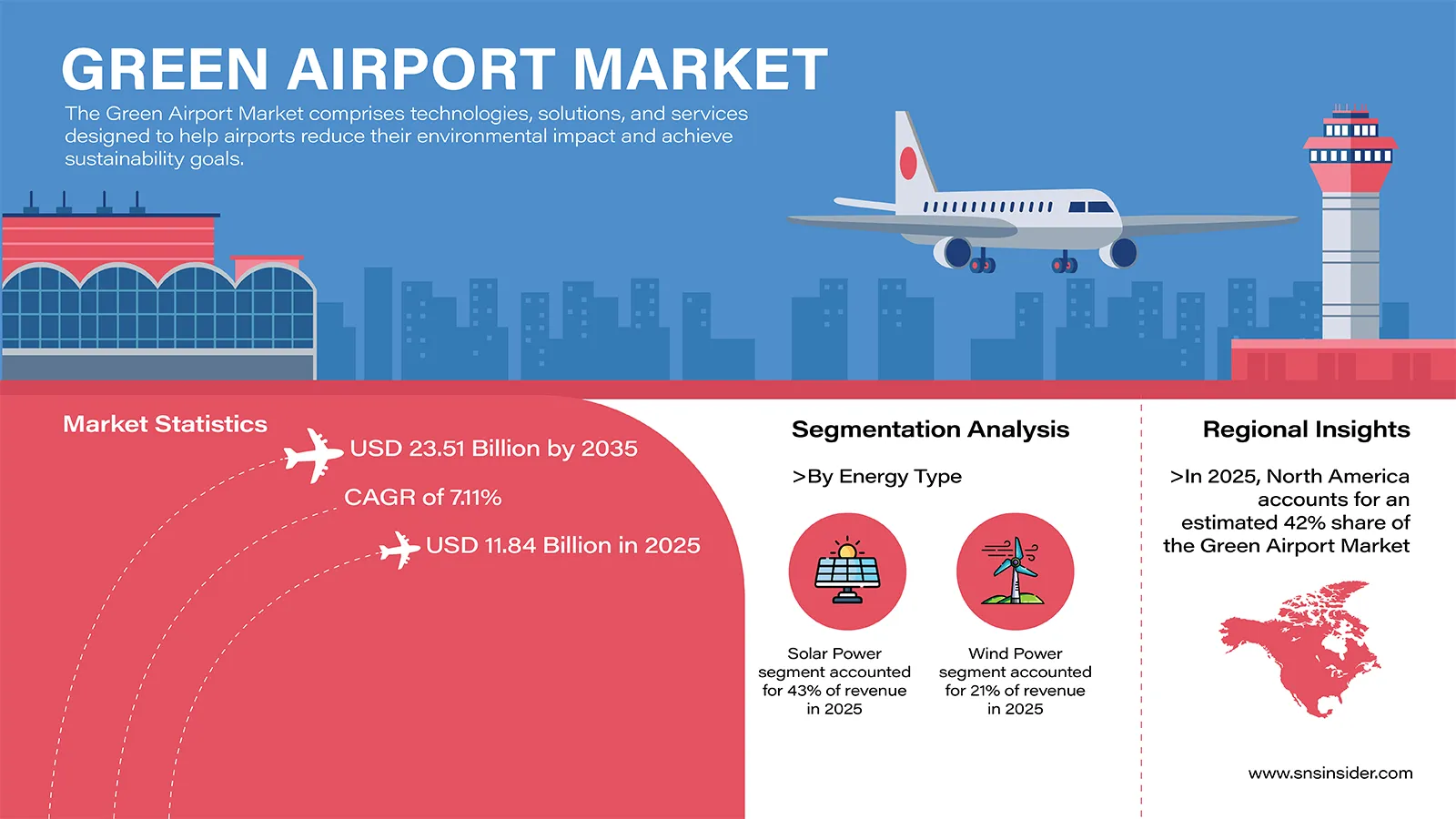
As per the SNS Insider Report titled, Green Airport Market by Application, by Energy Type, by Airport Class, by Airport Type, and Region | Global Forecast 2026-2035, “The global Green Airport Market size valued at USD 11.84 billion in 2025, is anticipated to grow to USD 23.51 billion by 2035, registering a CAGR of 7.11% over the 2026–2035 forecast period.”
Key Takeaways
-
Civil & Commercial Airports accounted for nearly 63% of the market share in 2025, driven by increasing passenger traffic, sustainability mandates, and investments in low-carbon airport infrastructure.
-
Military Airports are projected to witness the fastest growth during 2026–2035, registering a CAGR of 8.96% due to growing emphasis on energy independence and resilient defense infrastructure.
-
Solar Power dominated the energy type segment with a 43% revenue share in 2025 owing to its cost-effectiveness and widespread deployment across airport facilities.
-
Bioenergy is expected to register the fastest CAGR of 9.77% through 2035 as airports increasingly adopt waste-to-energy and renewable fuel solutions.
-
Class A Airports held approximately 52% share in 2025, supported by large-scale investments in green terminals, renewable energy systems, and carbon reduction programs.
-
Class B Airports are anticipated to emerge as the fastest-growing airport class segment, expanding at a CAGR of 8.08% during the forecast period.
-
International Airports represented nearly 62% of market revenue in 2025 due to stringent sustainability standards and high operational energy requirements.
-
North America accounted for approximately 42% of the global Green Airport Market in 2025, supported by advanced airport modernization initiatives and renewable energy adoption.
Why Green Airport Market is Growing?
The Green Airport Market is growing steadily due to increased efforts by various parties in the aviation industry to cut down carbon emissions and become more environmentally sustainable. Airports around the world are increasingly using renewable energy sources, energy-efficient systems, electric ground support equipment, and other innovations aimed at achieving this goal.
The increase in air passengers' movement and development of new airports is causing increased energy usage, thus the need for investments in clean and efficient infrastructures. There are efforts by the government and aviation organizations and airport managers aimed at attaining carbon neutrality, using sustainable aviation fuels, and obtaining green certification for buildings.
Advances in technology within the areas of renewable energy production, smart grid networks, battery technology, and energy management platforms are contributing to increased adoption rates. Moreover, growing consumer knowledge about environmental sustainability and growing pressure from aviation organizations are contributing to a positive environment for future growth.
Green Airport Market Statistics:
-
There are increased efforts by airports around the world to invest in renewable energy infrastructure to help achieve carbon reductions over time.
-
The installation of solar energy facilities has become one of the most popular sustainability practices by many large airports around the world.
-
The use of electric ground support equipment is increasing as airlines attempt to minimize fuel usage and emissions from their operations.
-
Sustainable building and green terminal development programs are on the rise in the airport industry.
-
Advanced energy management systems have been developed by airports to manage energy efficiently.
-
Waste and water management programs have become part of the sustainability programs at many airports.
-
There have been increased investments in sustainable aviation fuel infrastructure programs.
Emerging Trends:
There is a major shift happening within the Green Airport Market through the application of smart energy technology, digital energy monitoring, and renewable energy ecosystems. Airports have started implementing intelligent building management systems, energy monitoring systems via IoT and optimization platforms based on artificial intelligence.
As part of the shift, solar energy combined with storage facilities has gained traction among airports looking for ways to generate electricity sustainably. Bioenergy plants that utilize energy from airport and municipal waste flows also seem to be a promising solution for airports interested in diversification of their renewable energy portfolio. Additionally, microgrids are becoming an important tool to ensure reliability and independence of energy supply.
Another important trend includes the development of infrastructure for electric mobility and installation of charging stations for electric ground vehicles. With further increase in sustainability goals, airports will most likely ramp up their investments into carbon-neutral solutions in the coming years.
Top 10 Companies
-
Siemens AG
-
Honeywell International Inc.
-
Schneider Electric SE
-
ABB Ltd.
-
Johnson Controls International plc
-
Veolia Environment S.A.
-
TIBA Parking Systems
-
Royal HaskoningDHV
-
Amadeus IT Group
-
Hitachi Energy Ltd.
About the Author

Get in touch




