
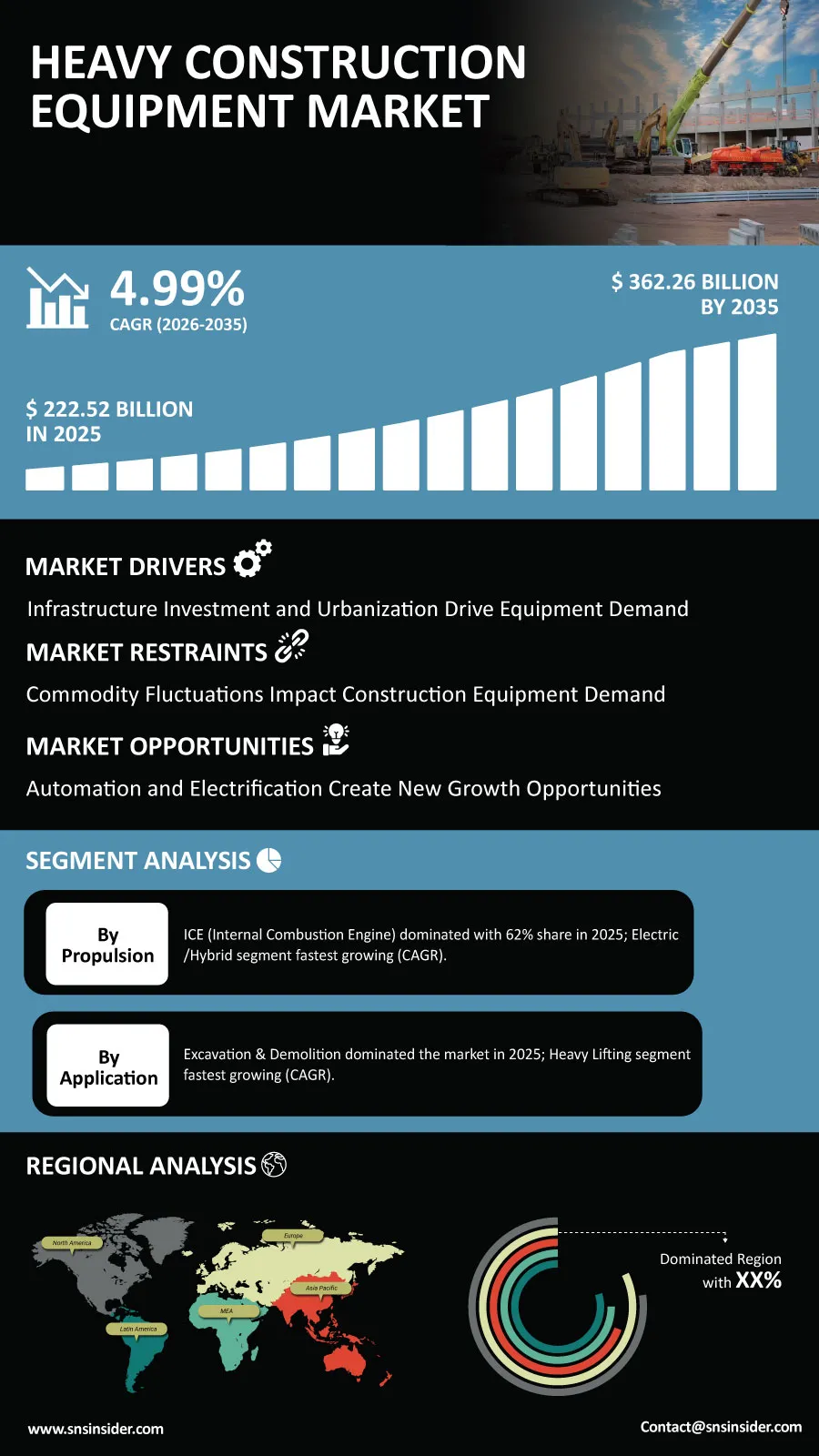
The global Heavy Construction Equipment Market is poised for sustained expansion as governments accelerate infrastructure modernization, mining companies increase capital investments, and contractors adopt advanced machinery to improve project efficiency. “According to a recent study by SNS Insider, the global Heavy Construction Equipment Market size valued at USD 222.52 billion in 2025, is anticipated to grow to USD 362.26 billion by 2035, registering a CAGR of 4.99% over the 2026–2035 forecast period.”
Demand for high-performance equipment continues to rise as transportation corridors, urban developments, industrial facilities, renewable energy projects, and public utilities expand worldwide. Contractors are increasingly investing in technologically advanced machinery capable of delivering higher productivity while reducing fuel consumption, downtime, and operating costs.
At the same time, digital construction practices are transforming equipment utilization. Machine intelligence, telematics, remote diagnostics, and automation are enabling fleet operators to maximize asset performance, improve workplace safety, and enhance project scheduling across complex construction environments.
To Get Detailed Insights on This Market – Request a Sample Report
Infrastructure Modernization and Equipment Innovation Create Long-Term Growth Opportunities
Public infrastructure programs remain one of the strongest catalysts supporting equipment demand across both developed and emerging economies. Major investments in highways, railways, airports, ports, energy facilities, and urban infrastructure continue generating opportunities for equipment manufacturers and rental providers.
Mining expansion is also contributing significantly to market growth as demand increases for critical minerals supporting electric vehicles, renewable energy systems, and digital technologies. Large-scale mining operations require highly durable earthmoving and material-handling equipment capable of operating efficiently under demanding conditions.
Meanwhile, equipment manufacturers are accelerating development of electric, hybrid, and low-emission machinery while integrating artificial intelligence, automation, and predictive maintenance capabilities. These innovations help contractors improve productivity, reduce environmental impact, and optimize lifecycle operating expenses.
Key Market Insights Highlight Changing Equipment Demand
Based on propulsion, Internal Combustion Engine (ICE) equipment accounted for 62% of global market revenue in 2025 due to its proven reliability and broad deployment across construction and mining operations. The Electric/Hybrid segment is projected to record the fastest expansion through 2035 as sustainability initiatives and emissions regulations encourage fleet modernization.
By power output, equipment below 100 HP represented 38% of market revenue in 2025 owing to widespread use in compact construction projects and urban development. Machinery exceeding 400 HP is expected to witness the highest growth during the forecast period as large infrastructure developments and mining projects continue expanding globally.
In terms of engine capacity, the 5–10L category captured 42% of market share in 2025 because of its versatility across multiple equipment types. Engines exceeding 10L are anticipated to grow rapidly as demand rises for high-capacity machinery supporting large-scale industrial and infrastructure applications.
By application, Excavation & Demolition remained the leading segment in 2025, reflecting consistent demand for earthmoving activities across residential, commercial, and public infrastructure projects. Heavy Lifting is forecast to achieve the strongest growth through 2035 as investments increase in high-rise construction, industrial facilities, renewable energy installations, and transportation infrastructure.
Smart Construction Technologies Accelerate Industry Transformation
The heavy construction equipment industry is undergoing a technological shift as digital solutions become central to fleet management and project execution. Connected equipment equipped with GPS, telematics, and real-time performance monitoring allows contractors to optimize machine utilization while reducing maintenance costs and unplanned downtime.
Automation is further reshaping job sites through advanced machine guidance, autonomous operation, and AI-powered site management systems that improve operational precision and enhance worker safety. Manufacturers are also expanding investments in electrified powertrains and alternative fuel technologies to support the industry's transition toward lower-emission construction equipment.
These developments are enabling contractors to complete projects more efficiently while addressing growing environmental and regulatory expectations across global markets.
Europe Accounted for the Leading Market Share in 2025; Asia Pacific Expected to Register the Fastest Growth Through 2035
Europe maintained its leadership position in the global Heavy Construction Equipment Market during 2025, supported by extensive infrastructure modernization initiatives, stringent environmental standards, and widespread adoption of advanced construction technologies. Continued investment in transportation networks, renewable energy facilities, and sustainable urban development is expected to sustain regional demand.
Asia Pacific is projected to remain the fastest-growing regional market through 2035, driven by rapid urbanization, industrial expansion, and substantial government investment in transportation and energy infrastructure. China, India, and Southeast Asian economies continue expanding construction activity, creating significant opportunities for equipment manufacturers and rental service providers.
North America also represents a major growth market, supported by long-term infrastructure renewal, commercial construction, mining activity, and increasing adoption of digitally connected heavy equipment. Meanwhile, the Middle East & Africa and Latin America continue benefiting from large-scale infrastructure developments, mining investments, and urban expansion.
Industry Participants Strengthen Innovation Through Automation and Sustainable Equipment
Competition across the heavy construction equipment industry remains focused on technological advancement, equipment efficiency, and digital fleet solutions. Manufacturers are investing heavily in automation, electrification, hydrogen-powered machinery, and intelligent construction platforms to improve productivity while helping customers reduce operating costs and environmental impact.
Key companies operating in the global Heavy Construction Equipment Market include Caterpillar Inc., Komatsu Ltd., Volvo Construction Equipment, Deere & Company, CNH Industrial N.V., Liebherr Group, Hitachi Construction Machinery Co., Ltd., JCB, Doosan Bobcat Inc., Sany Group Co., Ltd., XCMG Group, Zoomlion Heavy Industry Science & Technology Co., Ltd., Wirtgen Group, Terex Corporation, Sandvik AB, Atlas Copco AB, Manitowoc Cranes, KOBELCO Construction Machinery Co., Ltd., Tadano Ltd., and HD Hyundai Construction Equipment.
An SNS Insider analyst Santosh Bhul commented, "Global infrastructure investment, digital construction technologies, and the transition toward cleaner equipment are reshaping the competitive landscape of heavy construction machinery. Companies that accelerate innovation in automation, connectivity, and sustainable power solutions are expected to strengthen their market position as construction activity continues expanding across both developed and emerging economies."
About the Author

Get in touch




