
Human Growth Hormone Market is entering a new phase of expansion as developments in biopharmaceuticals revolutionize therapies for hormone deficiency conditions and other endocrine disorders. Biopharmaceutical companies are increasingly investing in extended-release products, patient management systems, and biopharmaceuticals in an effort to boost compliance and widen access to treatment.
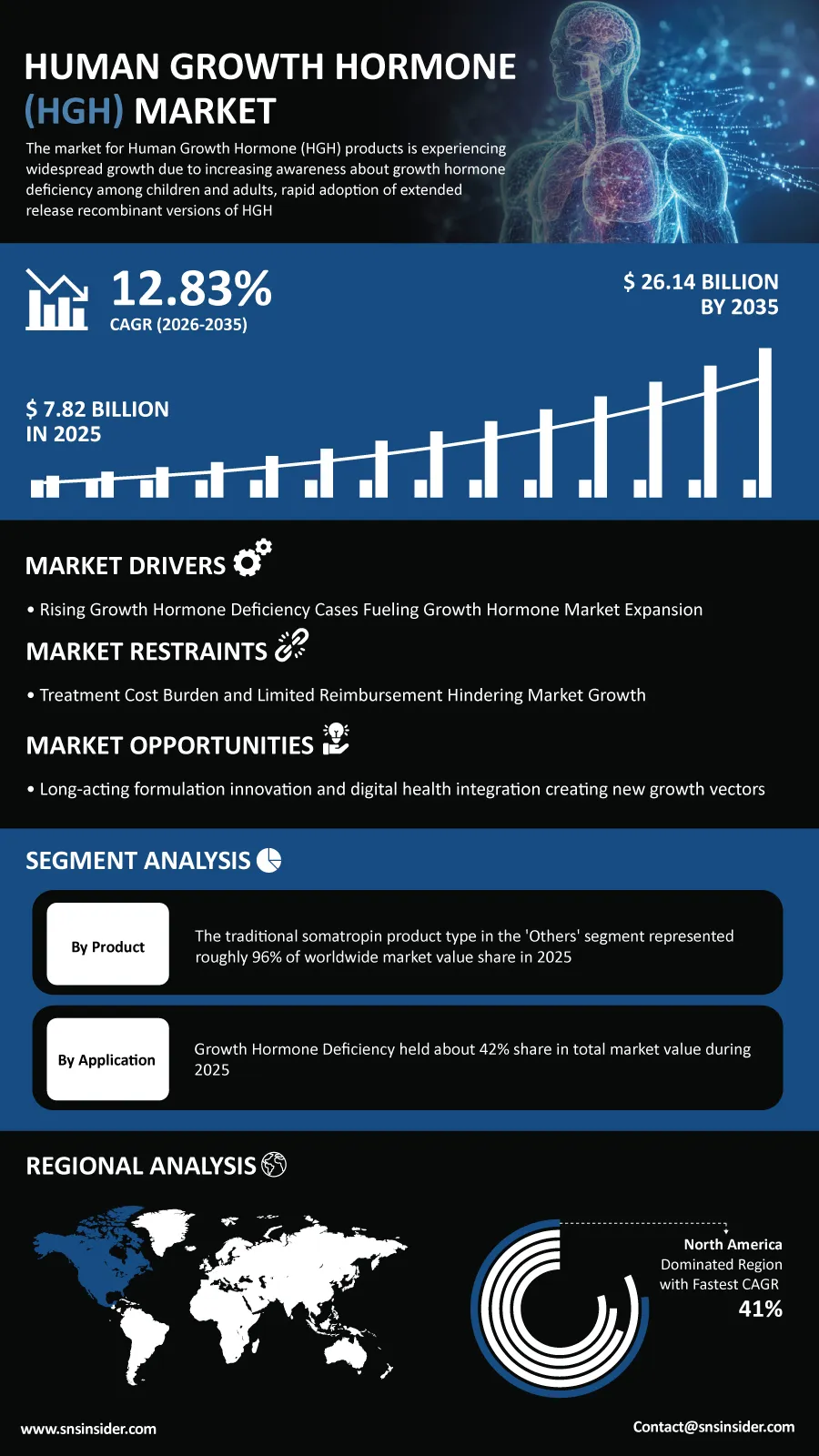
According to a recent study by SNS Insider, the global Human Growth Hormone Market size valued at USD 7.82 billion in 2025, is anticipated to grow to USD 26.14 billion by 2035, registering a CAGR of 12.83% over the 2026–2035 forecast period. Growing awareness of growth hormone deficiency, wider adoption of recombinant therapies, and continued progress in drug delivery technologies are strengthening the market outlook worldwide.
More and more, healthcare practitioners have been able to detect hormone deficiencies sooner due to better diagnostic techniques, while at the same time pharmaceutical companies are creating even more advanced drugs which allow for less frequent dosages, making long-term management of diseases easier.
To Get Detailed Insights on the Human Growth Hormone Market – Request a Sample Report
Long-Acting Therapies Redefine Patient Care
Switching to extended-release products from standard injections is one of the most significant innovations in the industry today. Weekly dosages are minimizing the effort required from both children and adults and enhancing compliance over long-term treatment sessions.
Moreover, integration of technologies into health care is changing the way diseases are managed. The connected delivery systems, remote monitoring, electronic health records, and telemedicine consultations are allowing doctors to monitor patients' progress and develop personalized approaches more effectively. Another innovation, that contributes to improving accessibility through affordable biosimilars, is spreading across different global markets.
Market Segments Highlight Emerging Growth Opportunities
Based on product type, conventional somatropin therapies constituted around 96% of total market revenue in 2025, owing to years of successful use in clinics, and trust placed by physicians in them. In turn, long-acting HGH products are projected to experience the highest growth rate up until 2035, as healthcare practitioners will start relying on therapies that require less frequent administrations.
By application, Growth Hormone Deficiency (GHD) occupied close to 42% of the total market revenue in 2025, remaining the dominant segment in the therapeutics space. Pediatric Growth Hormone Deficiency is expected to deliver the strongest future expansion due to increased awareness of parents about the therapy, school screenings, and innovations in treatment of young patients.
Across distribution channels, hospital pharmacies remained the largest dispensing network in 2025 due to specialist supervision required during treatment initiation and dosage adjustments. Online pharmacies are forecast to achieve the highest growth rate over the coming decade as digital prescription services, telehealth adoption, and direct-to-patient delivery models continue expanding globally.
Innovation and Digital Health Strengthen Competitive Advantage
The competition in the HGH sector is gradually shifting towards patient convenience, product differentiation, and better results. The pharmaceutical companies are focusing on developing highly sophisticated systems for delivering their products. Auto-injectors and devices that work without needles are some examples of such systems.
The other benefit of this industry is that there are increased uses of artificial intelligence and electronic medical records in diagnosing the hormones deficiency early enough. Such innovations make it possible for doctors to diagnose the right candidates in an easier way.
Regional Markets Continue to Expand
The North American region is still the biggest market in the year 2025 accounting for about 41% of the global market revenue. Factors such as well-established reimbursement mechanisms, solid endocrinology network, and constant product innovations have enabled this trend. In North America, the US accounted for about 78% of the regional revenue. In 2025, the US Human Growth Hormone Market was valued at USD 3.06 billion. This market is expected to grow and reach USD 9.74 billion by 2035, recording a CAGR of 12.28%.
The Asia-Pacific region is expected to record the highest regional growth rate due to increased investments in health care facilities, expansion of the biosimilar production industry and increasing awareness of endocrine diseases. The region of China contributed about 42% of the regional revenue.
In other regions, Germany made up 28% of the market revenue in Europe, Brazil accounted for 54% of Latin America's market, and Saudi Arabia was responsible for 34% of Middle East and Africa's revenue.
Industry Leaders Advance Next-Generation Therapies
The competitive landscape continues to evolve as manufacturers accelerate research into extended-duration formulations and patient-focused treatment technologies. During 2026, several biotechnology companies progressed long-acting HGH candidates into late-stage clinical development while telemedicine-based hormone management platforms expanded across North America and Europe.
In March 2025, Novo Nordisk A/S received FDA approval for a once-weekly long-acting HGH therapy, strengthening innovation within the category. During the same year, Pfizer Inc. and OPKO Health reported positive Phase III clinical results for somatrogon in pediatric growth hormone deficiency, reinforcing confidence in long-acting treatment approaches.
Major companies operating in the global Human Growth Hormone Market include Novo Nordisk A/S, Pfizer Inc., Eli Lilly and Company, Merck KGaA, Genentech Inc., Ferring Pharmaceuticals, Teva Pharmaceutical Industries Ltd., Sandoz International GmbH, Ipsen S.A., Anhui Anke Biotechnology (Group) Co. Ltd., Ascendis Pharma A/S, GeneScience Pharmaceuticals Co., Ltd., LG Chem, F. Hoffmann-La Roche Ltd., Merck Serono, Novartis AG, Theratechnologies Inc., Biopartners GmbH, LifeTein LLC, and Versartis, Inc.
An SNS Insider analyst Parry Kardani commented, "The Human Growth Hormone market is transitioning from traditional replacement therapy toward a more patient-centric model built around long-acting biologics, digital health integration, and improved treatment accessibility. Companies that successfully combine clinical innovation with convenient delivery technologies are expected to strengthen their competitive position as demand for endocrine therapies continues to expand globally."
About the Author

Get in touch




