
The Hyaluronidase Market is increasingly being recognized for its strategic importance in today’s healthcare environment due to innovations in the area of biologic drugs and continued expansion of aesthetic medicine. The enzyme is growing in significance not just for delivering treatments better but also to ensure patient safety during cosmetic treatments, thereby ensuring the future success of the market.
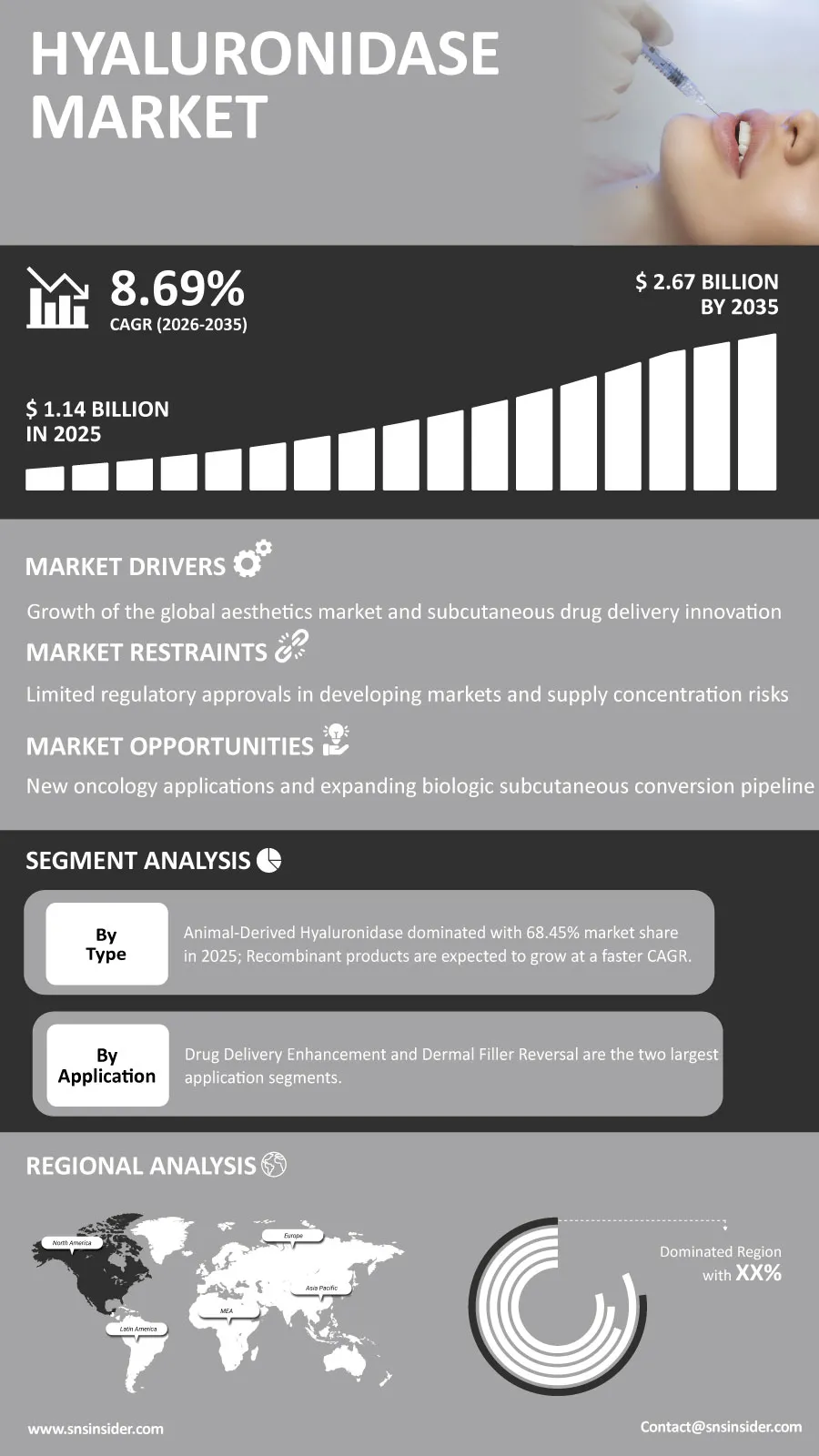
According to a recent study by SNS Insider, the global Hyaluronidase Market size valued at USD 1.14 billion in 2025, is anticipated to grow to USD 2.67 billion by 2035, registering a CAGR of 8.69% over the 2026–2035 forecast period. Increasing preference for minimally invasive cosmetic surgeries, increasing popularity of biological drugs, and advancements in the field of recombinant enzymes have opened up new avenues for companies catering to pharmaceuticals and aesthetics sectors.
The demand for effective drug delivery systems is driving healthcare professionals to use systems that not only save time but increase the convenience for the patients. At the same time, aesthetic specialists are now keeping hyaluronidase preparations as an indispensable part of patient safety protocol measures.
To Get Detailed Insights on the Hyaluronidase Market – Request a Sample Report
Drug Delivery Innovation Creates New Commercial Opportunities
Drug manufacturers are now increasingly incorporating hyaluronidase in conjunction with more sophisticated biological drugs, simplifying the process of drug administration and making it easier for patients. The capability to help in the subcutaneous administration of drugs that have previously been administered using the time-consuming process of intravenous infusion is revolutionizing treatment procedures while ensuring better efficiency in healthcare delivery.
The other factor that is contributing to the growth of this market is the increasing popularity of minimally invasive cosmetic surgery procedures, where hyaluronidase proves to be very useful in reversing the effects of hyaluronic acid fillers, if needed by the patient.
Market Segments Highlight Diverse Growth Potential
By the type, animal-derived hyaluronidase dominated the market with a share of 68.45% in 2025 due to its established usage in clinical practice and easy availability. Recombinant hyaluronidase is expected to grow at a higher rate than the former through 2035 due to increasing preference of pharmaceutical companies for highly consistent and advanced biologic formulation.
By application, drug delivery enhancement and dermal filler reversal emerged as the leading sources of revenue generation in 2025 due to growing number of biologic drugs driving drug delivery applications and increasing aesthetic treatments driving dermal filler reversals.
By the end user, hospitals emerged as the leading purchasers of the product due to its extensive usage in oncology and surgery treatments. The aesthetic clinics are projected to witness fastest growth in the coming years due to increasing preference of non-invasive aesthetic procedures across the world. Oncology is expected to become another important area of application with increasing number of biologic drugs being administered subcutaneously.
Clinical Advancements Strengthen Market Outlook
Technology developments have been changing the competitive environment as well because companies continue concentrating on new recombinant compounds providing better purity, consistency, and lower immunogenicity than conventional products. The above-mentioned technology developments help pharmaceutical companies gain more confidence in developing new generations of biologics.
On the other hand, industry participants are making strategic partnerships which involve hyaluronidase and innovative platforms for medicine administration. Future regulatory approvals of new combination biologics will increase the use of the enzyme in several therapeutic areas.
Regional Markets Maintain Strong Growth Momentum
The presence of established pharmaceutical research and development, along with a developed aesthetic medicine market made North America the leading regional market in 2025, which was further expected to be emphasized by expansion into biologics discovery and development in this region. The US amounted to about 80% of regional revenue. The U.S. Hyaluronidase market was valued at USD 0.325 billion in 2025 and is predicted to be worth USD 0.758 by 2035, growing at a CAGR of l8.80%.
As cosmetic procedural volumes expand in South Korea, China, Japan and other emerging healthcare markets, Asia Pacific is expected to exhibit the fastest regional growth through 2035. South Korea accounted for around 30 percent of regional revenue, underscoring its global lead in aesthetic medicine.
In Europe, the UK represented around one-third 29% of regional revenue due to a strong pharmaceutical pipeline and increased uptake of biologics therapies. Brazil accounted for about 52% of Latin American revenues, and the United Arab Emirates represented around 38% share in the Middle East & Africa, supported by increasing investment in aesthetic healthcare and medical tourism.
Industry Leaders Accelerate Product Development
The competitive environment keeps changing, given that the pharmaceutical industry is continuously developing its biologic drug delivery systems, manufacturing processes, and innovative recombinant techniques. Examples of such achievements are the FDA approval of the subcutaneous formulation Tecentriq Hybreza by Roche in September 2024, using recombinant hyaluronidase technology, and the FDA approval of SKINVIVE by JUVÉDERM in 2023.
Major companies operating in the global hyaluronidase market include Halozyme Therapeutics Inc., Sun Pharmaceutical Industries, PriMed Pharma, CoLucid Pharmaceuticals, Amphastar Pharmaceuticals, Ethex Corporation, Anika Therapeutics Inc., Bioregen Biomedical, VWR International, Merz Aesthetics, Galderma S.A., Allergan Aesthetics (AbbVie), Roche Holding AG, Pfizer Inc., and Johnson & Johnson.
An SNS Insider analyst Parry Kardani commented, "The hyaluronidase market is evolving beyond its traditional clinical applications as pharmaceutical innovation and aesthetic medicine continue advancing simultaneously. Organizations that combine recombinant technology expertise, strategic biologic partnerships, and expanding clinical applications are expected to strengthen their competitive position as demand for efficient drug delivery and minimally invasive healthcare solutions continues to grow.
About the Author

Get in touch




