
The latest report by SNS Insider Instrument Cluster Market states that the global market is growing steadily as automakers replace analog gages with digital and hybrid displays. Now drivers want clear, screen-based information about speed, range, navigation and safety alerts. Car makers see the cluster as part of the cabin design, not just part of the dash.
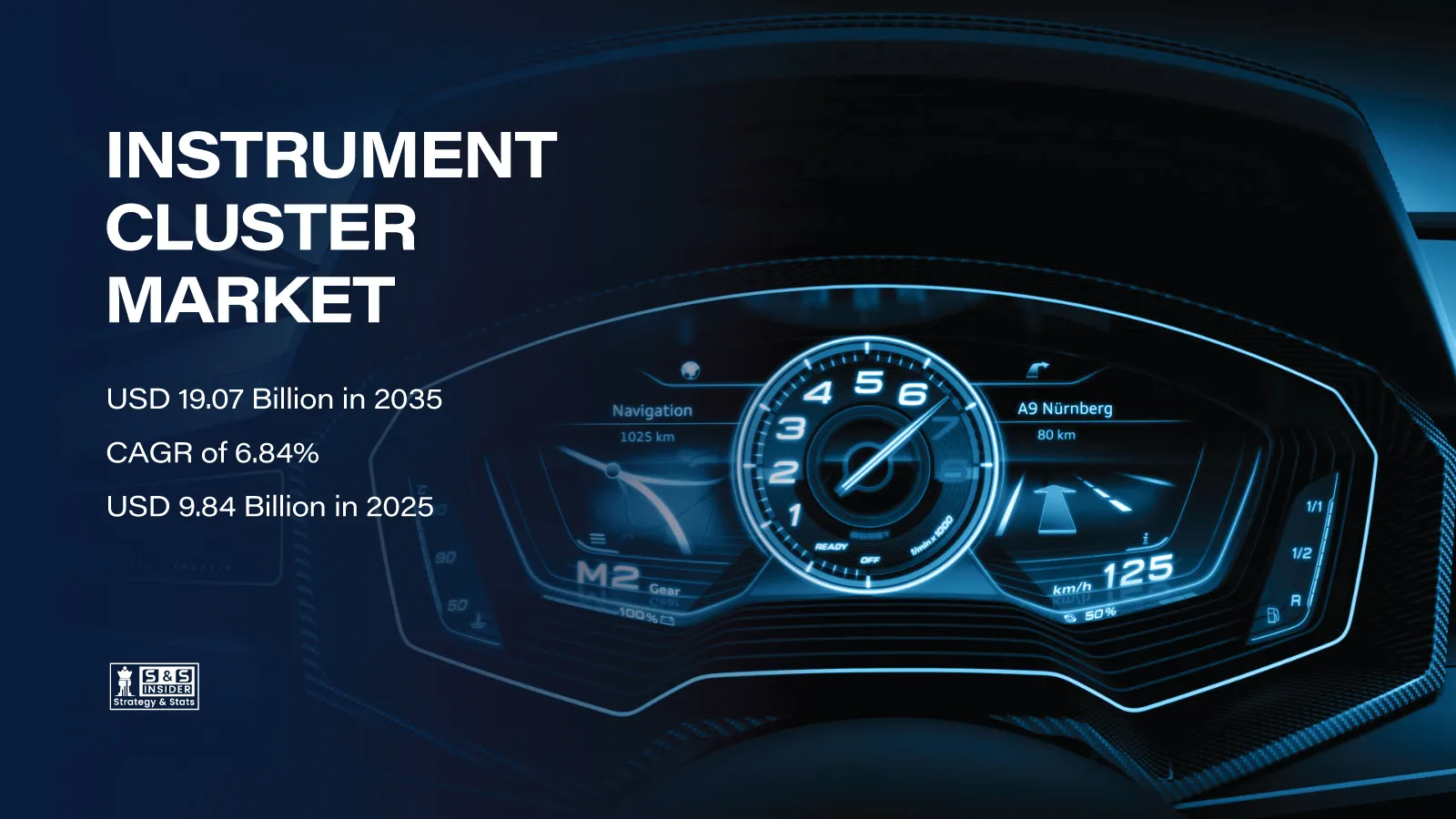
The global instrument cluster market was valued at USD 9.84 Billion in 2025 and is estimated at USD 10.51 Billion in 2026. It is projected to reach USD 19.07 Billion by 2035, growing at a CAGR of 6.84% during 2026–2035.
Hybrid clusters lead the market today because they mix physical gauges with a digital screen at a moderate cost. Fully digital clusters are growing faster as screen prices fall and more vehicles share one computer across the cabin.
Electric vehicles add steady demand, since drivers need clear battery, range, and charging information. New safety rules in Europe, China, and Japan also require vehicles to show more warnings and driver-attention alerts on the cluster.
Asia Pacific is both the largest and the fastest growing region, supported by high vehicle production in China, India, Japan, and South Korea.
To Get Detailed Insights on the Instrument Cluster Market – Request a Sample Report
Demand Drivers and Constraints
Primary Demand Drivers
-
Shift to digital and hybrid clusters: Automakers are replacing analog dials with screens that can show more information and be updated over time.
-
Rising vehicle production: Global output reached about 96.40 million units in 2025, which keeps demand for clusters high across all vehicle classes.
-
Electric vehicle growth: More than 20 million electric vehicles were sold in 2025, and each one needs a display for range, battery, and charging data.
-
Safety and driver-attention rules: The EU General Safety Regulation and China's GB 47955-2026 standard require clear warnings and driver monitoring alerts.
-
Better display technology: OLED panels, curved screens, and head-up displays give automakers new ways to present information to drivers.
Potential Growth Constraints
-
Higher memory chip costs and steady price pressure from automakers.
-
Euro NCAP scoring that rewards physical controls over screen-heavy cabins.
-
Some premium brands reducing display sizes in new models.
-
Tariffs on imported display panels and chips.
-
Long qualification cycles of two to three years for new suppliers and parts.
Demand Structure by Cluster Type
Hybrid Cluster (2025 Market Share: 44.60%)
In 2025, hybrid clusters accounted for 44.60% of the instrument cluster market. They combine physical gages with a central digital display, giving drivers familiar dials and modern information in one unit. It is cheaper than a full digital cluster and therefore is suited to mid-range cars and high volume models. Hybrid clusters are used to add features without a significant increase in vehicle prices in price-sensitive markets. These cars are a huge part of worldwide production and demand stays steady.
Current trend: Wider use of larger center screens inside hybrid cluster designs.
Major trends: Mid-range vehicle upgrades, cost-optimized displays, modular cluster platforms, and software-based gauge graphics.
Digital Cluster (Forecast CAGR: 8.46%)
Digital clusters are projected to grow at a CAGR of 8.46% through 2035. A fully digital cluster replaces every dial with a screen, so automakers can change the layout, add maps, or show safety alerts as needed. Falling screen prices make these clusters practical for more vehicle classes. Many new electric vehicles use digital clusters as standard because they fit a clean, screen-based cabin. Software updates also let automakers add features after the vehicle is sold.
Current trend: Fully digital clusters becoming standard in new electric and mid-range vehicles.
Major trends: Reconfigurable layouts, over-the-air updates, cockpit domain controllers, and integrated navigation views.
Demand Structure by Display Technology
TFT LCD (2025 Market Share: 58.80%)
TFT LCD panels held a 58.80% share in 2025. They are reliable, ubiquitous and cheaper than newer display types, so they are the default in most vehicles. Suppliers have years of experience producing these panels for automotive purposes, including heat and vibration testing. Automakers have lots of factories to source them from, so the risk of supply is low. These strengths keep TFT LCD at the center of cluster production in the mass-market models.
Current trend: Continued use of TFT LCD panels in high-volume vehicle programs.
Major trends: Higher resolution panels, improved sunlight readability, wider screen formats, and lower power use.
OLED (Forecast CAGR: 9.12%)
The OLED displays are expected to grow at a CAGR of 9.12% till 2035. They offer more contrast, thinner panels and flexible shapes, so designers can create curved clusters that follow the dashboard. OLEDs are being adopted first by premium automakers and costs should fall with higher production. In April 2026, Aumovio announced an order for a series of OLED displays with under-display camera from a European premium car maker. Such orders demonstrate how OLED is making its way into production cars.
Current trend: Premium automakers adopting OLED clusters with curved and integrated designs.
Major trends: Curved panels, under-display cameras, flexible OLED, and pillar-to-pillar screens.
Demand Structure by Vehicle Type
Passenger Cars (2025 Market Share: 56.40%)
In 2025, passenger cars held 56.40% of the instrument cluster market. They account for the majority of the world’s vehicle production, and today almost every new car has a digital or hybrid cluster. The automakers are marketing the cluster as a selling point, since buyers compare cabin screens when they shop for a car. Electric cars add another layer of demand, as they require clear information about range and charging. "This segment is expected to remain the largest through 2035, supported by ongoing model refreshes and steady auto sales."
Current trend: Larger and more connected clusters in new passenger car models.
Major trends: Integrated cockpit screens, EV-specific displays, driver monitoring alerts, and head-up displays.
Two-Wheelers (Forecast CAGR: 7.64%)
Two-wheelers are projected to grow at a CAGR of 7.64% through 2035. Motorcycle and scooter makers are adding digital clusters with phone connectivity, turn-by-turn navigation, and battery data for electric models. Demand is strongest in India and Southeast Asia, where two-wheelers are a main form of transport. Electric scooters in particular use digital screens as standard. Local suppliers are building new capacity to serve this growing demand.
Current trend: Rapid adoption of connected TFT clusters in motorcycles and electric scooters.
Major trends: Bluetooth connectivity, navigation displays, electric two-wheeler dashboards, and compact TFT screens.
Key Market Participants
The instrument cluster market includes automotive electronics suppliers, display module makers, and cockpit system providers.
Key participants include Aumovio, DENSO, Visteon, Nippon Seiki, Bosch, Marelli, Panasonic Automotive Systems, Hyundai Mobis, Desay SV, Pricol, and Minda Corporation.
Competition centers on display quality, cockpit software, cost control, and long-term supply contracts with automakers. Suppliers that can offer integrated cockpit controllers, reliable displays, and support for safety rules are well placed to win new vehicle programs.
Regional Market Dynamics
Asia Pacific (2025 Market Share: 46.20%; Forecast CAGR: 8.02%)
Asia Pacific accounted for the largest share of 46.20% in the global instrument cluster market in 2025 and is estimated to grow at the fastest CAGR of 8.02% during 2025-2035. China is the biggest source of new demand for digital clusters supported by high sales of electric vehicles and local cockpit suppliers. China’s GB 47955-2026 standard effective early 2027 adds driver monitoring requirements. Japan to mandate camera-based driver monitoring in new cars from 2031 India brings demand with two-wheeler, passenger car sales.
Direction: Continued leadership and fastest growth supported by vehicle production, electric vehicles, and new safety standards.
North America (2025 Market Share: 28.40%)
North America held a 28.40% share in 2025. The United States is the leading country market, valued at USD 2.40 Billion in 2025 and projected to grow at a CAGR of 6.42%. Pickup trucks and SUVs with large digital clusters support demand. Tariffs on imported panels and chips raise costs, and NHTSA's proposed exemptions for automated vehicles add some uncertainty about future cabin designs.
Direction: Stable growth supported by large vehicles with advanced digital displays.
Europe (2025 Market Share: 16.80%)
Europe held a 16.80% market share in 2025 and is expected to witness a growth over the forecast period. Germany, United Kingdom, France, Italy, and Spain are the key markets in the region. The second phase of the EU General Safety Regulation requires more driver warnings, which increases the role of the cluster. Euro NCAP, however, rewards physical controls as well, so some automakers are balancing screens with buttons. Premium brands still cling to OLED and curved displays.
Overall, the instrument cluster market is set for steady growth through 2035, and suppliers will compete mainly on display quality, cockpit software, cost control, and support for new safety rules.
About the Author

Get in touch




