
The latest SNS Insider Mobile Robots Market report shows the global market is growing rapidly. As it becomes harder and more expensive to find and keep workers, manufacturers, logistics operators and retailers are deploying robots to move goods. Mobile robots are no longer pilot projects. They now run full shifts in many plants and fulfillment centers.
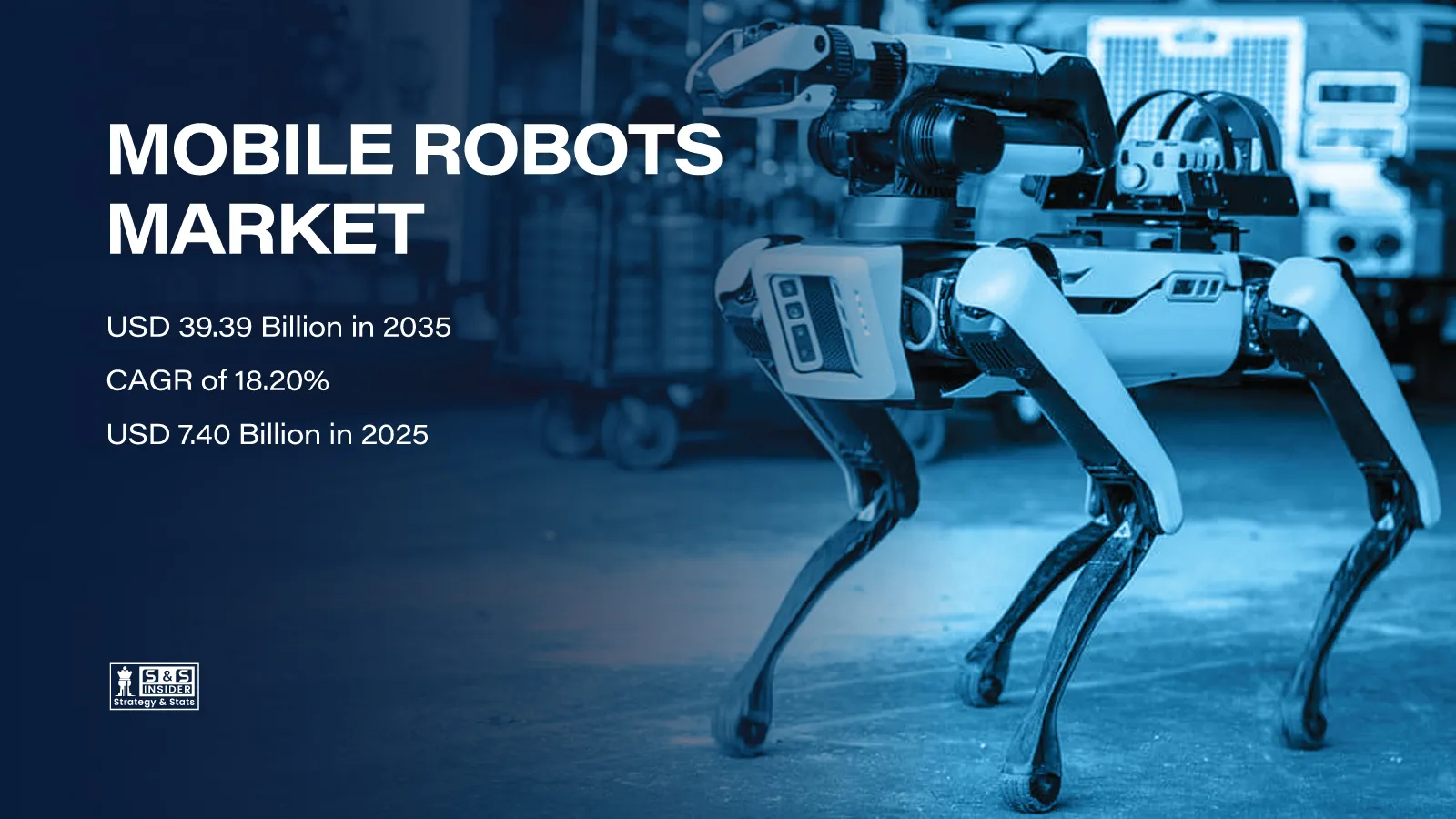
The global mobile robots market size was valued at USD 7.40 Billion in 2025 and is estimated at USD 8.75 Billion in 2026. It is expected to reach USD 39.39 Billion by 2035, growing at a CAGR of 18.20% during 2026–2035.
The market leaders are autonomous mobile robots, which can find their own way and do not need fixed tracks. Mobile manipulators, which pick and carry things, are the fastest growing, combining a mobile base with a robotic arm.
Manufacturing is still the largest user, but warehousing and logistics are the fastest-growing as Internet orders rise. Better AI, vision and navigation software make robots easier to deploy and safer to run next to humans.
Asia Pacific is both the largest and the fastest-growing region, supported by large factory bases and government automation programs in China and other countries.
To Get Detailed Insights on the Mobile Robots Market – Request a Sample Report
Demand Drivers and Constraints
Primary Demand Drivers
-
Labor shortages and rising wages: Companies use robots to fill hard-to-staff roles and keep output steady when workers are scarce.
-
E-commerce and omnichannel fulfillment: More online orders and faster delivery promises push warehouses to automate picking and transport.
-
Advances in AI, vision, and navigation: Smarter software lets robots work in busy spaces and shortens setup time.
-
Government automation programs: National industrial plans in Asia Pacific and the Middle East support robot adoption in factories.
-
Robots-as-a-service models: Subscription pricing lowers upfront spending and makes robots practical for smaller operators.
Potential Growth Constraints
-
High upfront purchase and system integration costs.
-
Cyclical capital spending and trade uncertainty.
-
Changing safety standards and regulatory requirements.
-
Vendor consolidation and rising import costs.
-
Difficulty connecting robots from different suppliers.
Demand Structure by Type
Autonomous Mobile Robots (2025 Market Share: 51.20%)
Autonomous mobile robots held 51.20% of the global mobile robots market in 2025. They use sensors and onboard software to plan their own paths, so they don’t need floor tape, magnets or fixed routes. This makes them easy to install in existing buildings and easy to relocate when layouts change. Factories use them to transport parts from line to line . Warehouses use them to transport goods to pickers .Their flexibility and short setup time keep them the most popular choice among buyers.
Current trend: Replacement of fixed-path vehicles with free-navigating robots in mixed work areas.
Major trends: Fleet management software, goods-to-person systems, shared traffic control, and people-aware navigation.
Autonomous Mobile Manipulators (Forecast CAGR: 26.80%)
Autonomous mobile manipulators are projected to grow at a CAGR of 26.80% during 2026–2035, the fastest rate by type. These robots are an arm on a moving base so you can have one machine that travels, picks and places. This removes a manual step that other robots still need to do. They are used by buyers for machine tending, order picking and handling parts in laboratories. Grippers and vision systems are getting better, and more and more tasks that once required a person can now be automated.
Current trend: Growing use of robots that both move and handle items in one unit.
Major trends: Vision-guided picking, collaborative arms, flexible grippers, and humanoid platforms for logistics.
Demand Structure by Component
Hardware (2025 Market Share: 66.80%)
Hardware held a share of 66.80% in 2025 in terms of revenue. Each robot needs a chassis, motors, batteries, sensors, cameras and controllers, and these account for most of the purchase price. Large fleet orders from manufacturers and logistics companies keep hardware spending high. Buyers also replace batteries and sensors over the life of each robot. As fleets grow from a few units to hundreds, hardware remains the largest share of total spending.
Current trend: Larger fleet orders with standardized robot platforms.
Major trends: Lidar and 3D vision sensors, fast-charging batteries, modular chassis, and higher payload designs.
Software (Forecast CAGR: 22.30%)
Software is expected to expand at a CAGR of 22.30% through 2035. Fleet management, route planning, and warehouse system integration decide how much value a robot fleet delivers. Buyers now judge suppliers on software as much as on the machines. AI models help fleets avoid traffic jams and share work across robots. Subscription licenses also create recurring revenue for vendors and lower the entry cost for customers.
Current trend: Shift of buyer focus toward fleet intelligence and system integration.
Major trends: AI fleet models, cloud-based monitoring, interoperability standards, and subscription licensing.
Demand Structure by Payload Capacity
100 to 500 kg (2025 Market Share: 47.30%)
Robots with a payload of 100 to 500 kg represented 47.30% of the market in 2025. This range covers most totes, carts, shelves, and small pallets moved in factories and warehouses. These robots are compact enough to work in narrow aisles and strong enough for most daily loads. Because they fit so many tasks, buyers often pick them as a first step into automation. Steady demand from electronics, automotive parts, and retail logistics supports this class.
Current trend: Wide use of mid-payload robots for cart and shelf transport.
Major trends: Shelf-lifting robots, cart towing, compact designs, and multi-purpose top modules.
Above 1,000 kg (Forecast CAGR: 21.50%)
Robots with a payload capacity of more than 1,000 kg are expected to grow at a CAGR of 21.50% from 2026 to 2035. Automotive, metals and heavy manufacturing plants have to move full pallets, engines and large assemblies. Users turn to autonomous options due to forklift driver shortages, safety issues. Heavy-duty robots also cut damage to goods and buildings caused by manual handling. Better safety sensors are making these large machines practical in shared work areas.
Current trend: Automation of pallet and heavy-load movement in large plants.
Major trends: Autonomous forklifts, heavy-duty platforms, advanced safety scanners, and outdoor yard operation.
Demand Structure by End Use
Manufacturing (2025 Market Share: 48.50%)
Manufacturing was the largest end use in 2025, representing 48.50% of global market revenue. Mobile robots are used in plants to transport raw materials, parts and finished goods between storage areas and production lines. Smooth material flow decreases line stoppages and frees workers for skilled tasks. The main buyers are automotive, electronics and consumer goods manufacturers. Continued factory upgrades and labor shortages will support demand.
Current trend: Connecting robot fleets with production planning systems.
Major trends: Line-side delivery, just-in-time supply, machine tending, and smart factory integration.
Warehousing and Logistics (Forecast CAGR: 21.90%)
Warehousing and logistics is projected to register the highest end-use CAGR of 21.90% through 2035. The growth of e-commerce has led to higher order volumes and shorter delivery times, putting pressure on manual picking. Robots deliver goods to workers, sort parcels and move pallets around the clock. Third-party logistics providers like these systems because they can grow or shrink fleets depending on seasonal demand. “It’s easier for mid-sized operators to adopt subscription models.”
Current trend: Rapid automation of fulfillment and parcel sorting operations.
Major trends: Goods-to-person picking, robotic sortation, robots-as-a-service, and humanoid robot trials.
Key Market Participants
The mobile robots market includes specialist robot makers, industrial automation companies, and large logistics technology providers.
Key participants include Geekplus, Hai Robotics, Locus Robotics, Mobile Industrial Robots, KUKA, Seegrid, BALYO, Rockwell Automation, Hikrobot, AutoStore, Boston Dynamics, Agility Robotics, Amazon Robotics, Symbotic, Daifuku, and Vecna Robotics.
Competition focuses on fleet software, ease of deployment, payload range, and flexible pricing. Suppliers that can show a clear return on investment at fleet scale and connect easily with existing warehouse systems are well placed to win large contracts.
Regional Market Dynamics
North America (2025 Market Share: 25.00%)
North America held a 25.00% share of the global market in 2025. The United States accounts for 85.00% of regional demand. U.S. Market was valued at USD 1.57 Billion in 2025 and is expected to grow at a CAGR of 17.10%. Big e-commerce and 3PL companies are deploying robots throughout their fulfillment networks. High labor costs and strong venture funding for robotics companies also drive growth.
Direction: Steady growth led by fulfillment automation and fleet-scale deployments.
Europe (Second-Largest Regional Market, 25.60%)
Europe was the second largest regional market in 2025 with a share of 25.60%. Germany remains the largest consumer with 24.60% of regional demand, thanks to its large automotive and machinery sectors. Manufacturers and retailers are looking to automation to address worker shortages and high wages. Robots are built and certified under strict safety rules . Grocery and fashion retailers are also investing in automated warehouses.
Direction: Stable expansion supported by industrial automation and retail logistics investment.
Asia Pacific (2025 Market Share: 41.80%; Forecast CAGR: 20.20%)
The Asia Pacific market led with a 41.80% share in 2025 and is projected to register the fastest growth at a CAGR of 20.20% through 2035. China accounts for 58.40% of the region’s demand, aided by a large base of factories, domestic robot makers and national automation goals. Japan and South Korea have aging workforces, prompting a need for robots. India and Southeast Asia are building new warehouses and factories that are often designed with automation in mind from the start.
Direction: Leading and fastest-growing region, driven by manufacturing scale and government support.
Overall, the mobile robots market is set for strong growth through 2035, with success depending on fleet software, easy integration, flexible pricing, and proven return on investment.
About the Author

Get in touch




