
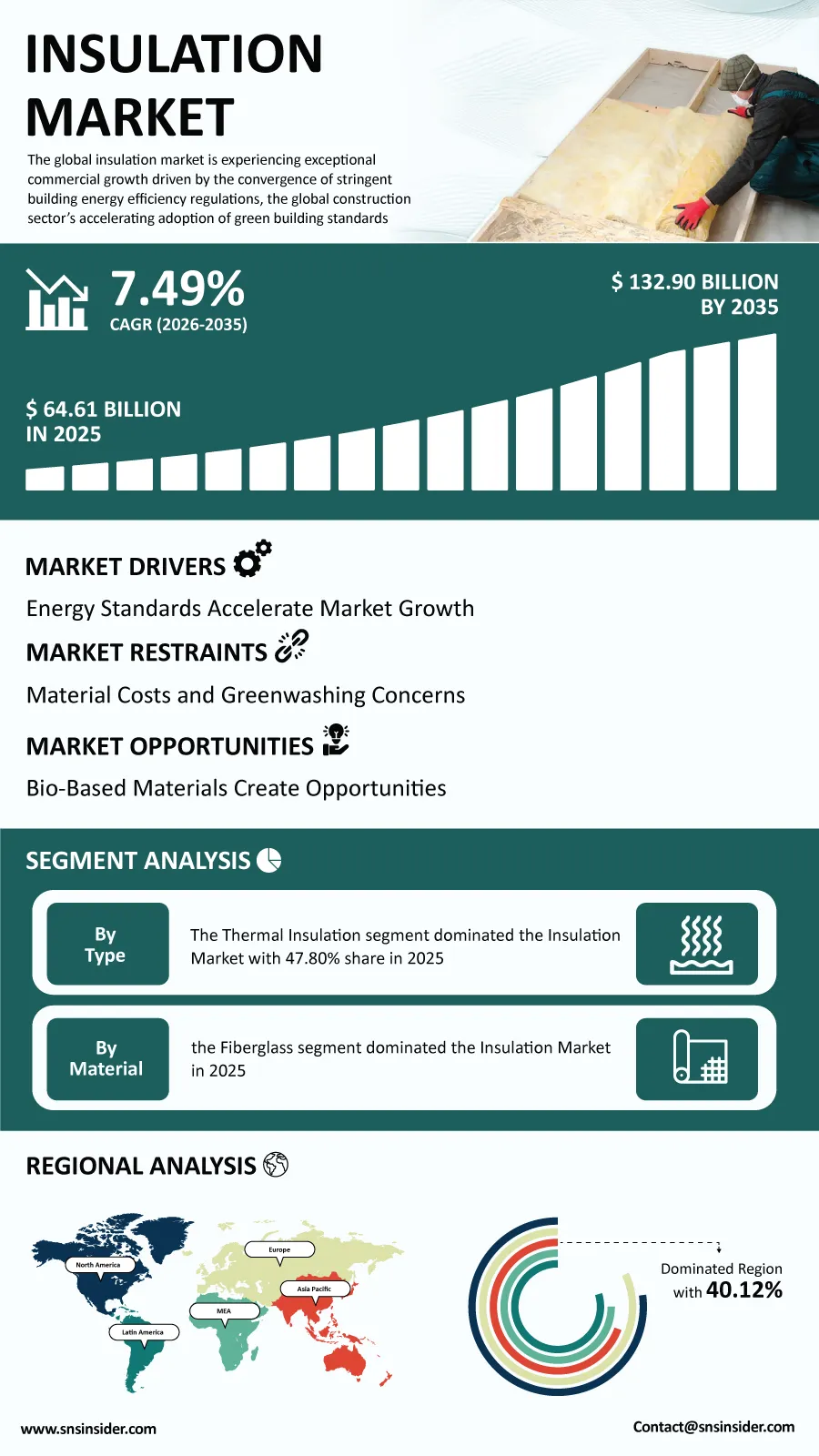
The global Insulation Market is expected to witness robust expansion over the next decade as governments, developers, and industrial manufacturers intensify efforts to improve energy efficiency and reduce carbon emissions across residential, commercial, and industrial infrastructure. “According to a recent study by SNS Insider, the global Insulation Market size valued at USD 64.61 billion in 2025, is anticipated to grow to USD 132.90 billion by 2035, registering a CAGR of 7.49% over the 2026–2035 forecast period.”
Increasing investment in sustainable construction projects, energy-efficient building codes, and higher demand for high-performance thermal insulation materials have transformed the insulation industry. Owners of buildings are focusing on insulations that help save energy as well as enhance the comfort levels of occupants, making insulations a critical part of infrastructure development plans.
Outside of the construction industry, the electrification of transport, manufacturing processes, and industries has provided a new avenue for developing advanced insulations. Companies are developing materials that provide better thermal insulation, fire, moisture resistance, and acoustic properties.
To Get Detailed Insights on the Insulation Market – Request a Sample Report
Sustainable Construction and Energy Efficiency Continue to Drive Market Opportunities
Globally, governments are enhancing efficiency standards of buildings and launching incentives programs aimed at promoting energy-efficient renovation activities and sustainable building processes. The trends are boosting insulation usage in both new constructions and renovations to minimize operational costs of property owners and adhere to stricter environmental laws.
The popularity of modular building and prefab solutions is driving market growth by raising demand for insulation solutions facilitating easy installation and improving structural efficiency of buildings. In addition, companies are developing recyclable, biodegradable, and low-carbon emitting insulation solutions to achieve sustainability goals in the construction industry around the world.
At the same time, the rise in the production of electric vehicles is contributing to the demand for specific insulation solutions used for better battery performance, comfort of passengers, and fire protection in new cars.
Key Market Insights Highlight Shifting Demand Patterns
By type, thermal insulation would contribute 47.80% towards total market value by 2025, as thermal insulation is widely used in all kinds of applications where there is a need for energy savings. The acoustic insulation segment would grow at the fastest pace up till 2035, at a CAGR of 9.20%, owing to increased use in urban developments and transportation systems.
Based on material, fiberglass is expected to remain the market leader in 2025 owing to its economic viability, robustness, and proven use in several industries. On the other hand, polyurethane foam is projected to experience rapid growth as the fastest growing segment in the market fueled by rising demand for effective insulating materials.
By end user, the segment of building and construction industry will account for 52.10% of total market revenue by 2025 owing to increased efforts by the government towards developing energy efficient infrastructure. It has been observed that the transport industry would see the maximum growth with a CAGR of 8.80% by 2035 due to growing electric vehicles manufacturing and thermal management demands in various segments.
Product Innovation and Advanced Materials Shape Industry Growth
Manufacturers are stepping up their investments in cutting-edge insulation technology that not only offers better thermal performance but also meets the growing environmental and safety concerns. The use of high-end mineral wool, advanced polyurethane compounds, aerogel insulation, and recycled insulation materials is becoming more common for premium construction and industrial applications.
In addition, technological advancements in the manufacturing processes and material science are helping manufacturers in providing higher consistency in their products and ease of installation. Moreover, increasing focus on the concept of a circular economy is also leading to the design of insulation materials that offer both energy efficiency and reduced environmental footprint.
Asia Pacific Dominates with 40.12% Revenue Share as North America Records 8.63% CAGR by 2035
The Asia Pacific region will contribute to the overall revenue of the global market by making up more than 40.12% of the total market revenue in 2025 owing to urbanization, increase in construction, and stricter building energy requirements across prominent countries in the region.
North America will register as the fastest-growing regional market, recording a growth rate of 8.63% CAGR from 2020 to 2035. The favorable market environment will be fueled by supportive policies for energy-efficient renovations, investments in sustainable construction, and adoption of advanced insulation materials.
As countries continue implementing ambitious carbon reduction strategies, insulation materials are expected to play an increasingly important role in improving building performance and supporting long-term sustainability objectives.
Industry Participants Focus on Sustainable Innovation
Competition within the insulation market continues to intensify as manufacturers expand production capacity, introduce environmentally responsible products, and strengthen research and development capabilities. Companies are focusing on improving thermal performance, fire safety, durability, and recycled content while responding to changing customer expectations and evolving regulatory requirements.
Key companies operating in the global Insulation Market include Rockwool International, Saint-Gobain, Kingspan Group, Johns Manville, BASF, DuPont, Knauf Insulation, GAF Materials Corporation, Huntsman International, Armacell International, Covestro, URSA, Recticel, Atlas Roofing Corporation, Carlisle Companies, Cellofoam North America, OC Fiberglas, Paroc Group, Isover, and Owens Corning.
An SNS Insider analyst Sushant Kadam commented, “The insulation industry is benefiting from the convergence of energy efficiency regulations, sustainable construction practices, and expanding industrial applications. Companies that continue investing in high-performance materials, environmentally responsible manufacturing, and innovative thermal management technologies will be well positioned to capitalize on the market's long-term growth opportunities.”
About the Author

Get in touch




