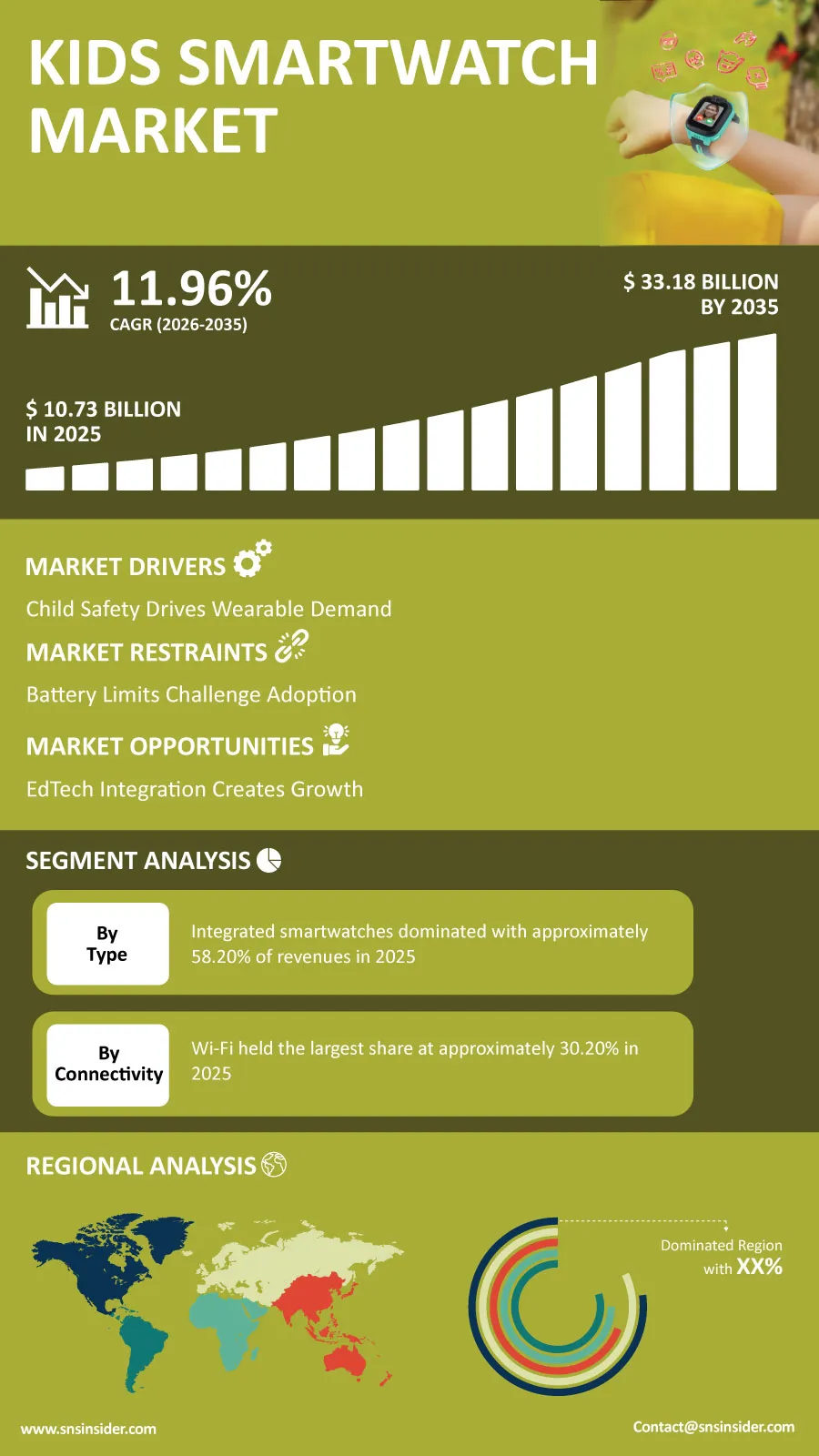
The global Kids Smartwatch Market is witnessing robust growth as parents increasingly adopt connected wearable devices that balance child safety, communication, and digital wellness. According to a recent study by SNS Insider, the global Kids Smartwatch Market size valued at USD 10.73 billion in 2025, is anticipated to grow to USD 33.18 billion by 2035, registering a CAGR of 11.96% over the 2026–2035 forecast period.
Increased focus on the safety of children, combined with the shift in the choices made by today’s parents, is prompting families to opt for purpose-built smartwatches rather than cell phones for their young kids. The gadgets provide security features like reliable communication, constant location tracking, and even help during emergencies but do not offer free access to the Internet and social networks.
Manufacturers are also expanding product capabilities through AI-powered educational content, health monitoring functions, and improved connectivity, creating greater value for parents seeking multifunctional wearables that support both safety and learning.
To Get Detailed Insights on the Kids Smartwatch Market – Request a Sample Report
Connected Parenting Trends Open New Market Opportunities
As the ties between families grow tighter, there is increasing need for wearable technology that will enable the parents to stay in touch with their kids without adding the distraction caused by using smartphones. Kids' smartwatches are becoming an integral part of family communication systems, which feature GPS location finding, phone calls, video conferencing, and learning applications designed specially for children.
Due to innovations in wearable electronics, falling prices of components used in manufacturing, and increased availability of cellular networks, sophisticated smartwatches have become cheaper in developed countries as well as in emerging economies. It helps increase sales in middle-class families and encourages companies to make different models at different price levels.
Health monitoring capabilities, including activity tracking, sleep monitoring, hydration reminders, and wellness features, are further strengthening the appeal of kids' smartwatches as family wellness devices.
Key Market Insights Highlight Shifting Demand Patterns
By type, integrated smartwatches are expected to account for approximately 58.20% of global market revenue in 2025 owing to their built-in cellular connectivity, GPS tracking, SOS functionality, and all-in-one communication features. Standalone smartwatches are projected to register the fastest growth through 2035 as manufacturers introduce richer functionality while maintaining lightweight and cost-effective designs.
Based on connectivity, Wi-Fi-enabled devices are anticipated to contribute approximately 30.20% of market revenue in 2025 due to their affordability and ability to support communication and educational applications. NFC-enabled smartwatches are emerging as a rapidly growing category as contactless authentication and payment capabilities become increasingly relevant for older children.
By distribution channel, online sales are expected to account for 57.20% of market revenue in 2025 as parents increasingly rely on e-commerce platforms for product comparisons, customer reviews, and competitive pricing. Offline retail continues to play an important role by allowing consumers to evaluate product quality, comfort, and usability before purchase.
Based on watchband material, silicon bands are projected to represent approximately 51.80% of market revenue in 2025 due to their durability, comfort, flexibility, and suitability for everyday children's activities.
Educational Features and Digital Wellness Shape Product Development
Educational experience along with proper use of technology by kids has become the prime focus of the next batch of smartwatches for kids. With the help of educational AI apps, gaming, language learning tools and educational content, wearable devices have been transformed into learning aids for kids.
On the other hand, parental control, secure communication, restricted app environment and screen time management tools have been prioritized by companies because of increasing concern about kids' digital well-being.
China Accounts for 52.4% of Asia Pacific Revenue as the Region Leads the Global Market
The Asia Pacific region will continue to hold the distinction of being the biggest and fastest-growing regional market during the forecast period due to increasing disposable income levels, increasing number of urban dwellers, consumer electronics manufacturing capability, and rising use of connected parenting technologies. China alone contributes around 52.4% toward total revenues generated by the Asia Pacific market.
The North American region will also maintain its status as a dominant market due to parental awareness, digital infrastructure, high-end consumer base, and GPS-based child safety devices. Future investments by key players in wearable technology are also anticipated to aid regional growth.
Industry Participants Focus on Innovation and Child-Centric Features
Competition within the kids smartwatch market remains dynamic as manufacturers invest in advanced safety technologies, educational software, AI-powered features, extended battery life, and enhanced parental control platforms. Product differentiation increasingly centers on delivering secure communication, reliable connectivity, and age-appropriate digital experiences that meet evolving family expectations.
Key companies operating in the global Kids Smartwatch Market include TickTalk Tech LLC, Xplora Technologies AS, Garmin Ltd., Huawei Technologies Co. Ltd., VTech Holdings Ltd., Jiobit, Verizon Communications Inc., Tencent Holdings Ltd., Oaxis Asia Pte Ltd., Doki Technologies Ltd., Abardeen Technology Co. Ltd., Omate Inc., Angel Watch Company, Alcatel, Kurio, MyKi, LG Electronics Inc., Qihoo 360 Technology Co. Ltd., and Kido.
An SNS Insider analyst Sushant Kadam commented, “Parents are increasingly seeking connected devices that prioritize child safety while promoting healthy digital habits. Manufacturers combining secure communication, educational innovation, wellness monitoring, and reliable parental controls will be well positioned to capitalize on sustained global demand as connected parenting technologies continue to evolve.”
About the Author

Get in touch