
Kids Smartwatch Market Report Scope & Overview:
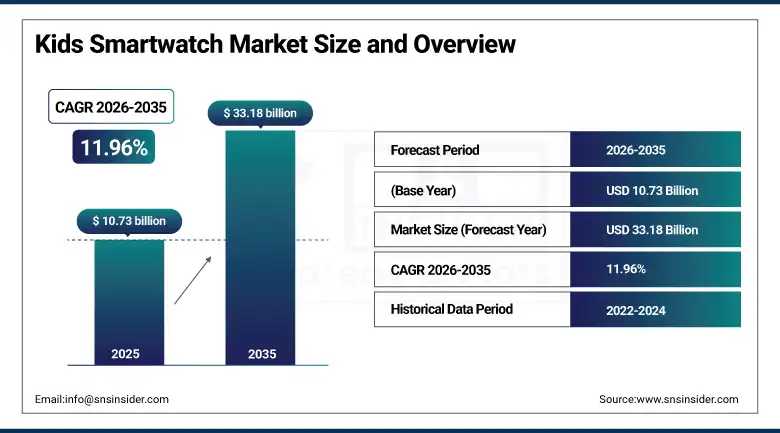
The Kids Smartwatch market was valued at USD 10.73 billion in 2025 and is expected to reach USD 33.18 billion by 2035, growing at a CAGR of 11.96% from 2026–2035.
The market's growth is being propelled by a convergence of parenting culture shifts and technological enabling factors. Urban parents in developed and developing markets alike are delaying smartphone ownership for children while simultaneously seeking connected safety tools that provide the location visibility and communication access that shared family schedules in dual-income households demand. Approximately 55% of urban parents in surveyed markets reported using GPS wearables to track school commutes and extracurricular activity attendance, a figure that reflects both the practical utility of the category and the normalisation of technology-assisted parenting supervision as a routine part of modern family life. Manufacturers are responding with successive product generations that add features while maintaining or reducing price points through economies of scale in Asian component manufacturing.
Children's smartwatch manufacturers are increasingly positioning their products as screen-time management tools that provide parental peace of mind and child connectivity in a controlled, curated digital environment, a positioning that directly addresses the growing concern among parents and paediatricians about unrestricted smartphone access for school-age children and that is driving premium pricing acceptance among health and education-conscious consumer segments.
To Get more information On Kids Smartwatch Market - Request Free Sample Report
Kids Smartwatch Market Trends
-
Rising integration of AI-powered educational content within smartwatch interfaces, including voice-activated tutoring assistants, adaptive language learning games, and mathematics challenges that respond to a child's demonstrated performance level and adjust difficulty to maintain engagement without frustration.
-
Increasing adoption of SIM-enabled integrated smartwatches that operate independently of a parent's smartphone through their own cellular data plans, enabling children to communicate, share locations, and access approved content without requiring proximity to or dependence on a paired adult device.
-
Growing parental preference for devices that explicitly limit social media, web browsing, and app download access while providing a curated selection of age-appropriate communication, entertainment, and educational functions, as concerns about children's digital health and screen addiction drive the market toward purposefully restricted functionality.
-
Expanding health and wellness monitoring feature sets including heart rate tracking, sleep quality monitoring, step counting with daily activity goal gamification, hydration reminders, and mood logging tools that position children's smartwatches as health-supportive family wellness devices alongside their primary safety and communication functions.
-
Accelerating product launches from Asian consumer electronics manufacturers offering feature-competitive devices at price points substantially below European and North American flagship brands, expanding the addressable market in emerging economies where per-capita disposable income constraints previously limited adoption to upper-income households.
U.S. Kids Smartwatch Market Outlook
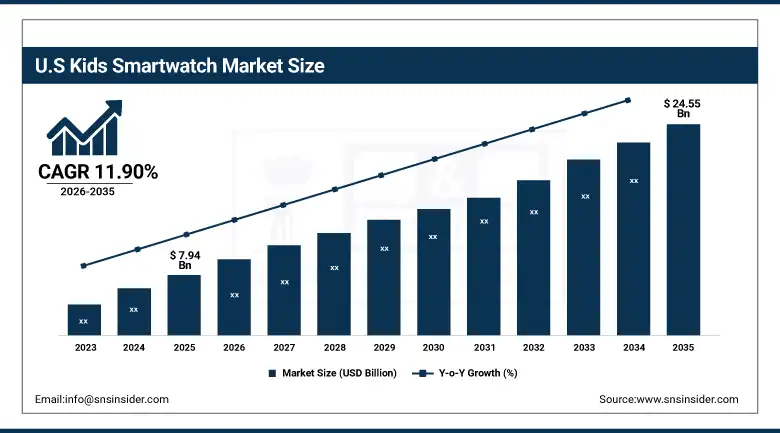
The U.S. Kids Smartwatch Market was valued at approximately USD 7.94 billion in 2025 and is expected to reach approximately USD 24.55 billion by 2035, growing at a CAGR of 11.90%, driven by high parental awareness of child safety technologies, strong digital infrastructure enabling cellular-connected wearables, and a premium consumer segment willing to pay for feature-rich, quality-validated devices for their children.
In terms of being the largest single national market for kid smartwatches, the USA is characterized by the presence of a combination of relatively high levels of disposable income per household; the ubiquity of smartphones among parents who create an environment necessary for kids' watches to perform their function; broad 4G and 5G network coverage; and a particular cultural focus on children's safety and supervised autonomy, which makes such a gadget as a tracking device a part of parents' considerations when making purchase decisions about new technologies. The competition on the American market for kids' smartwatches involves American inventors like TickTalk and Jiobit; large multinational technology firms producing kids' wearables, such as Garmin or Verizon; and Asian producers of children's smartwatches with the lower prices, thus, increasing the consumer pool. The existence of certain regulation on the matter of child safety, including provisions of COPPA and FCC regulations, forces all players on the market to ensure compliance with safety measures; thereby indirectly contributing to the premium nature of their products.
The growing medical evidence base linking excessive unsupervised smartphone use among pre-teens and adolescents to anxiety, depression, and sleep disruption is creating a parenting-informed market segment actively seeking smartphone alternative products that provide necessary connectivity without unrestricted digital exposure, directly benefiting the kids smartwatch category's value proposition in the U.S. market.
Kids Smartwatch Market Segment Analysis
-
By Type, Integrated smartwatches dominated with approximately 58.20% of revenues in 2025 through their all-in-one features including SIM-enabled cellular calling, real-time GPS, SOS emergency functions, and educational apps in a single compact package preferred by parents seeking comprehensive child safety solutions; Standalone is the fastest-growing type as increasing consumer sophistication drives demand for richer feature environments.
-
By Connectivity, Wi-Fi held the largest share at approximately 30.20% in 2025 as it supports real-time communication and learning applications at lower device cost; NFC is emerging as a growing connectivity option enabling contactless payment and authentication features appealing to older children in the target demographic.
-
By Distribution Channel, Online led with approximately 57.20% of revenues in 2025 as e-commerce platforms offer convenience, competitive pricing, and detailed product comparison that suits considered parental purchasing decisions; Offline retail remains important for hands-on demonstration that helps parents evaluate size, weight, and ease of use before purchasing for their child.
-
By Watchband Material, Silicon dominated with approximately 51.80% in 2025 through its combination of durability, comfort, hypoallergenic properties, and ease of cleaning that parents prioritise for everyday children's wear; Plastic variants serve the entry-level price-sensitive segment while stainless steel features in premium models targeting older children seeking adult-adjacent design aesthetics.
By Type, Integrated dominates, Standalone is expected to grow fastest
Integrated smartwatches retained the dominant type position with approximately 58.20% of Kids Smartwatch Market revenues in 2025, reflecting their status as the definitive form factor for parents seeking a self-contained child safety and communication tool that operates reliably independently of any adult device. The integrated category's defining feature is the inclusion of a physical or embedded SIM card enabling cellular calling and data connectivity that allows the device to transmit GPS coordinates, receive incoming calls, and connect to parental monitoring applications even when the child is beyond Bluetooth or Wi-Fi range, which is precisely the usage scenario that motivates parents' purchases. The TickTalk 5's HD video calling with encrypted messaging and the Xiaomi Mitu Kids Watch 7X's dual-frequency GPS with 90-day tracking history represent the technological frontier of integrated kids smartwatches whose feature depth justifies premium pricing in markets where child safety is a high-priority expenditure category.
Standalone smartwatches depend on Bluetooth pairing with a parent's smartphone to relay location data and communications, which limits their operational range to Bluetooth coverage but enables a simpler, lighter, and typically less expensive device architecture that appeals to parents of younger children in age groups where supervised environments and close parental proximity reduce the requirement for independent cellular connectivity. The standalone segment is growing as manufacturers develop richer feature environments within Bluetooth-connected architectures, including enhanced educational content libraries, creative tools, fitness tracking, and games that provide engaging daily device utility beyond the safety monitoring function that motivates purchase.
By Distribution Channel, Online dominates, Offline retail maintains importance for trial and demonstration
Online distribution led with approximately 57.20% of Kids Smartwatch Market revenues in 2025, reflecting the product category's strong alignment with e-commerce purchasing behaviour where detailed product specification comparison, customer review analysis, and competitive price discovery between brands and retailers are facilitated by digital platforms in ways that physical retail environments cannot replicate. Amazon, specialist child safety technology retailers, and brand direct-to-consumer websites enable parents to evaluate technical specifications including GPS accuracy, battery life, cellular compatibility, subscription cost, and parental app quality through detailed listings and verified customer reviews that inform considered purchasing decisions for products that serve a child safety function where underperformance has meaningful consequences. Subscription model bundling, where kids’ smartwatch brands offer device hardware bundled with monthly cellular plan subscriptions directly through their own online channels, is expanding the direct sales share and improving customer lifetime value metrics for brands that successfully retain subscribers through strong parental app and customer service experiences.
Offline retail encompassing specialty electronics retailers, retailers dealing in children products, and mobile operators’ stores continue to earn around 42.80% of revenues from the Kids Smartwatch Market in 2025, owing to the nature of the product category that is suitable for physical inspection and examination, whereby parents have an opportunity to physically gauge the appropriate size and weight of the smartwatch, check the readibility of its face, accessibility of buttons for a child’s small fingers, among other features. Moreover, mobile operators’ stores act as channels for SIM card-based integrated smartwatches plans in which the combination of the smartwatch and a cell plan makes the procedure easy for parents who are new to sim provisioning.
Regional Analysis
|
Region |
Major Country |
Share within Region, 2025 (%) |
|---|---|---|
|
North America |
United States |
82.3% |
|
Europe |
Germany |
21.8% |
|
Asia Pacific |
China |
52.4% |
|
Middle East & Africa |
UAE |
28.6% |
|
Latin America |
Brazil |
44.7% |
North America Kids Smartwatch Market Insights
North America held a substantial share of global Kids Smartwatch Market revenues in 2025, with the United States accounting for approximately 82.3% of North American revenues. The region's market performance reflects high parental technology adoption, strong disposable income supporting premium device purchases, nationwide 4G/5G coverage enabling reliable cellular-connected wearable functionality, and established consumer awareness of the category cultivated through sustained marketing investment by brands including Xplora, TickTalk, Verizon, and Garmin. U.S. school districts' growing engagement with child digital wellness programmes that recommend purposefully limited communication devices over smartphone ownership for elementary school-age students is creating a school-endorsed market demand signal that meaningfully supports parental purchase consideration.
Get Customized Report as per Your Business Requirement - Enquiry Now
Europe Kids Smartwatch Market Insights
Europe is a sophisticated kids smartwatch market characterised by strong child data privacy regulation under GDPR's provisions for children's personal data, which set a higher compliance standard than equivalent markets and create a competitive advantage for European-developed brands including Xplora whose privacy architectures are designed for the GDPR environment. Germany accounts for approximately 21.8% of European kids smartwatch revenues as the region's largest national market, supported by high household income, strong parental investment in educational technology, and a technology retail infrastructure providing effective product access and after-sales support. Northern European markets including Sweden, Norway, Denmark, and the Netherlands show above-average penetration rates reflecting both higher disposable income and strong cultural emphasis on outdoor supervised child independence that makes location tracking a practically motivated purchase.
Asia Pacific Kids Smartwatch Market Insights
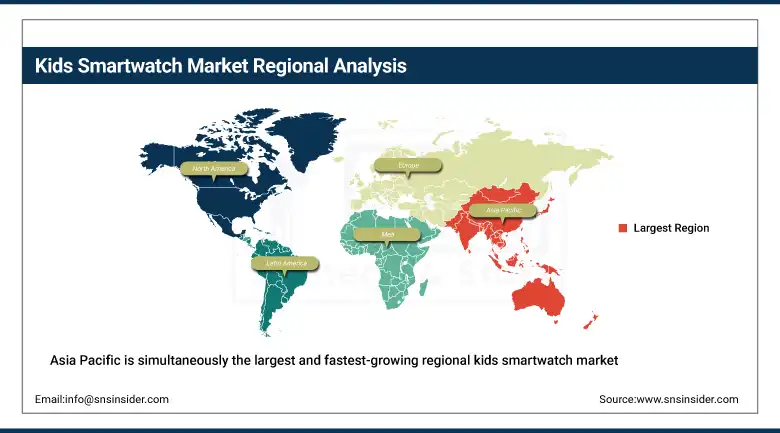
Asia Pacific is simultaneously the largest and fastest-growing regional kids smartwatch market, with China accounting for approximately 52.4% of Asia Pacific revenues through its combination of massive school-age child population, world-leading consumer electronics manufacturing creating cost-competitive domestic products, and rapidly expanding urban middle-class families adopting connected parenting technologies. The region's CAGR of 12.60% over the 2026 to 2035 period reflects adoption expansion beyond China's first-tier cities into second and third-tier urban markets as price points decline, combined with strong growth in India, South Korea, Japan, and Southeast Asian markets where rising household incomes are making premium children's technology accessible to a wider consumer base. China's unique indoor positioning requirement for school environments, where GPS satellite signals may be weak, has driven innovation in hybrid positioning technologies combining GPS, Wi-Fi, and cellular triangulation that is feeding back into global product development roadmaps.
MEA & Latin America Kids Smartwatch Market Insights
The Middle East and Africa and Latin America represent growing kids smartwatch markets where the combination of young demographic profiles with large school-age populations, rapidly expanding smartphone penetration creating the parental device ecosystem that paired smartwatches depend upon, and rising urban middle-class income are creating market development conditions that support sustained adoption growth. UAE leads MEA adoption at approximately 28.6% of regional revenues through its high income per capita, strong technology retail infrastructure, and parent community characteristics aligned with premium child safety product adoption. Brazil accounts for approximately 44.7% of Latin American kids smartwatch revenues, driven by urban parents in major metropolitan areas seeking child safety solutions that address urban mobility challenges in cities where school commute safety is a high-priority parenting concern.
Market Dynamics
Growth Drivers: Heightened parental concern about child safety in public environments combined with the global movement toward smartphone delay strategies for school-age children creating a structured demand opportunity for dedicated children's wearable technology
The primary structural growth drivers for the Kids Smartwatch Market are the convergence of rising parental anxiety about unsupervised child mobility in public spaces that makes real-time GPS location tracking a practically valued capability, and the growing paediatric and educational consensus that smartphone exposure should be delayed for children below approximately twelve years of age to protect developing attention, social, and emotional regulatory functions, creating a market gap between children's desire for peer-recognised technology and parents' willingness to provide unrestricted smartphone access that kids smartwatches are uniquely positioned to fill. Urban population density and increasingly complex family logistics in dual-income households, where children travel between school, after-school activities, and childcare arrangements across multiple locations during a single day, create practical real-time location monitoring requirements that GPS-enabled wearables satisfy in ways that periodic phone calls cannot. The COVID-19 pandemic's acceleration of remote learning and outdoor play norms contributed to sustained category awareness that is maintaining higher penetration levels than existed in the pre-pandemic period.
Restraints: Device durability and battery life limitations relative to the all-day wear requirements of a child's active lifestyle, subscription cost adding ongoing cost of ownership beyond device purchase price, and data privacy concerns around children's location and usage data
A significant restraint on the Kids Smartwatch Market is the practical durability challenge that active children impose on wrist-worn electronics, where swimming, playground activity, contact sports, and the general physical carelessness of childhood use reliably test the water resistance, drop resistance, and structural integrity of smartwatch hardware to standards that consumer electronics not designed specifically for children may not reliably survive over the typical two-to-three-year ownership horizon that parents require for device economics to be favourable. Battery life is a persistent challenge in a device whose primary value lies in continuous GPS location tracking and cellular connectivity, functions that create sustained power draw that many current devices cannot maintain through a full school day plus after-school activities on a single charge, limiting the reliability of the safety monitoring function that motivates purchase. Monthly cellular subscription costs for SIM-enabled integrated smartwatches add an ongoing financial obligation of typically USD 9 to 15 per month that meaningfully increases total cost of ownership and creates churn risk in cost-sensitive household segments when competing priorities emerge.
Opportunities: EdTech platform integration creating revenue-generating subscription content ecosystems, health monitoring feature expansion positioning kids smartwatches as children's wellness devices, and emerging market middle-class expansion
Kids Smartwatch brand partnerships for educational technology platforms would constitute an excellent avenue for differentiating the product on account of providing credible curriculum and pedagogy aligned learning experiences through the kids' smart watches, thus providing additional recurring revenue through the form of subscriptions for edtech learning content which are increasingly becoming desirable among parents due to the increasing number of educational softwares that provide compelling evidence regarding their effectiveness in keeping their children productively busy using the technology. Kids' smart watch brands incorporating clinically validated health monitoring tools such as medical accuracy of heart rates, sleep quality, body temperature, and menstrual cycles for mature young women in the target demographic group could enable the development of these devices as children's healthcare devices.
Recent Developments:
-
April 2024: TickTalk introduced its latest model, the TickTalk 5, which includes HD video calls, real-time location tracking, secure messaging, SOS functionalities, and integration of nano SIM card services via TickTalk Wireless that provides its customers with prepaid monthly packages, thus presenting a set of features that is by far the best in the company's entire product line-up history.
-
March 2024: Xiaomi released its newest Mitu Kids Smartwatch 7X, which includes dual frequency GPS positioning, 3D indoor location technology and storage for 90 days worth of location data in the mid-level price range where competition between Chinese companies based on the feature-to-price ratio is especially strong.
-
2025: Xplora expanded their marketing campaigns aimed at schools and worked together with teachers and school authorities to market its Xplora X6 Play model as a communication gadget that should be used by the children of parents who have not yet decided to buy their kids a smartphone.
-
2025: Garmin offered its upgraded GPS tracker in the family product range, increasing its battery performance up to 36 hours of continuous operation, resolving its previous limitation regarding battery life which was a main point of concern for consumers in this particular market segment.
-
2025: VTech expanded its Kidizoom smartwatch product line with new interactive educational game content and a companion parental app update offering more granular location history and activity time management controls, responding to parent feature requests for tighter parental oversight tools.
Kids Smartwatch Market Key Players
-
TickTalk Tech LLC
-
Xplora Technologies AS
-
Garmin Ltd.
-
Huawei Technologies Co. Ltd.
-
VTech Holdings Ltd.
-
Jiobit
-
Verizon Communications Inc.
-
Tencent Holdings Ltd.
-
Oaxis Asia Pte Ltd.
-
Doki Technologies Ltd.
-
Abardeen Technology Co. Ltd.
-
Omate Inc.
-
Angel Watch Company
-
Alcatel
-
Kurio
-
MyKi
-
LG Electronics Inc.
-
Qihoo 360 Technology Co. Ltd.
-
Kido
Kids Smartwatch Market Report Scope:
| Report Attributes | Details |
|---|---|
| Market Size in 2025 | USD 10.73 Billion |
| Market Size by 2035 | USD 33.18 Billion |
| CAGR | CAGR of 11.96% From 2026 to 2035 |
| Base Year | 2025 |
| Forecast Period | 2026-2035 |
| Historical Data | 2022-2024 |
| Report Scope & Coverage | Market Size, Segments Analysis, Competitive Landscape, Regional Analysis, DROC & SWOT Analysis, Forecast Outlook |
| Key Segments | • By Type (Integrated, Standalone) • By Connectivity (Bluetooth, Wi-Fi, NFC, Others), By Distribution Channel (Online, Offline) • By Watchband Material (Silicon, Plastic, Stainless Steel, Others) |
| Regional Analysis/Coverage | North America (US, Canada, Mexico), Europe (Eastern Europe [Poland, Romania, Hungary, Turkey, Rest of Eastern Europe] Western Europe] Germany, France, UK, Italy, Spain, Netherlands, Switzerland, Austria, Rest of Western Europe]), Asia Pacific (China, India, Japan, South Korea, Vietnam, Singapore, Australia, Rest of Asia Pacific), Middle East & Africa (Middle East [UAE, Egypt, Saudi Arabia, Qatar, Rest of Middle East], Africa [Nigeria, South Africa, Rest of Africa], Latin America (Brazil, Argentina, Colombia, Rest of Latin America) |
| Company Profiles | TickTalk Tech LLC, Xplora Technologies AS, Garmin Ltd., Huawei Technologies Co. Ltd., VTech Holdings Ltd., Jiobit, Verizon Communications Inc., Tencent Holdings Ltd., Oaxis Asia Pte Ltd., Doki Technologies Ltd., Abardeen Technology Co. Ltd., Omate Inc., Angel Watch Company, Alcatel, Kurio, MyKi, LG Electronics Inc., Qihoo 360 Technology Co. Ltd., Kido |
Frequently Asked Questions
The Kids Smartwatch Market is expected to grow at a CAGR of 11.96% from 2026 to 2035.
