
The global automated test equipment industry is entering a phase of steady commercial growth. Semiconductor makers are under pressure to ship more devices with fewer defects and at lower cost per unit. A single faulty chip that reaches the field can lead to recalls, warranty claims, and lost customer trust. As a result, test capacity has moved from a back-end production cost to a direct factor in yield, margin, and brand value.
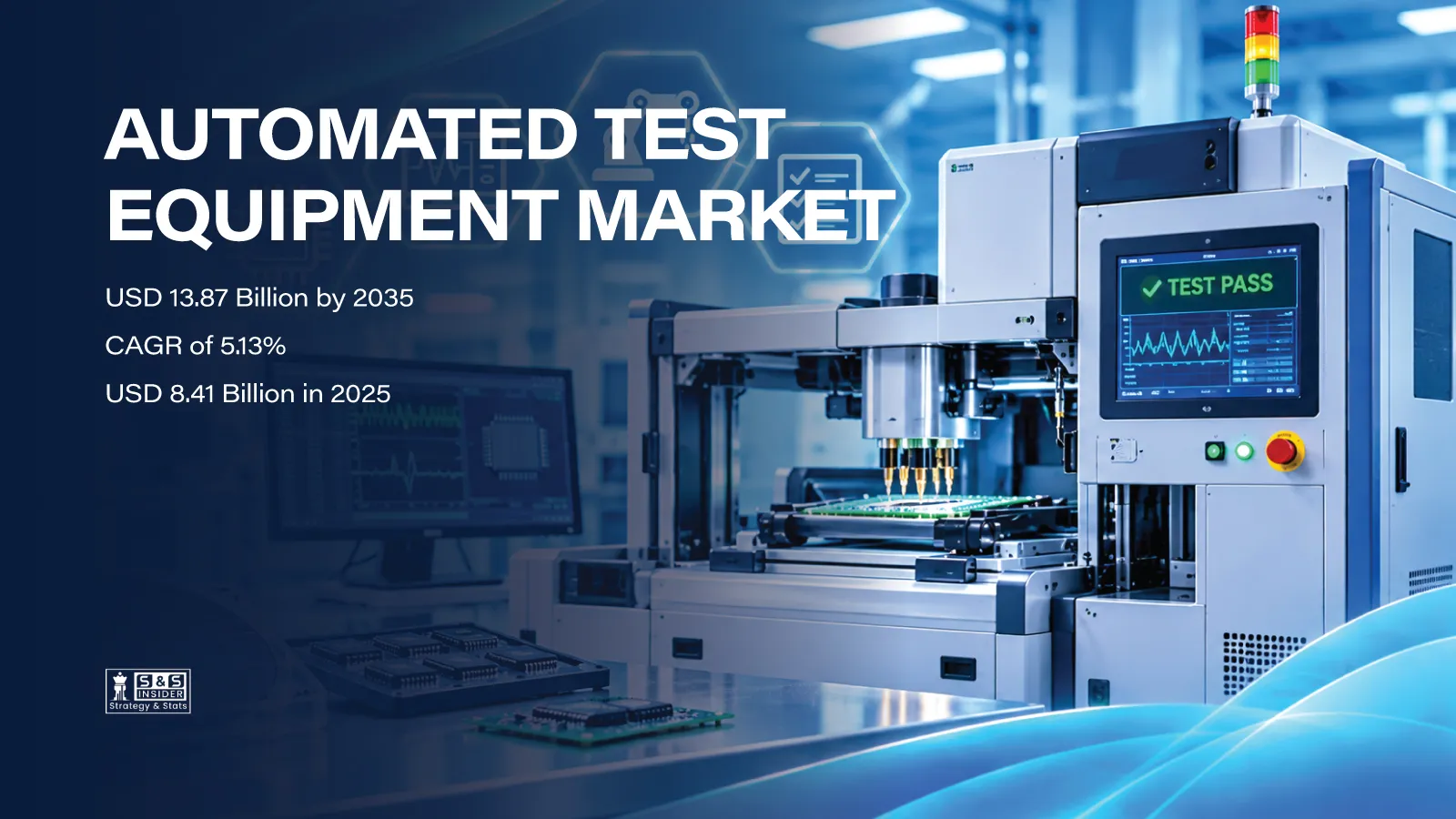
According to a recent study by SNS Insider, the global Automated Test Equipment Market size was valued at USD 8.41 Billion in 2025 and is anticipated to reach USD 13.87 Billion by 2035, registering a CAGR of 5.13% over the forecast period 2026–2035. The market is estimated at USD 8.84 Billion in 2026.
Yield Economics Are Making Test a Profit Lever
For chip producers, every percentage point of yield has a clear effect on profit. Test equipment that finds defects earlier keeps waste out of costly packaging and assembly steps. This makes early, accurate testing a way to protect margins, not just a quality check.
Production managers now look at test cost per good unit rather than the purchase price of each tester. Faster test times, higher parallel testing, and fewer false failures all lower that cost.
Suppliers that can show clear gains in yield and throughput are in a strong position during budget talks. The sales focus shifts from machine specifications to the financial results on the factory floor.
To Get Detailed Insights on the Automated Test Equipment Market – Request a Sample Report
Test Data Opens Opportunities Beyond Hardware Sales
Every test run generates a wealth of data on device behavior and process health. By linking this data to design and fabrication records, it enables manufacturers to trace problems to their source. It becomes a valuable asset to improve future product lines.”
It opens up space for analytics platforms, yield management software and cloud-based data tools from suppliers. Such services keep suppliers in touch with customers long after the equipment is installed.
Recurring revenue and improved customer retention can come from test program development and remote diagnostics, and software subscriptions.
Automated Test Equipment Market Segmentation Highlights
By Product
In 2025, non-memory ATE had the largest market share of 60.77% due to strong testing needs for processors, logic chips and mixed-signal devices. The Memory ATE is expected to record the highest CAGR of 6.00%, providing opportunities in high bandwidth memory used in AI and data center systems.
By Component
Tester mainframes accounted for 55.90% of the market in 2025, as they form the core of every test cell. System-level burn-in racks are anticipated to grow at the highest CAGR of 12.40%. They give suppliers a growing opportunity as chipmakers test complete multi-chip packages under real operating conditions.
By Type
Logic testing held the largest share in 2025. Steady demand for computing and communication chips. Discrete testing is expected to be the fastest growing with opportunities related to power devices used in electric vehicles and energy systems.
By End-User
Consumer electronics led the market in 2025. The automotive segment is projected to record the fastest growth, supported by opportunities in electric drivetrains, driver assistance systems, and safety-critical vehicle chips.
Asia Pacific Leads with 52.32% Market Share as the U.S. Reaches USD 1.57 Billion
Asia Pacific dominated the Automated Test Equipment Market with a revenue share of 52.32% in 2025 and is also the fastest-growing region. Taiwan accounted for 36.90% of regional revenue. The region offers strong prospects for suppliers that can support high-volume foundries, outsourced test providers, and fast-growing local chip design firms. Local service teams, short delivery times, and cost-efficient platforms are key to winning business here.
In North America, the U.S. held 85.30% of regional revenue. The U.S. market was valued at USD 1.57 Billion in 2025 and is projected to reach USD 2.56 Billion by 2035, growing at a CAGR of 5.00%. New domestic fab projects and AI hardware programs are opening doors for advanced test platforms and long-term service contracts.
In Europe, Germany accounted for 27.10% of regional revenue. Brazil held 37.60% of Latin America and the UAE held 26.40% of the Middle East & Africa. Opportunities in these regions will depend on automotive electronics output, industrial policy, and local investment in chip assembly and testing.
Leasing and Test-as-a-Service Could Widen the Customer Base
The high initial cost of advanced test systems can be a barrier for smaller chipmakers and outsourced test firms. Leasing plans, capacity-sharing arrangements and pay-per-use test services allow these customers to access modern test capability without a large capital commitment.
Manufacturers can tap this group through partnerships with outsourced assembly and test providers, equipment financing companies and regional test centers.
These models also provide the potential for ongoing revenue through maintenance contracts, test program updates, operator training and software access.
Competitive Outlook: Throughput and Flexibility to Become Key Differentiators
The future for the automated test equipment industry will likely be challenged not just on raw test speed. Customers want platforms that can quickly adapt to new chip designs, scale across product lines and integrate into connected factory systems.
Suppliers that mix flexible hardware with strong software, fast field support and flexible buying options may find a stronger position. Partnerships with foundries, chip designers and probe card manufacturers may also help expand commercial reach.
Automated Test Equipment Market Outlook Through 2035
Automated test equipment will play a bigger role in yield planning, product reliability and supply chain confidence in the next decade. “Suppliers that can demonstrate measurable improvements in test cost, throughput and defect detection will be well positioned to capture new demand across semiconductors, automotive, data centers and consumer devices.
About the Author

Get in touch




