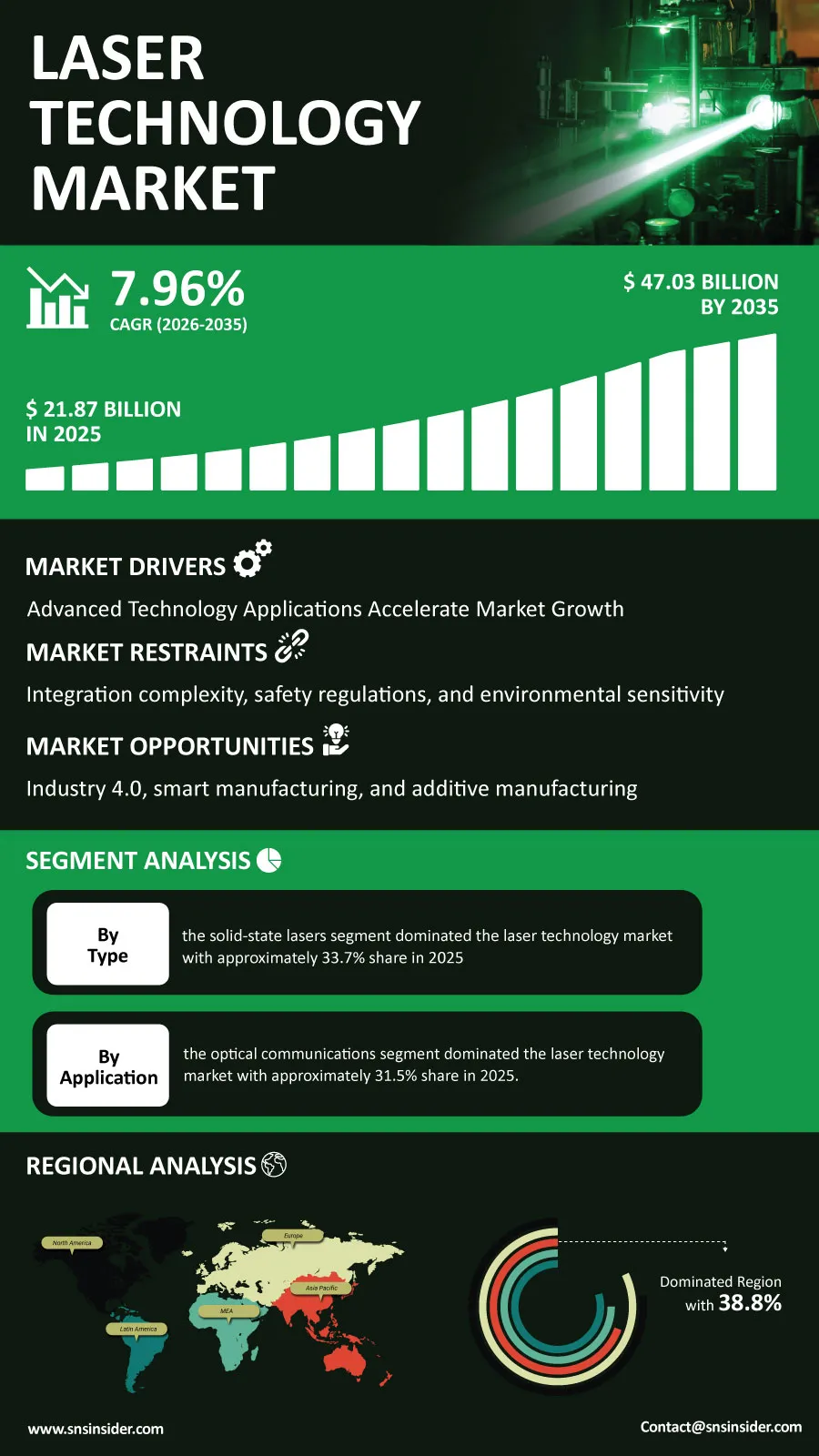
The global Laser Technology Market is advancing steadily as industries adopt high-precision technologies for manufacturing, communications, healthcare, defense, and emerging digital applications. According to a recent study by SNS Insider, the global Laser Technology Market size valued at USD 21.87 billion in 2025, is anticipated to grow to USD 47.03 billion by 2035, registering a CAGR of 7.96% over the 2026–2035 forecast period.
Laser systems’ demand has been growing as there is need for better accuracy, faster production cycle, and efficiency in terms of energy consumption. Auto manufacturers, aerospace companies, electronics companies and semiconductor firms have been including more laser technologies in their production line and hospitals have been increasingly adopting procedures aided by lasers.
Additionally, lasers are being used in applications such as self-driving cars, quantum computing, biomedical diagnostic techniques, and environmental monitoring among others. Future growth of this market will be driven by investments in high power lasers and semiconductor lasers.
To Get Detailed Insights on the Laser Technology Market – Request a Sample Report
Smart Manufacturing and Advanced Applications Create New Growth Opportunities Globally
Industry 4.0 will provide favorable circumstances for the development of laser technology manufacturers. The importance of automated systems for laser cutting, welding, marking, engraving, and additive manufacturing will increase since companies will modernize their plants and require greater precision in processing and manufacturing.
Fiber-optic communications infrastructure will continue to be installed which increases the demand for lasers that facilitate fast data transfer through optical fibers. In addition, LiDAR systems will play an important role in autonomous vehicles and sensing. This opens up new perspectives for efficient semiconductor lasers.
Healthcare represents another promising growth avenue, with laser systems supporting ophthalmology, dermatology, surgery, diagnostics, and other specialized medical procedures. As laser platforms become more precise and adaptable, their adoption is expected to expand into additional clinical and industrial applications.
Key Market Insights Highlight Shifting Demand Patterns
By type, solid-state lasers are expected to account for approximately 33.7% of global market revenue in 2025, supported by their broad utilization across industrial processing, medical procedures, and defense applications. Semiconductor lasers are projected to record the fastest growth through 2035 as demand increases for telecommunications, optical sensing, consumer electronics, and automotive LiDAR systems.
Based on application, optical communications are anticipated to hold approximately 31.5% of market revenue in 2025. Rising data traffic, cloud computing, and hyperscale data center expansion continue to drive the need for high-speed fiber-optic communication infrastructure. Laser processing is forecast to experience the fastest growth as automotive, aerospace, electronics, and semiconductor manufacturers increase their use of laser-based cutting, welding, marking, and micro-machining technologies.
By vertical, industrial applications are expected to dominate with approximately 30.8% of market revenue in 2025. The healthcare segment is projected to register the fastest growth through 2035 as laser-assisted surgeries, ophthalmic treatments, cosmetic procedures, and advanced diagnostic applications gain wider acceptance.
Precision Engineering and Emerging Technologies Strengthen Market Demand
Lasers are rapidly becoming a key element in production and automation techniques. High-power fiber lasers are being used in order to increase efficiency, while ultrafast laser systems are being deployed for operations requiring minimum heat effects.
The growth in additive manufacturing by means of lasers is bringing about new applications in aerospace, medical industries, and special tooling. In turn, the armed forces are developing directed energy systems, and chip makers are still researching advanced laser systems for their processes.
These developments are creating a diverse demand base that extends well beyond traditional industrial applications.
Asia Pacific Leads with 38.8% Market Share as the U.S. Contributes 82.5% of North American Revenue
The Asia Pacific region is forecasted to retain its position as the leading regional market, contributing about 38.8% to the global revenues in 2025. Robust electronics manufacturing, semiconductor fabrication, industrial automation, and telecommunication development in China, Japan, South Korea, and India are contributing towards regional dominance. China alone is predicted to have a share of about 40.6% in the Asia Pacific region revenue generation.
North America is forecasted to be the fastest growing region till 2035 owing to the rising use of laser technology in medical applications, self-driving vehicles' sensing devices, and military laser applications. The United States accounts for approximately 82.5% of North American revenue, supported by strong R&D activity and investments across multiple high-value application areas.
Industry Participants Focus on High-Power and Precision Innovation
The competitive landscape remains dynamic as leading companies invest in higher-power laser platforms, compact semiconductor solutions, advanced processing systems, and application-specific technologies. Manufacturers are also focusing on improving energy efficiency, beam quality, automation compatibility, and system reliability to address the evolving requirements of industrial and scientific users.
Key companies operating in the global Laser Technology Market include TRUMPF Group, Coherent Corp., IPG Photonics, Han's Laser, ASML Holding, Trotec Laser, Jenoptik, Mazak, Prima Power, Raycus Laser, CASTECH Inc., II-VI Incorporated, Lumentum Holdings, Huagong Tech, Bystronic Group, nLIGHT, Inc., Novanta Inc., Amplitude SA, Quantel Group, and MKS Instruments.
An SNS Insider analyst Sushant Kadam commented, “The laser technology industry is benefiting from simultaneous demand across precision manufacturing, optical communications, healthcare, autonomous sensing, and advanced research. Companies that continue improving laser efficiency, power density, integration, and application versatility will be well positioned to capture emerging opportunities as industries accelerate automation and adopt next-generation technologies.”
About the Author

Get in touch