
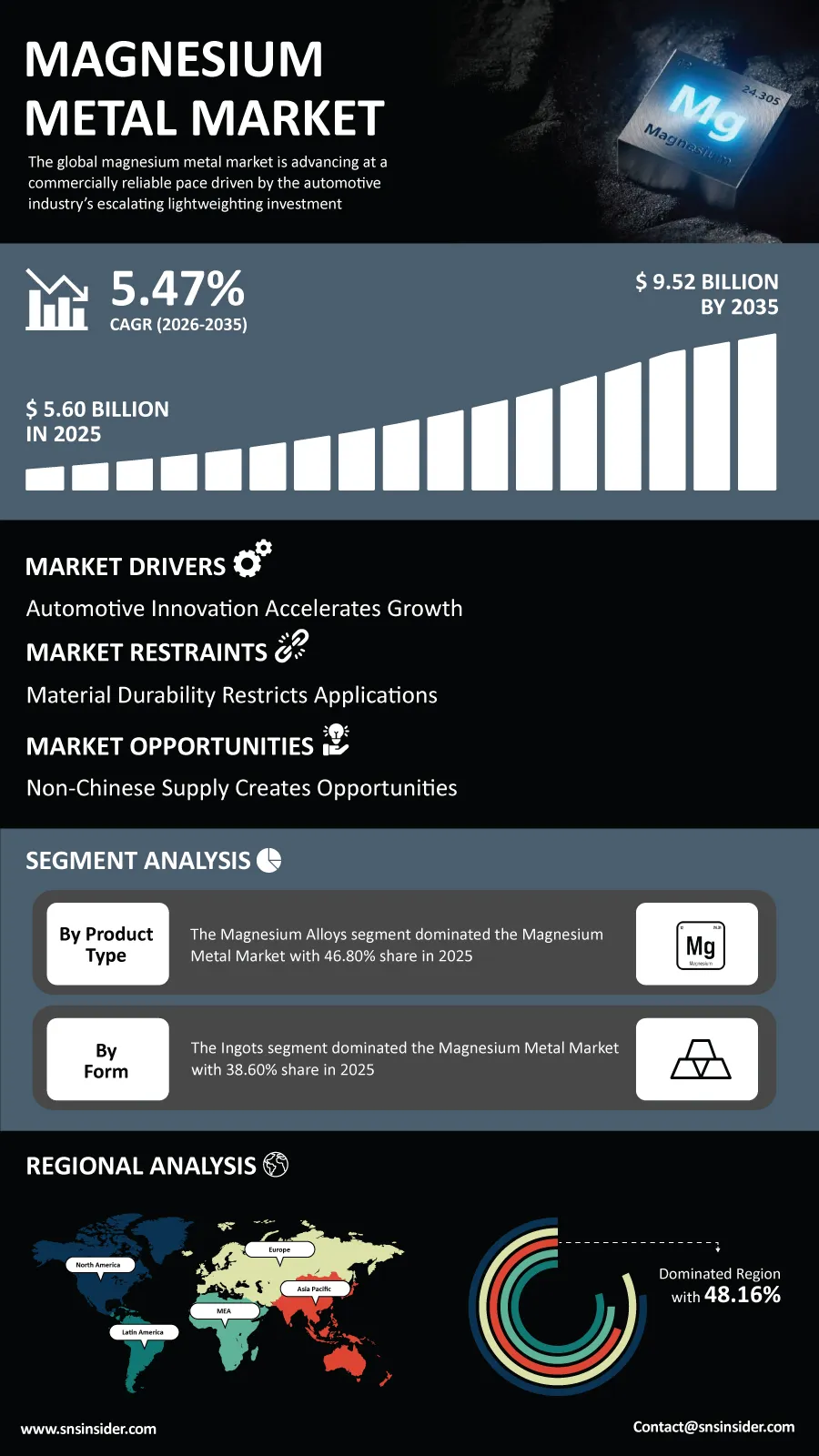
Global Magnesium Metal Market is expected to witnesses steady growth due, manufacturers in automotive, aerospace, electronics and industrial end use industries are increasingly focusing on lightweight materials for improving performance and energy efficiency. “According to a recent study by SNS Insider, the global Magnesium Metal Market size valued at USD 5.60 Billion in 2025, is anticipated to grow to USD 9.52 Billion by 2035, registering a CAGR of 5.47% over the 2026–2035 forecast period.”
The market continues to benefit from rising demand for materials that reduce product weight without compromising structural integrity. Manufacturers are increasingly incorporating magnesium into next-generation transportation platforms, industrial equipment, and electronic products as industries focus on efficiency, sustainability, and lower lifecycle emissions. Continuous improvements in alloy technology and processing techniques are also expanding commercial applications across multiple end-use sectors.
Rise in investments in electric mobility, advanced manufacturing, and aerospace innovations is boosting the growth opportunities. On the other hand, studies on corrosion-resistant alloys and ultra-high purity magnesium grades are expanding their application areas to those which require higher strength, thermal properties, and accuracy.
To Get Detailed Insights on the Magnesium Metal Market – Request a Sample Report
Automotive Lightweighting and Advanced Manufacturing Create Long-Term Growth Opportunities
The worldwide move up the energy immensity slope and towards lighter vehicle stages is imperative by, yet not limited to, higher state-of-the-art grease consumption guidelines for known transportation ventures. Magnesium materials are being increasingly introduced into electric vehicle platforms, structural assemblies, seating systems and battery-related applications to assist manufacturers on optimizing overall vehicle performance while meeting emissions legislation.
Apart from transportation, industrial manufacturers are investing in advanced production technologies for better materials quality and manufacturing consistency. Improved refining capabilities, coupled with additional recycling capacity, further helps de-risk long-term supply opportunity; New applications in healthcare, electronics and specialty engineering create combination of resilience and revenue diversification for market participants.
With a growing focus on robust supply chains, investments in regional magnesium manufacturing sites are also proliferating, offering further opportunities for manufacturers looking for stable and eco-friendly sources of raw materials.
Key Market Insights Highlight Shifting Demand Patterns
By Product Type, Eligibility Reported that magnesium alloys contributed 46.80% of total global revenue in the year 2025, primarily due to their widespread utilization in automotive, aerospace as well as industrial manufacturing sectors. Based on end-use industry, the magnesium compounds segment is anticipated to witness rapid growth during the forecast period owing to its increasing application in flame retardants, pharmaceuticals, agriculture and specialty chemicals through 2035.
Thermal reduction process accounted for approximately 49.12% of the total revenue by production process in line with commercial adoption and manufacturing infrastructure. While the electrolytic process will continue to experience robust growth in the forecast period driven by technological advancements and rising capital investment in cleaner methods of production.
Regarding the mode of production, ingots represented almost 38.60% stake in 2025 as they are widely used as primary source material in downstream manufacturing sectors. This is because sheets and plates are expected to grow at the fastest rate as demand rises for lightweight structural components in automotive and aerospace applications.
Advanced Alloy Development Supports Industry Transformation
Further innovation in technology is continually redefining the magnesium metals market with the development of stronger, lighter, and more durable products that can withstand tough engineering conditions. With better alloys, more accurate casting techniques, and enhanced surface treatments, magnesium metals can be more widely utilized due to their superior mechanical properties.
In addition to that, technological innovations in manufacturing processes and automation are allowing producers to increase their efficiency and cut down on waste and costs. Such innovations are anticipated to make magnesium metal products more competitive in the market.
Asia Pacific Led the Magnesium Market with 48.16% Revenue Share in 2025, North America to Record Fastest Growth Through 2035
Asia Pacific held the largest global market revenue share with an estimated 48.16% in 2025, due to dominant production capacity of existing regions along with a large automotive manufacturing ecosystem, an expanding electronics industry and well-established downstream processing infrastructure. Due to its prominent primary magnesium production capabilities and large domestic industrial base, China was the largest contributor in the region accounting for around 76.3% of Asia Pacific revenue.
Market Estimates & Forecasts North America is expected to be the fastest growing regional market until 2035, as governments and manufacturers continue to invest in domestic critical mineral production, electric vehicle manufacturing, aerospace modernization and strategic supply chain diversification. In addition, the market growth is also anticipated to be strengthened further due to the rising initiatives towards regional magnesium production facilities.
Industry Participants Focus on Capacity Expansion and Sustainable Production
The competitive environment is still rapidly developing as manufacturers continue to focus on production efficiency, new alloys, recycling technologies, and supply chain resilience. Now companies have increased the research and development investment for better quality product, advanced magnesium material development-provided support to fulfil dynamic customer demand from automotive, aerospace, graphics, electronics sectors and industrial market.
Key companies operating in the global Magnesium Metal Market include China Magnesium Corporation, US Magnesium LLC, Magontec Limited, RIMA Group, Dead Sea Magnesium, AMG Advanced Metallurgical Group, Henan Jingu Magnesium Industry, Jiangsu Yongxiang Magnesium, SeAH Magnesium, Western Magnesium Corp, Nova Magnesium, Valdi Magnesium, Shandong Yuyuan Industrial, Eastern Magnesium Corp, and Alliance Magnesium.
An SNS Insider analyst Himanshu Sharma commented, "Growing investments in lightweight engineering, regional supply chain development, and advanced magnesium processing technologies are creating strong long-term opportunities for the global magnesium metal industry. Companies focusing on innovation, production efficiency, and sustainable material solutions are expected to strengthen their competitive position as demand continues expanding across transportation, industrial, and high-performance engineering applications."
About the Author

Get in touch




