
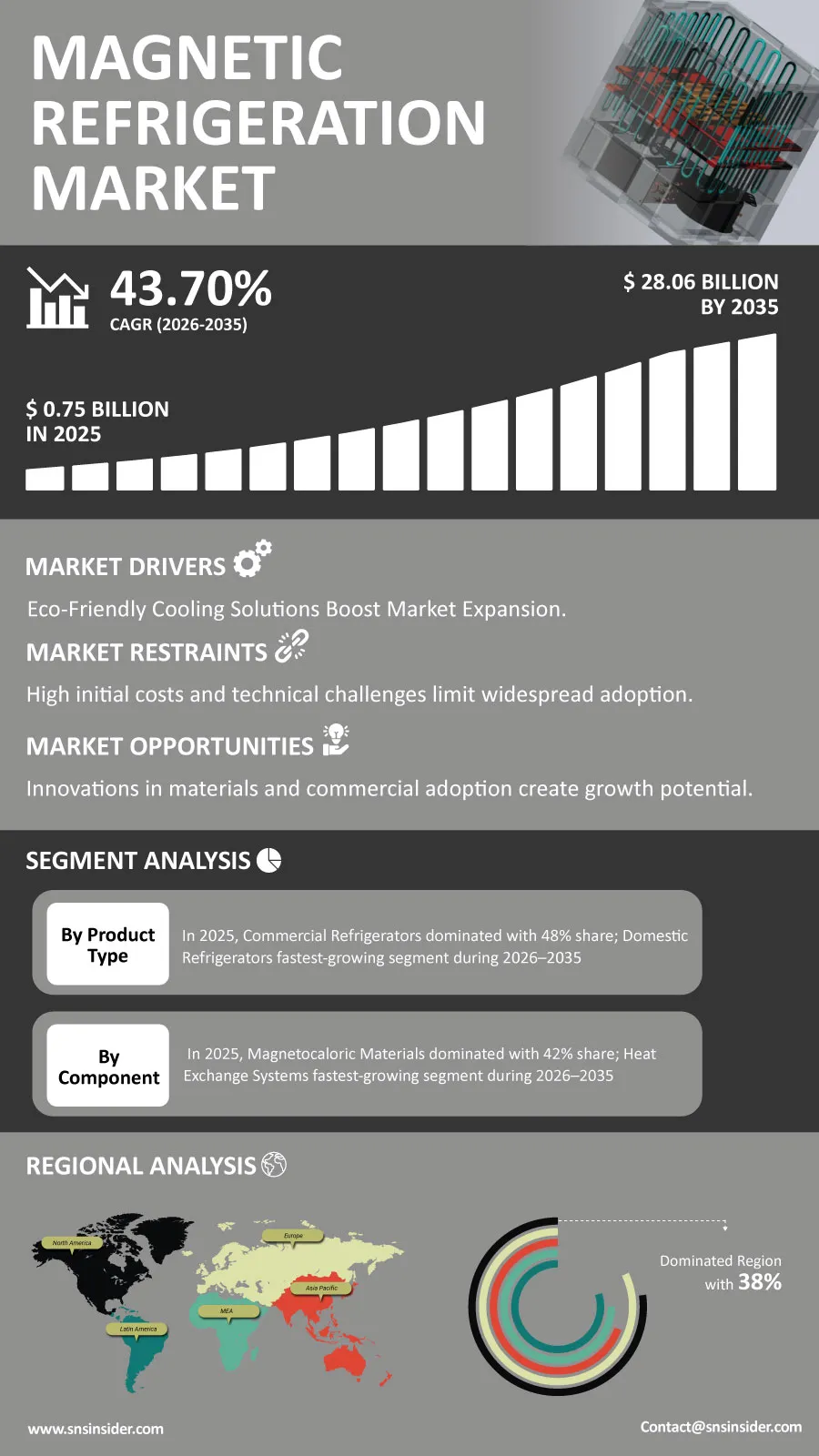
The global Magnetic Refrigeration Market is entering a transformative phase as industries and consumers increasingly seek cooling technologies that combine energy efficiency with lower environmental impact. According to a recent study by SNS Insider, the global Magnetic Refrigeration Market size valued at USD 0.75 billion in 2025, is anticipated to grow to USD 28.06 billion by 2035, registering a CAGR of 43.70% over the 2026–2035 forecast period.
Increasing demand to cut greenhouse gases and increase energy efficiency is leading companies to seek alternative means of cooling without using the traditional compression methods of refrigeration. The magnetocaloric method of refrigeration is becoming more popular as it uses the magnetocaloric effect to provide effective cooling.
Moreover, the technology is gaining traction in areas such as commercial refrigeration, health care, food storage, and even industry. Further advancements in the development of magnetic cooling systems through magnetocaloric materials and improved heat transfer will enhance their performance.
To Get Detailed Insights on the Magnetic Refrigeration Market – Request a Sample Report
Sustainable Cooling Investments Create New Growth Opportunities Globally
The move toward environmentally-friendly cooling technologies has created a very positive environment for magnetic cooling technology. There has been an increased interest in energy saving and technology in line with environmental considerations by various governments and organizations.
The developments in magnetocaloric material, particularly those which cut down the need for rare-earth materials, have led to the creation of new ways for developing technologies. Developments in heat exchange technology and magnetic field creation technology are also making it easier to deal with performance problems.
Integration with digital monitoring systems and IoT will further increase the market size potential through capabilities, such as predictive maintenance, automated energy management, and management of systems in real time.
Key Market Insights Highlight Shifting Demand Patterns
By product type, commercial refrigerators segment accounted for 48% of global market revenue in 2025, supported by demand from supermarkets, retail outlets, and other high-volume cooling environments. Domestic refrigerators are projected to register the fastest growth through 2035 as consumers increasingly prioritize energy-efficient and environmentally responsible household appliances.
Based on end-use industry, food and beverage segment dominated with a 50% of market revenue in 2025 due to extensive refrigeration requirements across food processing, cold storage, and retail distribution. Healthcare and pharmaceuticals are expected to emerge as the fastest-growing segment as precise temperature management becomes increasingly important for vaccines, medicines, biological samples, and specialized cold-chain applications.
By component, magnetocaloric materials segment held 42% of market revenue in 2025, reflecting their central role in generating the cooling effect. Heat exchange systems are projected to achieve the fastest growth as manufacturers focus on improving thermal transfer efficiency and overall system performance.
In terms of application, retail and supermarket refrigeration segment led with a 48% revenue share in 2025, supported by the large energy requirements of commercial cooling operations. Laboratory and medical storage segment is forecasted to be the fastest-growing application as pharmaceutical research, vaccine infrastructure, and clinical storage facilities increasingly require reliable and highly precise cooling environments.
Smart Cooling Technologies Strengthen Commercial Potential
Integration with advanced technological connections is providing new possibilities for magnetic cooling systems. IoT enabled system monitoring will allow the operators to have constant performance information available, while predictive analytics will help to predict maintenance needs even before the equipment fails.
Additionally, the energy-saving possibilities of the technology have led to the technology being considered by companies looking to cut down on costs. With the increasing digitization of commercial refrigerators, magnetic refrigeration could be useful because it is compatible with smart energy management and automation.
North America Holds 38% Market Share in 2025 as Asia Pacific Emerges as the Fastest-Growing Region
The share of North America in global market revenue is estimated at 38% by 2025, based on the high demand for energy efficient cooling systems, well-developed commercial refrigeration facilities and government policies encouraging the adoption of environment friendly technologies. The existing technology framework is also aiding the efforts in research and commercialization.
The Asia Pacific region will emerge as the fastest-growing market in the coming years until 2035 due to factors, such as industrialization, development of retail infrastructure, need for cold storage facilities and higher energy prices. There is an increasing demand for innovative cooling systems in countries, including China, Japan and India.
Europe will also emerge as an important market owing to strict environmental norms and increasing investments in sustainable refrigeration technologies. Latin America and Middle East and Africa will witness growth owing to increased urbanization, healthcare infrastructure, food distribution and commercial cooling needs.
Industry Participants Focus on Technology Innovation
The competitive landscape remains focused on material innovation, system efficiency, and commercialization. Industry participants are developing improved magnetocaloric materials, advanced heat exchangers, and modular refrigeration architectures designed to support applications across commercial, industrial, medical, and food storage environments.
Key companies operating in the global Magnetic Refrigeration Market include Cooltech Applications, Magnotherm Solutions GmbH, Camfridge Ltd., Astronautics Corporation of America, Kiutra GmbH, Magnoric SAS, MagREEsource, Vacuumschmelze GmbH & Co. KG, BASF SE, Eramet S.A., Arnold Magnetic Technologies, Hitachi Metals Ltd., TDK Corporation, Ad-Vance Magnetics Inc., Bunting Magnetics Co., Electron Energy Corporation, Dexter Magnetic Technologies, Goudsmit Magnetics Group, Ningbo Yunsheng Co., Ltd., and Shin-Etsu Chemical Co., Ltd.
An SNS Insider analyst Sushant Kadam commented, “The transition toward low-impact and energy-efficient cooling is creating a substantial opportunity for magnetic refrigeration technology. Continued progress in magnetocaloric materials, heat transfer engineering, and intelligent system controls will be critical to overcoming commercialization barriers and enabling the technology to move into broader commercial and specialized cooling applications.”
About the Author

Get in touch




