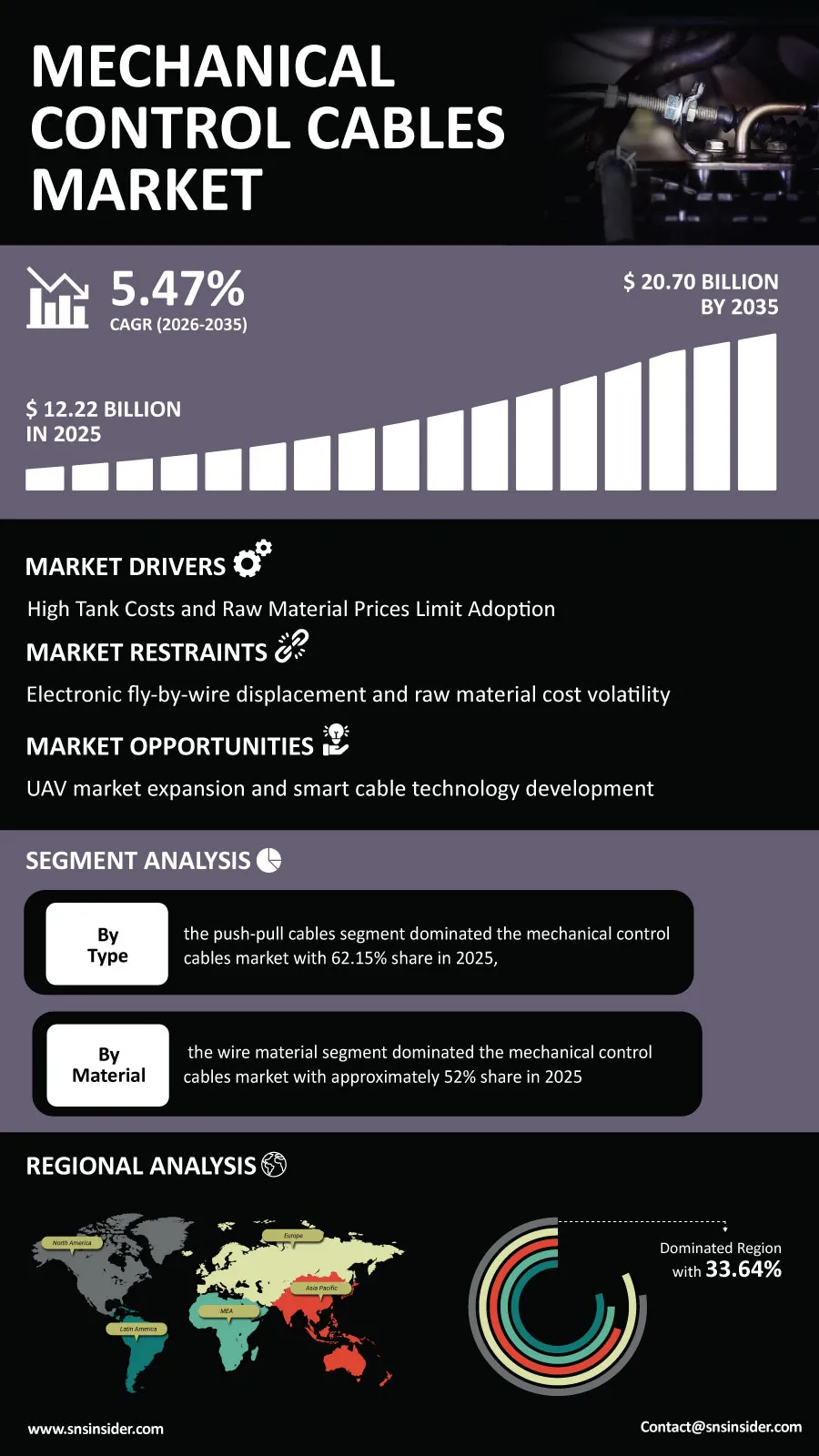
The global Mechanical Control Cables Market is poised for sustained growth as aerospace production, defense modernization, industrial machinery development, and advanced transportation systems continue to expand worldwide. “According to a recent study by SNS Insider, the global Mechanical Control Cables Market size valued at USD 12.22 billion in 2025, is anticipated to grow to USD 20.70 billion by 2035, registering a CAGR of 5.47% over the 2026–2035 forecast period.”
Cable actuators are still crucial elements when it comes to motion transmission for various mechanical systems employed by aircrafts, cars, boats, farm equipment, and other machines. Despite all technological advancements associated with digital technologies, there are sectors that still need reliable mechanical systems and invest in high-quality cable solutions.
Increasing investments into commercial air transport, modern military fleets, heavy equipment manufacturing and industrial automation contribute to long-term prospects for cable specialists. Innovation in terms of product development, such as lighter, corrosion-resistant and longer-life cable products, boosts market dynamics.
To Get Detailed Insights on This Market – Request a Sample Report
Aerospace Expansion and Defense Investments Create Long-Term Growth Opportunities
The rate of aircraft production is rapidly escalating due to fleet expansions by air companies and the development of better defense mechanisms by governments. These trends have been driving up the demand for advanced mechanical control cables that can provide consistent performances in critical operations.
Another factor behind the growth of the market is the automation of industrial processes that requires machines to use reliable motion-control solutions that not only make them more efficient but also need little maintenance. In addition, agricultural equipment, construction machinery, and other heavy-duty industrial vehicles require robust cable systems that function in harsh environments.
At the same time, research into advanced alloys, polymer coatings, and lightweight composite materials is enabling manufacturers to improve cable flexibility, reduce overall system weight, and extend operational lifespan across multiple industries.
Key Market Insights Reflect Growing Demand Across Diverse Applications
Based on type, Push-Pull Cables accounted for 62.15% of global market revenue in 2025 due to their extensive use across automotive, aerospace, and industrial control systems. Pull-Pull Cables are expected to register the fastest growth through 2035, supported by expanding applications in unmanned aerial vehicles and compact motion-control systems.
By material, Wire Material represented approximately 52% of market revenue in 2025, benefiting from superior mechanical strength and long-term durability. Jacket and Fiber Materials are forecast to expand at the fastest pace as industries increasingly adopt advanced protective materials for demanding operating environments.
In terms of application, Engine Control generated nearly 38% of total market revenue during 2025 owing to its broad deployment across transportation and industrial platforms. Brake Control is projected to witness the strongest growth throughout the forecast period as safety standards and performance requirements continue advancing.
By end use, the Commercial segment contributed around 60% of global revenue in 2025, while Defense is expected to emerge as the fastest-growing segment. Based on platform, Aerial applications segment has maintained market leadership during 2025, whereas Marine platforms are anticipated to record significant growth over the coming decade.
Advanced Engineering Innovations Accelerate Industry Transformation
The manufacturing companies are continuing to invest in next-generation engineering expertise that helps increase the reliability of products along with being able to support more challenging uses. Cables that have better corrosion resistance, increased flexibility, and low friction are contributing towards improved system performance in the areas of aviation, maritime, and industrial uses.
Innovations in the digital realm are also emerging within the sector in the form of smart cables with built-in sensors. Through such technologies, it becomes possible for organizations to monitor the health of their cables in real time and avoid any downtime.
As equipment manufacturers increasingly prioritize lifecycle efficiency, advanced mechanical control cable solutions are becoming an important element of modern mobility and industrial infrastructure.
North America Accounted for 33.64% Market Share in 2025; Asia Pacific Forecast to Expand at a 6.45% CAGR by 2035
North America held around 33.64% share of the global market revenue in 2025 owing to its presence of established aerospace industry, high-end manufacturing facilities and effective defense procurement programs. The United States remains the front-runner in terms of regional demand due to aircraft manufacture, military upgrades, automotive manufacturing, and industrial machinery development.
The Asia Pacific region is estimated to register the highest CAGR of 6.45% until 2035 with increased automotive manufacturing, aviation investments, industrialization, and defense upgradations in countries including China, India, Japan, and Southeast Asia. Initiatives from governments for increasing indigenous manufacturing and infrastructure have made regional market prospects more lucrative.
Europe continues to show stable growth with its strength in aerospace manufacturing, automotive engineering, and industrial modernization. On the other hand, Latin America and the Middle East & Africa are slowly increasing their demand via aviation, defense, marine, and infrastructural investments.
Industry Participants Focus on High-Performance Motion Control Solutions
Competition across the global mechanical control cables market continues to intensify as manufacturers strengthen engineering capabilities, introduce advanced materials, and expand production capacity to support evolving customer requirements. Continuous investment in lightweight technologies, aerospace-qualified products, and intelligent monitoring solutions is enabling companies to improve product differentiation while addressing growing demand across transportation, industrial, and defense sectors.
Key companies operating in the global Mechanical Control Cables Market include Triumph Group Inc., Loos & Co. Inc., Bergen Cable Technology Inc., Cablecraft Motion Controls, Orscheln Products LLC, Tyler Madison Inc., Wescon Controls, Glassmaster Controls Company Inc., Kongsberg Automotive ASA, Dunlop Aircraft Tyres Ltd., Hi-Lex Corporation, Suprajit Engineering Ltd., AeroControlex (Parker Hannifin), Crane Aerospace & Electronics, Elliott Manufacturing Co. Inc., Carl Stahl Sava Industries, Sievert Larson Rigg, Grand Rapids Controls LLC, Dura Automotive Systems LLC, and LEONI AG.
An SNS Insider analyst Santosh Bhul commented, "Increasing investments in aerospace manufacturing, defense modernization, and advanced industrial automation continue to strengthen demand for precision mechanical control systems worldwide. Companies focusing on lightweight engineering, intelligent monitoring technologies, and high-performance cable materials will be well positioned to capitalize on long-term market opportunities as global mobility and industrial infrastructure continue evolving."
About the Author

Get in touch