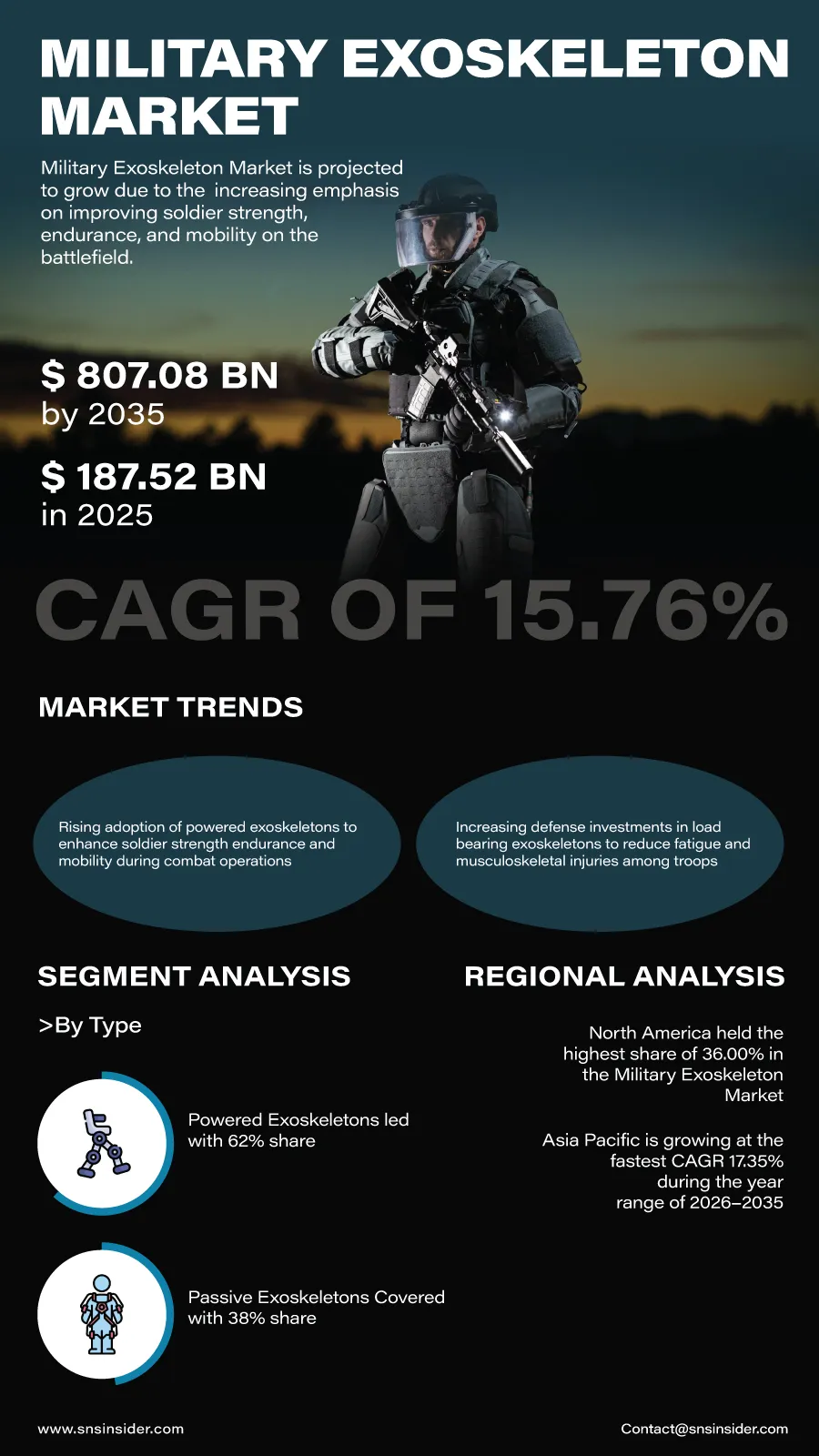
The global Military Exoskeleton Market is set for substantial expansion over the next decade as defense organizations invest in advanced soldier augmentation technologies to improve operational effectiveness and reduce physical strain during demanding missions. According to a recent study by SNS Insider, the global Military Exoskeleton Market size valued at USD 187.52 million in 2025, is anticipated to grow to USD 807.08 million by 2035, registering a CAGR of 15.76% over the 2026–2035 forecast period.
Modernization projects in the defense sector have become highly focused on the development of exoskeletons, which help increase strength, endurance, and mobility of soldiers, making them less susceptible to fatigue even after long hours of service. With increasing complexity in future environments, exoskeleton systems could become essential equipment for enhanced mission effectiveness.
Constant innovations in such areas as material science, batteries, control systems, and design are contributing significantly to the process of product development. This makes it possible to introduce exoskeleton systems suitable for use in various military operations.
Defense Modernization Programs Create Significant Growth Opportunities
Global governments are investing in the development of new-generation defense technologies for better survivability and preparedness of the soldiers. The use of exoskeleton technology is being considered to be one such solution that would allow the personnel to carry heavy loads, walk long distances, and perform effectively in a challenging environment.
The increasing usage of wearable devices, artificial intelligence, and performance monitoring in exoskeleton technology is leading to more functionalities. This would provide better situational awareness to the commanders along with effective management of the resources.
Furthermore, increased investments in the field of rehabilitation technologies, injury prevention, and military health care systems are opening up many business opportunities in the industry for companies developing exoskeleton technology.
Key Market Insights Highlight Shifting Demand Patterns
By type, powered exoskeletons are expected to account for 62% of global market revenue in 2025 owing to their ability to significantly enhance soldier strength, endurance, and load-carrying capacity during field operations. Passive exoskeletons are projected to register the fastest growth through 2035 as defense organizations increasingly adopt cost-effective solutions for reducing fatigue and preventing musculoskeletal injuries.
Based on mobility, lower body exoskeletons are anticipated to contribute 44% of market revenue in 2025 due to their widespread use in improving mobility across demanding terrain. Full body exoskeletons are forecast to witness the fastest growth as military research programs continue advancing comprehensive soldier augmentation systems.
In terms of application, load carrying and logistics support are expected to represent 39% of market revenue in 2025, reflecting the growing need to improve operational endurance while reducing physical stress on personnel. Rehabilitation and injury prevention are projected to emerge as the fastest-growing application segment as military organizations strengthen long-term health and recovery initiatives.
By end user, the army is forecast to account for 51% of market revenue in 2025 because of its extensive deployment requirements across infantry, logistics, and combat support units. Special forces are expected to register the fastest growth through 2035 as elite military units continue adopting advanced wearable technologies for high-risk missions.
Intelligent Wearable Systems Reshape Battlefield Operations
Military Exoskeleton technology is advancing from simple mechanical augmentation into intelligent wearable devices that allow operational decisions to be made in real time. Robotics, advanced control software, artificial intelligence in motion support and communications are all contributing to improving soldier performance and overall mission efficiency.
Similarly, equipment manufacturers are focusing on reducing weight, enhancing battery longevity, and improving durability in order to ensure use in different settings. These developments are expected to accelerate wider adoption as military organizations look for enhanced flexibility in their soldier augmentation solutions.
Regional Markets Demonstrate Strong Investment Momentum
North America is expected to dominate the market share of 36.00% worldwide in 2025, owing to high defense spending, high militarization efforts, and investment in futuristic soldier enhancement technologies. High levels of cooperation between defense departments, R&D centers, and technology providers have consistently driven the dominance of the region in the market.
Asia-Pacific is expected to be the most rapidly growing market in terms of CAGR of 17.35%, growing until 2035. The reason behind this rapid growth is increasing defense spending, growing domestic manufacturing capacity, and investments in next-generation battlefield technologies.
As military organizations continue strengthening force modernization programs, adoption of wearable robotic systems is expected to increase across both established and emerging defense markets.
Industry Participants Focus on Innovation and Advanced Soldier Augmentation
The competitive landscape still remains very dynamic due to continuous research into the development of powered exoskeletons, light-weight materials, smart controls, and battlefield integration by companies operating in the defense technology industry. Collaborations and innovations are key ingredients for success in the market.
Key companies operating in the global Military Exoskeleton Market include Lockheed Martin Corporation, Sarcos Technology and Robotics Corporation, Rostec State Corporation, Safran SA, BAE Systems plc, Dephy Inc., Ekso Bionics Holdings Inc., Bionic Power Inc., SRI International, SpringActive Inc., 20 Knots Plus Ltd, General Atomics, Raytheon Technologies Corporation, Boeing, General Dynamics Corporation, Honeywell Aerospace, Aselsan A.S., CYBERDYNE Inc., QinetiQ Group plc, and Northrop Grumman Corporation.
An SNS Insider analyst Santosh Bhul commented, “Growing investments in soldier modernization, wearable robotics, and battlefield digitization are accelerating the adoption of military exoskeleton technologies. Companies that prioritize lightweight designs, intelligent assistance systems, and operational reliability will be well positioned to capitalize on expanding defense procurement opportunities over the coming decade.”
About the Author

Get in touch