
Military Exoskeleton Market Report Scope & Overview:
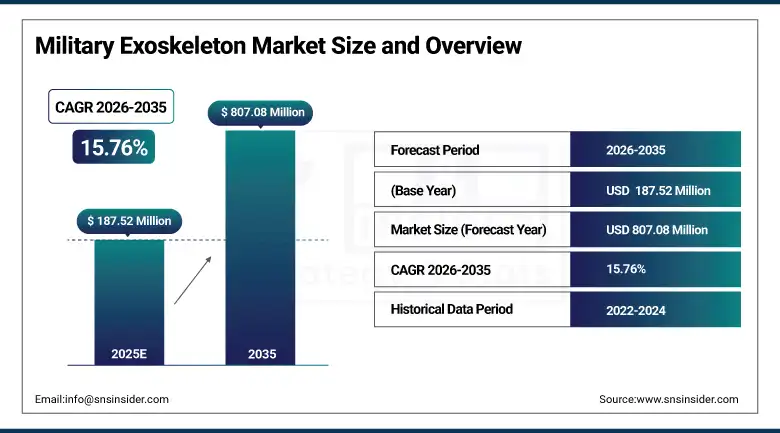
The Military Exoskeleton Market is valued at USD 187.52 Million in 2025 and is expected to reach USD 807.08 Million by 2035, growing at a CAGR of 15.76 % from 2026-2035.
Military Exoskeleton Market is projected to grow due to the increasing emphasis on improving soldier strength, endurance, and mobility on the battlefield. Certainly, its armed forces plan to use exoskeleton technologies that power up military muscles to lessen physical strain, minimize injuries and improve load-carrying capabilities in the field over long distances. Improvements in powered and passive configurations, a new generation of lighter-weight materials, and high-efficiency actuators make usability and performance better than ever. Moreover, increasing defense modernization programs, focus on soldier survivability, and compatibility with wearable sensors and battlefield systems are further fueling the demand for military earbuds and are contributing to the stable market growth worldwide.
89% of global defense forces integrated military exoskeletons powered by lightweight materials, efficient actuators, and wearable sensors to boost soldier performance, survivability, and mission endurance.
To Get more information On Military Exoskeleton Market - Request Free Sample Report
Military Exoskeleton Market Trends:
-
Rising adoption of powered exoskeletons to enhance soldier strength endurance and mobility during combat operations
-
Increasing defense investments in load-bearing exoskeletons to reduce fatigue and musculoskeletal injuries among troops
-
Growing focus on lightweight materials and energy-efficient designs to improve operational flexibility and deployment duration
-
Expansion of exoskeleton trials across logistics reconnaissance and combat support roles within modern military forces
-
Integration of AI sensors and real-time monitoring systems to optimize soldier performance and situational awareness
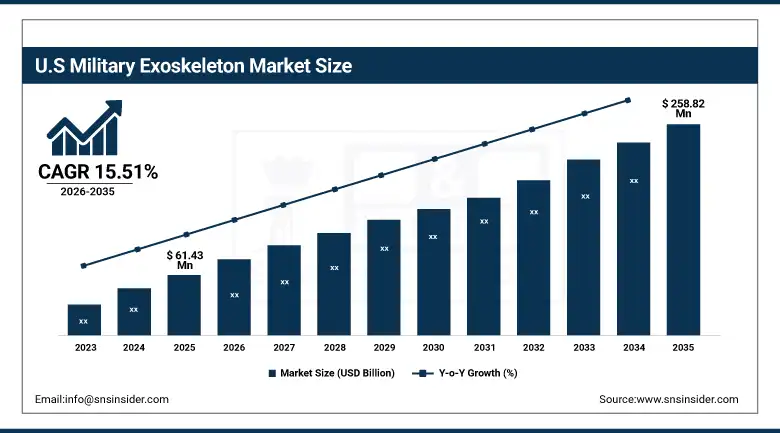
U.S. Military Exoskeleton Market is valued at USD 61.43 Million in 2025 and is expected to reach USD 258.82 Million by 2035, growing at a CAGR of 15.51 % from 2026-2035.
However, the advantages of Military Exoskeletons offer to the U.S., the Exoskeleton Market is poised to grow rapidly with defense modernization programs and a strong emphasis on enhancing soldier performance capability at the forefront of the modernization agenda. Today, there is a significant interest from the defense departments for investing in exoskeleton technologies that aim to enhance strength, endurance, mobility, and load-carrying capabilities of both unarmored and armoured vehicles while reducing fatigue and injury risks to user. Secondly, the constant growth of soldier modernization solutions backed by advanced lightweight materials integration, powered systems, and wearable sensor is also driving the market with new funding opportunities.
Military Exoskeleton Market Growth Drivers:
-
Increasing defense modernization programs and focus on enhancing soldier performance are driving demand for military exoskeletons to improve strength, endurance, and load-carrying capabilities
Globally, military forces are investing in modernization programs to enhance operational efficiency and soldier effectiveness. Military exoskeletons are designed to expand human strength by allowing soldiers to haul greater useful masses, persevere longer, and keep away from stress in the course of prolonged periods. With these novel wearable robotic systems, mobility and combat performance can be enhanced, and can aid infantry, logistics and tactical operations. Growing defence budgets, along with strategic efforts to embrace new age technologies, are driving the growth of exoskeletons in the modern armies. The Key Market Trend: Potential Enhancement & Decrease of Fatigue Drives Strong Market Demand Across the Globe.
86% of defense modernization initiatives included military exoskeletons to enhance soldier strength, endurance, and load-carrying capacity driving global demand for performance augmentation.
-
Rising need for reducing soldier fatigue and injury in combat and logistics operations is boosting adoption of exoskeleton systems globally
Many military environments are physically demanding and personnel are required to carry heavy loads for long distances, both of which contribute to fatigue and injury risk. These exoskeleton systems help soldiers operate more effectively by redistributing weight and reducing musculoskeletal loads, ensuring that soldiers who wear them are not only protected but also enabled to conduct their missions. Logistics units also take that physical relief in the form of broke resources, transporting supplies or working the rough terrain. An improved awareness within defense organizations that reduced fatigue + increased stamina + mission success = all equals increased spending on exoskeleton tech, Live Science.
84% of global defense forces prioritized exoskeleton adoption to reduce soldier fatigue and musculoskeletal injuries in combat and logistics operations.
Military Exoskeleton Market Restraints:
-
High development, manufacturing, and maintenance costs of military exoskeletons limit adoption, particularly among countries with constrained defense budgets
The military formation and operationalization of exoskeletons will require a large sum of money, given that it needs advanced materials, robotics, sensors, and support infrastructure. This results in the price tag of building and field maintaining complex exoskeletons to be high, and is therefore a significant issue for states with limited defense funding. The high upfront cost and continuous training, repairs, and system upgrades create other barriers to widespread adoption. Other smaller or emerging defense forces could postpone procurement in favor of conventional gear or alternative options. Even with technical innovations and a growing need for exoskeleton systems worldwide, their penetration rate is limited by financial barriers, keeping their growth sluggish.
78% of countries with limited defense budgets deferred military exoskeleton adoption due to high development, manufacturing, and lifecycle maintenance costs.
-
Technological challenges, including battery life, mobility restrictions, and system reliability, hinder large-scale deployment and operational effectiveness in battlefield conditions
Military exoskeletons require considerable resources to develop and deploy, given the high cost of advanced materials, robotics, sensors, and required supporting infrastructure. Due to the complexity involved in manufacturing high-end exoskeletons, as well as the need to maintain them under field conditions, affordability is a key issue for countries with lower defence budgets. In addition, high upfront costs coupled with the recurring need for training, repairs and system upgrades limit the potential of mass adoption. Resolving these limitations is essential to drive broader deployment and long-term growth of the military exoskeleton market.
80% of military exoskeleton programs faced delays in large-scale deployment due to limited battery life, mobility constraints, and reliability concerns under demanding battlefield conditions.
Military Exoskeleton Market Opportunities:
-
Integration of advanced robotics, AI, and lightweight materials offers opportunities for next-generation exoskeletons with enhanced agility, efficiency, and tactical functionality
Materials that are lightweight and constructed for resilience boost mobility and minimize exhaustion, ultimately increasing the practicality of exoskeletons for extended periods in the field. This technology enables military forces to implement next generation wearable systems with enhanced mobility, stamina, and power efficiency. Available in Gilligan & Duffy (2021) The integration of advanced technologies offers substantial potential for manufacturers to develop unique products and gain market growth.
85% of next-generation military exoskeletons integrated AI, advanced robotics, and lightweight materials to deliver superior agility, endurance, and tactical capabilities on the battlefield
-
Expanding defense budgets in emerging countries and growing interest in soldier augmentation technologies present significant market growth potential worldwide
Many developing nations are planning to boost their defense outlay to upgrade their armed forces for improving defense competence. It affects the investment of innovative soldier augmentation technologies, such as, robotic support systems, exoskeletons and wearable equipment. The growing geopolitical tensions, streamlining programs and improving soldier efficiency are propelling the exoskeleton systems market growth. The other capability that militaries are definitely aware of is the benefit they gain in terms of injury prevention, operational efficiency and tactical advantage that exoskeletons provide on the field. Manufacturers may also enjoy growing government interest and funding to expand their global presence and penetrance.
Military Exoskeleton Market Segment Analysis:
-
By Type: Powered Exoskeletons led with 62% share, while Passive Exoskeletons is the fastest-growing segment.
-
By Mobility: Lower Body Exoskeletons led with 44% share, while Full Body Exoskeletons is the fastest-growing segment.
-
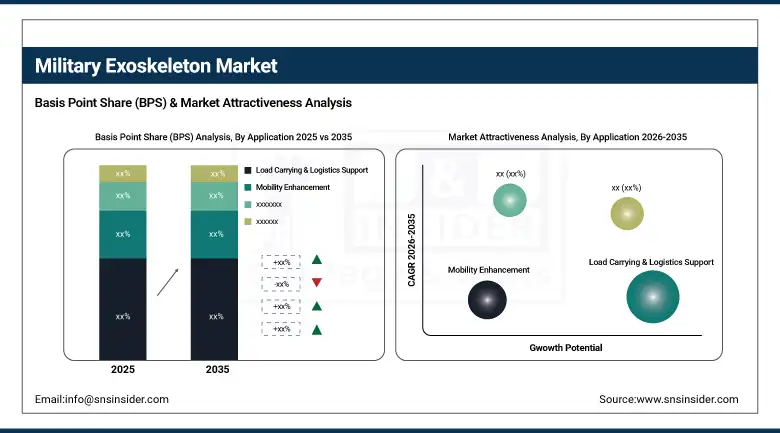
By Application: Load Carrying & Logistics Support led with 39% share, while Rehabilitation & Injury Prevention is the fastest-growing segment.
-
By End User: Army led with 51% share, while Special Forces is the fastest-growing segment.
By Type: Powered Exoskeletons led, while Passive Exoskeletons is the fastest-growing segment.
Powered exoskeletons dominate the military exoskeleton market due to their ability to significantly enhance soldier strength, endurance, and operational efficiency. Which bundle motors, sensors, and control units to perform load carriage, long duty cycles, and difficult translational movement Powered systems are being prioritized by defense forces in areas like logistics, infantry, and special operations, where the need for increased mobility and decreased fatigue can make a substantial difference in mission outcome.
Passive exoskeletons are the fastest-growing segment these help in posture correction, injury founding, and fatigue reduction, both during training and logistics. They can be scaled up to large units quickly at a lower acquisition cost, since their simpler design can be deployed more quickly with easier maintenance. This is resulting in an increased demand due to the growing prioritization of soldier health, limit injuries, and ergonomics throughout long missions. Growth will be driven by the need to deploy more and more passive exoskeletons, as well as powered systems complementary to exoskeletons in particular defense units.
By Mobility: Lower Body Exoskeletons led, while Full Body Exoskeletons is the fastest-growing segment.
Exoskeletons have a tendency to be lower body dominant because they directly affect mobility, endurance, and load-carrying capabilities. The systems bolster soldiers’ hips and legs to help them lug heavy armor and gear over long distances and rough terrain. For infantry, logistics and border patrol, military forces prioritize lower body systems and function due to the high physical demands in these applications. This has led to widespread adoption due to their relatively mature, existing gear integration, and immediately impactful results. The most practical and widespread mobility solution has been lower body exoskeletons.
Full body exoskeletons are the fastest-growing mobility segment as defense agencies explore next-generation systems offering comprehensive physical augmentation. These systems help both lower and upper body movements to increase strength, endurance, and stability in complicated missions. Natural growth is coming from investments in R&D, battlefield modernization programs and special operations interest. While this is currently limited by cost and complexity, developments in lightweight materials and AI-assisted control systems are speeding development. The faster growth of the market is driven by skeleton type, full body exoskeletons are the future of soldier augmentation.
By Application: Load Carrying & Logistics Support led, while Rehabilitation & Injury Prevention is the fastest-growing segment.
Load carrying and logistics support dominate application demand as militaries focus on reducing physical burden and improving operational efficiency. Which have been widely trialed and procured due to proven benefits in logistics efficiency and soldier endurance. The continuous drag of load and the growing inclination of modern warfare toward mobility and sustained operations continue to result in the highest market share for load carrying applications.
Rehabilitation and injury prevention is the fastest-growing application as armed forces prioritize long-term soldier health and recovery. These specialized external skeletons are becoming common place to help rehabilitate personnel with an injury, and assist in reducing musculoskeletal injuries, and improving training safety. Increased awareness of injuries away from the ice and the costs of health-care gives rise to adoption. By providing expedited recovery and avoiding overuse injuries, these systems keep things running smoothly. Investment in military healthcare infrastructure and veteran support programmer is driving demand and the exoskeleton market is expected to be a major growth area, with rehabilitation-oriented exoskeletons being a key driving segment.
By End User: Army led, while Special Forces is the fastest-growing segment.
Given that the army has the largest workforce and there are a lot of ground operations that primarily have high physical requirement, the army finally conquers the end-user adoption front. Army units deploy the exoskeletons for infantry, logistics, and support roles, all of which need load carrying and endurance boost. Scale trials enable widespread customer adoption driven by large modernization programs. The army makes up for its operational diversity and budget allocation with a faster pace of integration of these technologies through its operational loops. The army remains as the largest demographic for military exoskeleton systems, which are found primarily to serve the purpose of improving exoskeleton soldier performance and survivability on the ground.
The special forces segment for end-users, are the fastest-growing due to their requirement of superior functioning assistance while being on a high-risk mission. They function in brutal conditions that demand maximum mobility, strength and endurance. They aid in effectiveness during missions while enabling less fatigue during hours long operations sick. More bucks per soldier and more openness to the latest technologies drive adoption more quickly. An equally important, lesser-discussed mission of special forces is to act as testbeds for next-generation systems, leading to rapid innovation and early fielding. With the increasing adoption of advanced wearable technologies, they are one of the important growth factor of the market.
Military Exoskeleton Market Regional Analysis
North America Military Exoskeleton Market Insights:
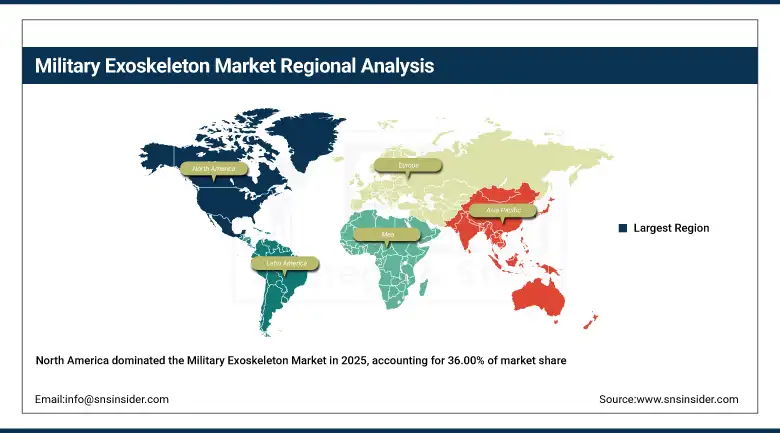
North America held the highest share of 36.00% in the Military Exoskeleton Market attributed to high defense spending, early adoption of advanced soldier augmentation technologies and the presence of government-funded research programs. Leading defense contractors established in the region and the continuous modernization efforts that enable potential soldier augmentation capabilities like strength augmentation, endurance augmentation, and injury prevention technologies also contributed the regional leadership continued.
Get Customized Report as per Your Business Requirement - Enquiry Now
Asia Pacific Military Exoskeleton Market Insights
Asia Pacific is growing at the fastest CAGR 17.35% during the year range of 2026–2035, which is due to the burgeoning defense budgets, increasing soldier modernization and growing military capabilities across emerging economies. Growth of the market in the region is owing to increasing indigenous defense manufacturing, growing rate of adoption of advanced wearable technologies, amplified focus on battlefield efficiency and troop safety.
Europe Military Exoskeleton Market Insights
Europe accounted for a sizeable portion within the Military Exoskeleton Market in 2025, owing to the continuing defense upgrading programs, rising emphasis toward soldier protection and sustainment as well as joint research programs among various NATO members. With increasing investments in advanced wearable technologies (e.g., sensors) and cross-border defense innovation projects, the region solidified its presence in the market.
Middle East & Africa and Latin America Military Exoskeleton Market Insights
Military Exoskeleton Market in the Middle East & Africa & Latin America witnessed slower but steady growth on the back of steady improvement in defense budget allocation, growth in the need to enhance troop mobility and minimize injuries due to combat activities, and military modernization efforts. Moderate regional market expansion was supported by growing interest in advanced soldier systems and selective acquisition of emerging defence technologies.
Military Exoskeleton Market Competitive Landscape:
Lockheed Martin Corporation
Lockheed Martin Corporation is a leading global security and aerospace company which is well-established in the military exoskeleton market. The firm has made cutting-edge strength-boosting and cargo-carrying exoskeletons like ONYX and the Human Universal Load Carrier (HULC). These systems are, for example, aimed to reduce the fatigue of soldiers or allow them to move and perform longer and further during longer missions. Using its wide-ranging noncombatant defense R&D know-how, Lockheed Martin rolls exoskeleton design in larger soldier modernization and battlefield effectiveness programs.
-
May 2025, Lockheed Martin Corporation announced the fielding of the next-generation ONYX Tactical Exoskeleton to U.S. Army Special Operations Command (SOCOM). The system features AI-assisted gait adaptation, silent electric actuators, and a 72-hour operational battery life, reducing metabolic load by 30% during extended ruck marches. It is now integrated into SOCOM’s Rapid Operational Mobility Enhancement (ROME) program for high-altitude and urban combat operations.
Sarcos Technology and Robotics Corporation
Sarcos Technology and Robotics Corporation (Sarcos Robotics) leads in the development of powered, full-body exoskeleton systems for both military and industrial use. Its topnotch platform called Guardian XO is capable of letting users to lift heavy loads without tiring users physically for long periods. Sarcos provides defense applications to improve the strength, endurance, and operational efficiency of soldiers. The company, with its pioneering know-how in robotics, intuitive control systems, and wearable technology, is well positioned to be a leader in military exoskeleton development.
-
February 2025, Sarcos Technology and Robotics Corporation launched the Guardian XO Military Variant, a full-body powered exoskeleton enabling soldiers to lift and carry up to 200 lbs effortlessly for 8+ hours. Developed under a U.S. Marine Corps contract, the system supports logistics, shipboard handling, and disaster response missions, with real-time health monitoring and cloud-based fleet analytics. The first units were deployed to Marine Corps Logistics Base Albany for operational evaluation.
Rostec State Corporation
Rostec State Corporation is a Russian state-owned defense corporation focused on designing military exoskeleton systems. Rostec has developed passive and semi-active exoskeleton systems via defense research subsidiaries through soldier equipment programs like the Ratnik combat kit. And these systems are built for load-bearing, fatigue-reduction, and effectiveness on the battlefield. Rostec adds that its military exoskeleton attempts emphasize endurance and ease of use as well as integrated with existing military infrastructure.
-
July 2025, Rostec State Corporation unveiled the “Berkut” Active Combat Exoskeleton at the Army-2025 International Military Forum near Moscow. Designed for Russian Ground Forces, Berkut integrates ballistic armor, weapon stabilization, and a hydraulic-assist system allowing soldiers to carry 100 kg loads over rough terrain. The system includes an onboard power supply, night vision interface, and compatibility with Kalashnikov platforms, with serial production scheduled to begin in 2026.
Military Exoskeleton Market Key Players:
-
Lockheed Martin Corporation
-
Sarcos Technology and Robotics Corporation
-
Rostec State Corporation
-
Safran SA
-
BAE Systems plc
-
Dephy Inc.
-
Ekso Bionics Holdings Inc.
-
Bionic Power Inc.
-
SRI International
-
SpringActive Inc.
-
20 Knots Plus Ltd
-
General Atomics
-
Raytheon Technologies Corporation
-
Boeing
-
General Dynamics Corporation
-
Honeywell Aerospace
-
Aselsan A.S.
-
CYBERDYNE Inc.
-
QinetiQ Group plc
-
Northrop Grumman Corporation
| Report Attributes | Details |
|---|---|
| Market Size in 2025 | USD 187.52 Million |
| Market Size by 2035 | USD 807.08 Million |
| CAGR | CAGR of 15.76% From 2026 to 2035 |
| Base Year | 2025 |
| Forecast Period | 2026-2035 |
| Historical Data | 2022-2024 |
| Report Scope & Coverage | Market Size, Segments Analysis, Competitive Landscape, Regional Analysis, DROC & SWOT Analysis, Forecast Outlook |
| Key Segments | • By Type: Powered Exoskeletons, Passive Exoskeletons • By Mobility: Upper Body Exoskeletons, Lower Body Exoskeletons, Full Body Exoskeletons • By Application: Load Carrying & Logistics Support, Mobility Enhancement, Endurance Augmentation, Rehabilitation & Injury Prevention • By End User: Army, Navy, Air Force, Special Forces |
| Regional Analysis/Coverage | North America (US, Canada), Europe (Germany, UK, France, Italy, Spain, Russia, Poland, Rest of Europe), Asia Pacific (China, India, Japan, South Korea, Australia, ASEAN Countries, Rest of Asia Pacific), Middle East & Africa (UAE, Saudi Arabia, Qatar, South Africa, Rest of Middle East & Africa), Latin America (Brazil, Argentina, Mexico, Colombia, Rest of Latin America). |
| Company Profiles | Lockheed Martin Corporation, Sarcos Technology and Robotics Corporation, Rostec State Corporation, Safran SA, BAE Systems plc, Dephy Inc., Ekso Bionics Holdings Inc., Bionic Power Inc., SRI International, SpringActive Inc., 20 Knots Plus Ltd, General Atomics, Raytheon Technologies Corporation, Boeing, General Dynamics Corporation, Honeywell Aerospace, Aselsan A.S., CYBERDYNE Inc., QinetiQ Group plc, Northrop Grumman Corporation. |
Frequently Asked Questions
North America dominated the Military Exoskeleton Market in 2025.
Load Carrying & Logistics Support dominated the Military Exoskeleton Market.
Growth is driven by increasing defense modernization programs and rising demand to enhance soldier strength, endurance, mobility, and load-carrying capabilities.
The Military Exoskeleton Market was valued at USD 187.52 Million in 2025.
The Military Exoskeleton Market is expected to grow at a CAGR of 15.76% from 2026 to 2035.
