
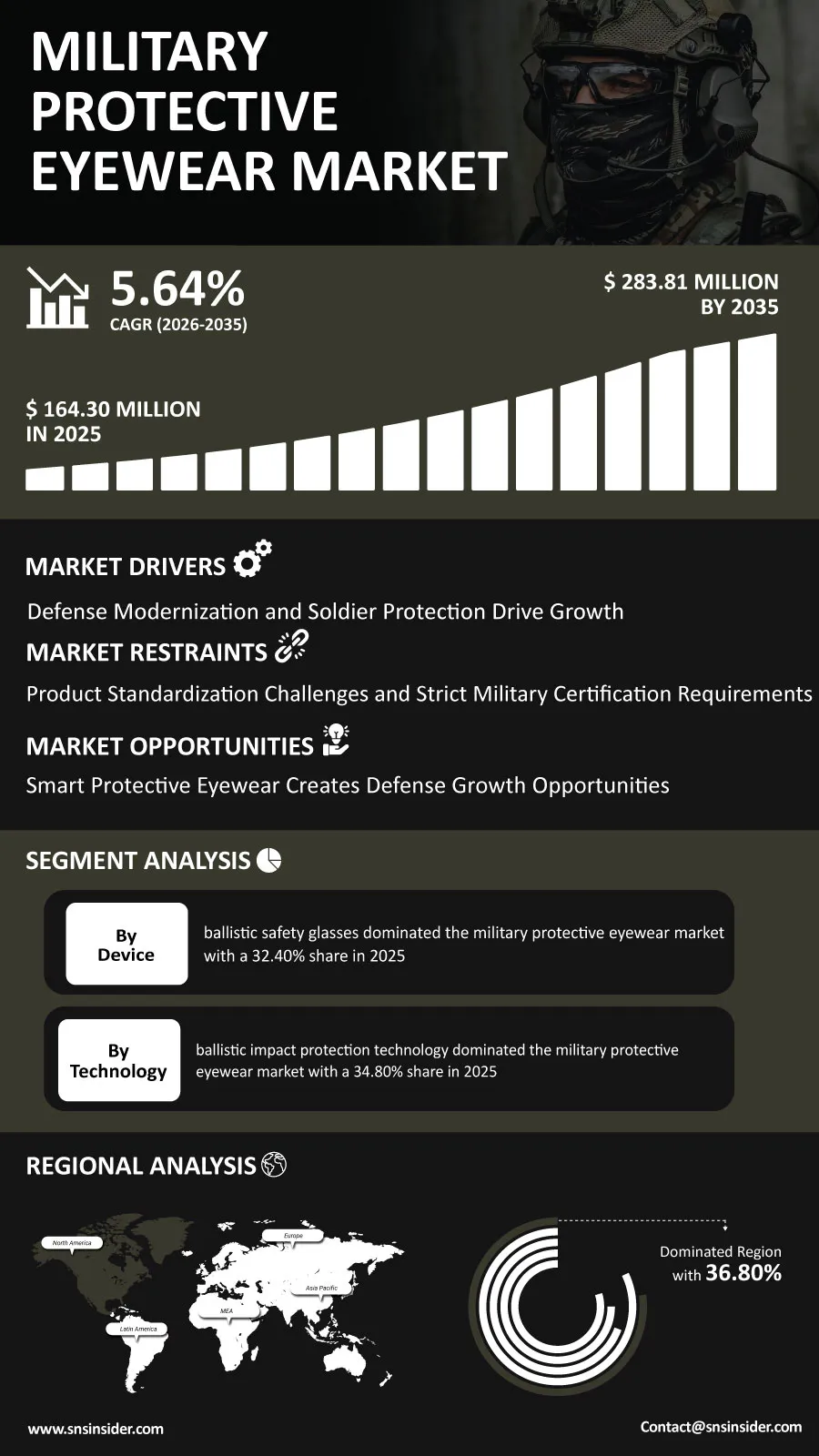
The global Military Protective Eyewear Market is gaining momentum as defense organizations place greater emphasis on soldier survivability, battlefield visibility, and advanced personal protection. “According to a recent study by SNS Insider, the global Military Protective Eyewear Market size valued at USD 164.30 Million in 2025, is anticipated to grow to USD 283.81 Million by 2035, registering a CAGR of 5.64% over the 2026–2035 forecast period.”
Contemporary warfare demands devices that can function efficiently in a rapidly fluctuating environment. In this regard, the current trend indicates that protective eyewear needs to become something more than merely resistant to impacts, as there are products currently under development that would be able to cope with ballistics, distortion, bright light, fogging, scratches, and even lasers. Compatibility with helmets and other devices becomes another growing demand.
Defense acquisition programs in various economic powerhouses have facilitated continuous demand. Spending on troops modernization, border monitoring, dedicated combat forces, and tactical preparedness has enabled armed forces to shift from heavy protective gear to more lightweight and flexible gear.
To Get Detailed Insights on This Market – Request a Sample Report
Defense Modernization Creates New Opportunities for Advanced Eye Protection
The upgrade of the equipment of military forces gives rise to the emergence of new products which will not only provide protection but also improve visual performance. Light polycarbonate lenses, new coating, modularity, and helmet compatibility have become an increasingly important criterion when buying defense goods.
One more interesting field is represented by smart eyewear. By combining smart eyewear with AR displays and other wearables, it will be possible for operators to receive information without the need to use any other devices. In this regard, the market players try to develop eyewear solutions that will integrate both protective and digital features.
Increased demand within special operation teams is highly advantageous for high-end products since members of such teams work in tough conditions where weight, compatibility, optics, and quick response to varying lighting levels play a significant role.
Key Market Insights Highlight Shifting Procurement Priorities
By device, ballistic safety glasses accounted for 32.40% of market revenue in 2025, reflecting their broad applicability across military personnel and training environments. Integrated helmet-mounted displays are projected to register the fastest growth through 2035 as defense agencies pursue connected soldier systems and enhanced situational awareness.
Based on technology, ballistic impact protection represented 34.80% of the market in 2025. Photochromic lens technology is expected to expand at the fastest pace as adaptive lenses offer greater visual flexibility across changing battlefield and training conditions.
By application, combat operations held the leading position with 36.50% market share in 2025. Special forces operations are forecast to grow fastest as elite units increasingly require lightweight, high-performance eyewear compatible with other tactical equipment.
By end user, the Army generated the largest share at 38.60% in 2025, while special operations forces are expected to represent the fastest-growing segment during the forecast period.
Smart Optical Technologies Accelerate Military Equipment Transformation
Innovation in military eyewear is now focused on its multifunctional features. Designers have set themselves the task of increasing optical quality, strength, durability under any environmental conditions, comfort and reducing the weight of products. The appearance of antifog and scratch-resistant coatings will be crucial for providing good visibility in the course of lengthy operations.
The introduction of augmented reality and heads-up display functions can also play an essential role in shaping the future of military eyewear. Integrating eyewear into wearable technology worn by soldiers can provide real-time information directly in their field of vision.
North America Accounted for 36.80% Market Share in 2025; Asia Pacific Forecast to Expand at the Fastest CAGR by 2035
North America was the leader in the worldwide market, accounting for approximately 36.80% revenue share in 2025 due to significant defense spending, state-of-the-art military procurement programs, and existing soldier protection programs in the U.S. and their allies. The market size in the U.S. was estimated at USD 47.40 million in 2025 and is expected to grow up to approximately USD 73.32 million by 2035.
The most rapid growth through 2035 will be observed in Asia Pacific because of growing defense spending, ongoing military modernization, increased demands on border security, and domestic manufacture of defense products in China, India, and other countries.
Europe is an important market as well since governments increase the defense potential and aim at improving interoperability of allied armed forces. The same trend is observed in Middle East, Africa, and Latin America, where nations invest in tactical equipment.
Industry Participants Prioritize Protection, Integration and Field Performance
Competition remains active companies are developing technologies involving high-tech materials, modularity, optics, and soldier systems. The emphasis in product development is on combining protection and comfort along with other considerations.
Key companies operating in the global Military Protective Eyewear Market include 3M, Oakley Standard Issue, Revision Military, ESS Eyewear, Wiley X, Smith Optics, Honeywell International, Bolle Safety, MCR Safety, Gentex Corporation, Thales Group, BAE Systems, Elbit Systems, Safariland Group, Avon Protection, POC Sports, Pilla Performance Eyewear, Uvex Safety Group, Armorsource, and Survitec Group.
An SNS Insider analyst Santosh Bhul commented, “The evolution of military operations is increasing the need for protective eyewear that combines reliable impact protection with advanced optical and digital capabilities. Continued defense modernization and growing investment in connected soldier technologies should create attractive opportunities for manufacturers delivering lightweight, adaptable, and mission-ready solutions.”
About the Author

Get in touch




