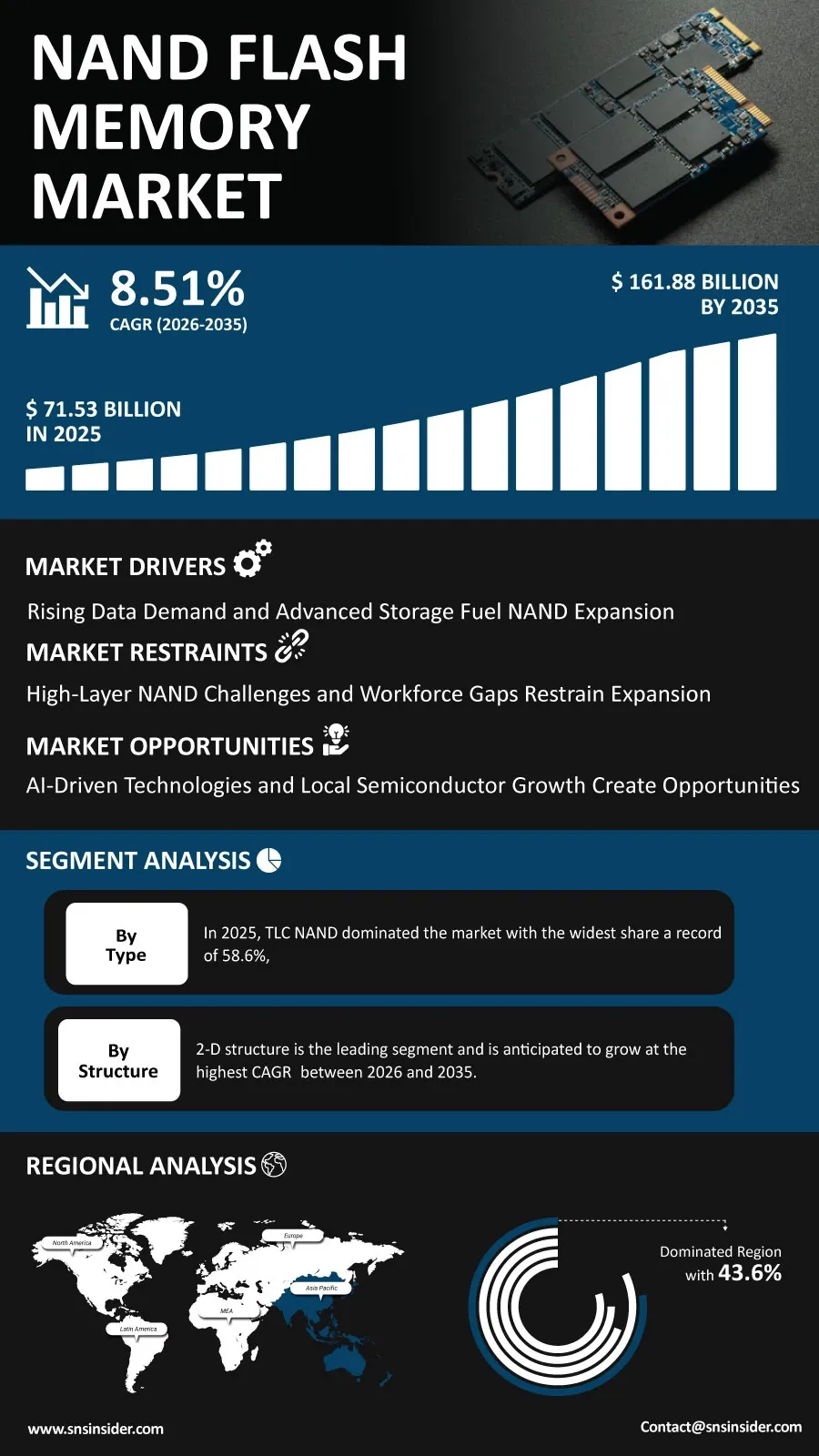
The global NAND Flash Memory Market is entering a sustained growth phase as rising data volumes, expanding AI infrastructure, and increasing demand for high-capacity digital storage reshape the semiconductor landscape. According to a recent study by SNS Insider, the global NAND Flash Memory Market size valued at USD 71.53 billion in 2025, is anticipated to grow to USD 161.88 billion by 2035, registering a CAGR of 8.51% over the 2026–2035 forecast period.
The fast-paced emergence of cloud services, data centers, cell phones, IoT devices, and enterprise computing has created an increased demand for more compact and energy-efficient storage technologies. This is what the semiconductor industry has been working hard to achieve through advanced memory design and storage solutions to meet the growing demands of application.
The shift toward AI computing has resulted in even more emphasis being put on the technology of NAND flash memory. Fast storage technologies have become more relevant to data-intensive applications while the automotive, edge computing, and industrial sectors offer more scope for their deployment.
To Get Detailed Insights on the NAND Flash Memory Market – Request a Sample Report
AI Infrastructure and Advanced Storage Create New Growth Opportunities
The rise in the volume of data generated due to the increasing use of AI and machine learning is creating a need for efficient storage solutions. This is leading to an increased deployment of storage based on solid-state drives, thereby creating a positive environment for companies that manufacture NAND flash memory.
On the customer side, there is a continued need for more storage capacity due to the complexity of applications being developed and the high amount of resolution-intensive data created by the users. 3D NAND technology advancements have facilitated the increase in capacity in addition to being economically feasible in the development of storage products.
There is also an increase in the market size due to the rise in the use of semiconductors in autonomous vehicles, smart factories, and edge computing. Governments' efforts in bolstering their semiconductor ecosystems will motivate further investments in semiconductor manufacturing and research.
Key Market Insights Highlight Shifting Demand Patterns
By type, TLC NAND was holding approximately 58.6% of global market revenue in 2025, supported by its balanced combination of capacity, performance, endurance, and cost. QLC NAND is projected to register the fastest growth through 2035 as hyperscale data centers and other storage-intensive applications seek greater capacity at lower cost per bit.
Based on structure, 2-D NAND remains a significant market segment, particularly across embedded electronics, industrial devices, USB products, and cost-sensitive applications. Its established manufacturing processes and suitability for moderate-capacity applications continue to support demand despite the broader industry transition toward vertically stacked architectures.
By application, smartphones segment dominated with around 38.0% share of the market revenue in 2025. Increasing storage requirements associated with 5G connectivity, AI-enabled applications, advanced cameras, and multimedia content are supporting NAND consumption in mobile devices. SSDs are expected to experience the fastest growth through 2035 as data centers, cloud providers, enterprise systems, and AI computing environments increasingly transition toward high-performance flash-based storage.
High-Density Memory Development Strengthens Market Momentum
The NAND producers are focusing on higher layer counts, better endurance, and faster data throughput for storage needs that keep growing. Thanks to the latest 3D technology, the manufacturers can fit more memory in smaller physical form factors, thus making storage technologies more economic.
Although, the increasing complexity of manufacturing creates technical issues. More layers mean better process control, better interconnections, and data retention. The lack of engineers in the field of semiconductor engineering can slow down the scaling up of advanced manufacturing.
Asia Pacific Holds 43.6% NAND Market Share in 2025 as the Region Grows at a 9.03% CAGR Through 2035
Asia Pacific is estimated to dominate the largest regional market, generating about 43.6% of total revenue in 2025, along with posting a higher CAGR of 9.03% over the forecast period 2025 to 2035. The region's strengths include strong electronics manufacturing facilities, leading semiconductor manufacturing hubs, high demand for smartphones, and rapidly growing data center infrastructures.
The Asia Pacific region includes China, which plays an important role in the regional market owing to the electronics manufacturing presence, strong consumer technologies, and efforts to enhance semiconductor capabilities. AI, 5G, cloud computing, and advanced manufacturing will continue to drive demand in the regional market.
North America benefits from investments in data center and enterprise storage solutions, whereas Europe has a growing requirement for automotive electronics, industrial automation, and smart manufacturing. Latin America and the Middle East & Africa regions are slowly increasing their shares due to the growth of digital services, telecommunication infrastructures, cloud services, and data center investments.
Industry Participants Focus on Next-Generation Memory Innovation
The competitive landscape remains highly technology-driven, with leading semiconductor companies investing in advanced NAND architectures, high-performance SSDs, fabrication capacity, and specialized storage solutions for AI and enterprise workloads. Product development is increasingly centered on higher density, improved endurance, faster throughput, and greater energy efficiency.
Key companies operating in the global NAND Flash Memory Market include Samsung, SK hynix, Kioxia, Western Digital, Micron, Intel, YMTC, ADATA, Kingston, Corsair, Winbond Electronics Corporation, Macronix International Co., Ltd., Transcend Information, Inc., TeamGroup Inc., Seagate Technology Holdings plc, Solidigm, Apacer Technology Inc., Lexar, PNY Technologies Inc., and Greenliant Systems.
An SNS Insider analyst Sushant Kadam commented, “The convergence of AI computing, cloud infrastructure, mobile technology, and high-performance storage is creating a broad-based demand cycle for NAND flash memory. Manufacturers that advance storage density, performance, reliability, and manufacturing efficiency will be well positioned to benefit from the next phase of digital infrastructure expansion.”
About the Author

Get in touch