
Solid State Drive Market Report Scope & Overview:
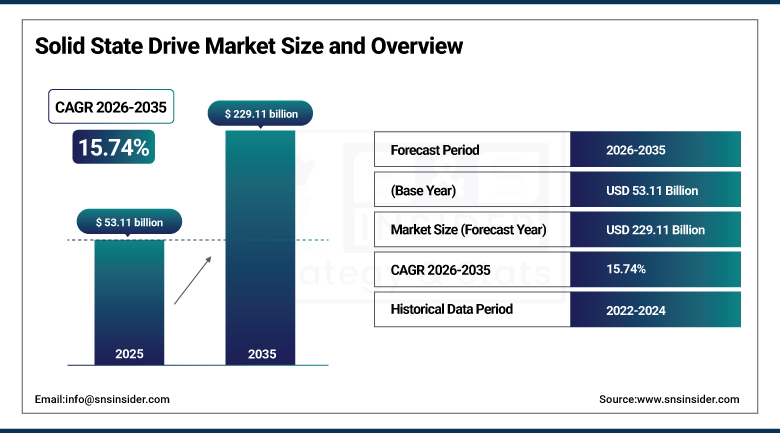
The Solid State Drive Market size was valued at USD 53.11 Billion in 2025 and is expected to reach USD 229.11 Billion by 2035, growing at a CAGR of 15.74% from 2026–2035.
The solid-state drive makes use of flash memory to hold the data as compared to the rotating magnetic disks. Due to technological advancements like NVMe, PCIe 4.0 and 5.0, and 3D NAND, it is guaranteed that speed, capacity, and density increase with each new generation, while hybrid storage that comprises of both SSD and conventional HDD gives users another option to opt for a middle way in terms of cost and performance. The SSD is highly useful in cloud computing and data centers because of its increased data access speed and minimized booting time.
In March 2025, Samsung introduced their 9100 PRO Series SSDs with PCIe 5.0 technology, offering maximum read speed of 14,800 MB/s and having storage capacity up to 4 TB, while the 8 TB model is currently in the pipeline. The drives are designed for high-performance PCs, AI workloads, and data-intensive applications, reflecting how quickly consumer-grade SSD performance is closing the gap with what enterprise systems required just a few years ago.
To Get more information on Solid State Drive Market - Request Free Sample Report
Solid State Drive Market Trends
-
Adoption of PCIe Gen 5 SSDs is accelerating across enterprise data centers and AI infrastructure, delivering significantly higher storage performance and bandwidth.
-
Declining NAND flash memory prices are making SSDs more affordable, driving replacement of traditional hard disk drives in consumer and enterprise devices.
-
Growing investments in cloud computing and hyperscale data centers are increasing demand for high-capacity enterprise SSDs to support AI and high-performance workloads.
-
Rising demand for portable and external SSDs is being fueled by remote work, gaming, and high-resolution content creation requiring fast and reliable storage.
-
Manufacturers are introducing higher-capacity SSDs exceeding 100TB to address the growing storage requirements of data centers, cloud providers, and enterprise applications.
U.S. Solid State Drive Market Size Outlook
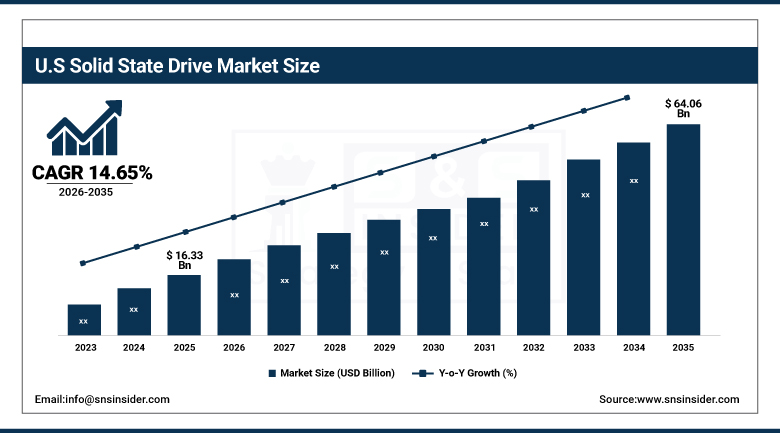
The U.S. Solid State Drive (SSD) Market was valued at approximately USD 16.33 Billion in 2025 and is expected to reach approximately USD 64.06 Billion by 2035, growing at a CAGR of approximately 14.65%.
Demand for high-performance storage in data centers, cloud computing, and AI applications continues to push the U.S. solid-state drive market forward. Enterprise SSD sales have climbed sharply as cloud infrastructure spending accelerates, with Western Digital reporting cloud revenue up 17% year-on-year on the back of enterprise SSD demand. Another driver of growth is the increase in adoption of consumer electronics products as solid-state drives replace hard drives in mainstream laptop computers and desktops at the same time as the cost per gigabyte falls on large capacity drives.
In August 2025, SK hynix began mass production of its 321-layer QLC NAND flash memory, the first in the industry to cross the 300-layer threshold using QLC technology. The company plans to bring the chips to PC SSDs first before extending them to enterprise and AI data center drives, with commercial products expected in the first half of 2026, part of a broader industry push toward ultra-high-capacity SSDs to meet surging AI server storage demand.
Solid State Drive Market Segment Analysis
-
By Form Factor, the 2.5-inch segment dominated the solid state drive market with a 39.8% revenue share in 2025, while the EDSFF segment is the fastest growing during the forecast period.
-
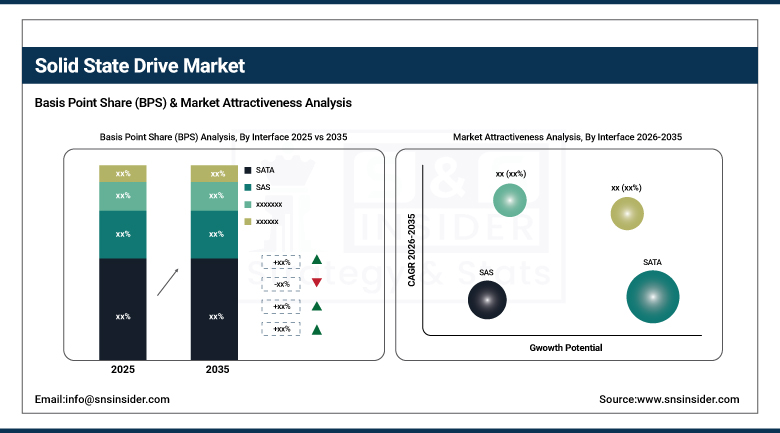
By Interface, the SATA segment dominated the solid state drive market with a 46.6% revenue share in 2025, while the PCIe segment is the fastest growing.
-
By Storage, the 120GB-320GB segment dominated the solid state drive market with a 32.3% revenue share in 2025, while the 320GB-500GB segment is the fastest growing.
-
By End-user, the enterprises segment dominated the solid state drive market with a 58.1% revenue share in 2025, while the individuals segment is the fastest growing during the forecast period.
By Interface, SATA dominates, PCIe grows fastest
The SATA SSD was the dominant type, having 46.6% market share in 2025, due to the relative low cost of the interface and its compatibility with existing hardware systems, which makes it the preferred choice among consumers and businesses looking to upgrade old systems due to cost savings. Its reliability for basic operations and ease of use on both desktops and laptop computers is a significant driver of its success.
The PCIe SSDs are growing in popularity due to high speeds, low latency, and increased use in high-performance computing systems. The PCIe Gen 4 and Gen 5 provide very high transfer rates that can be used in gaming machines, data centers, and even AI work, and as the price drops, the high performance offered by PCIe makes it the way forward.
By Storage, 120GB-320GB dominates, 320GB-500GB grows fastest
Drives from 120 GB to 320 GB held a market share of 32.3%, representing the largest capacity group, since they are generally found in cheap notebooks and inexpensive PCs, thus falling into the category of affordable consumer electronics. Drives of this capacity are economically optimal, having enough space for browsing the Internet, storing documents, and watching media content, making them quite popular among consumers in developing countries.
The 320GB-500GB range is the fastest-growing storage segment, driven by rising demand for higher-capacity storage in mid-range laptops, gaming devices, and office systems as users need more room for applications, media files, and growing software footprints. As digital content creation, software file sizes, and gaming continue expanding, demand for mid-range storage capacity is set to keep climbing as a primary growth driver over the next several years.
Regional Insights
|
Region |
Major Country |
Share within Region, 2025 (%) |
|---|---|---|
|
North America |
United States |
84.0% |
|
Europe |
Germany |
24.0% |
|
Asia Pacific |
China |
43.0% |
|
Middle East & Africa |
UAE |
29.0% |
|
Latin America |
Brazil |
38.0% |
North America Solid State Drive Market Insights
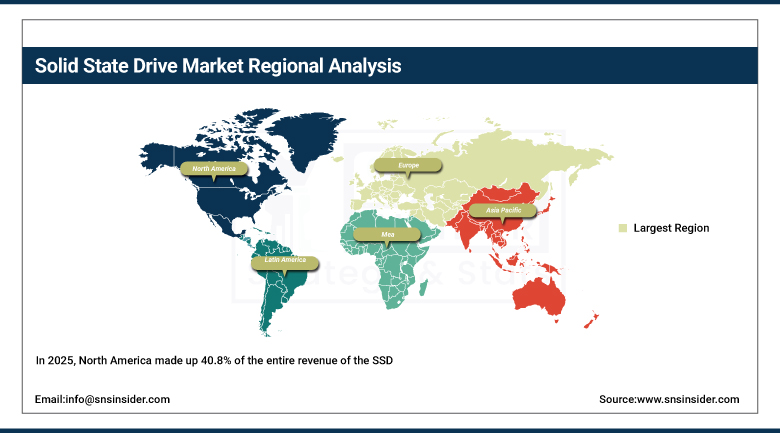
In 2025, North America made up 40.8% of the entire revenue of the SSD market due to the adoption of cloud computing solutions, availability of robust technology infrastructure, and wide-scale application of powerful computing facilities in the region. High demand for efficient and fast storage from such major players as Amazon Web Services, Google, and Microsoft has driven orders of enterprise SSDs.
Technological advancement in AI, big data analytics, and enterprise IT modernization has accelerated SSD adoption across nearly every industry in the region. Strong penetration in consumer electronics, gaming, and high-end computing further reinforces U.S. leadership in this space, and continued investment in AI infrastructure is expected to keep North America the largest regional market through the forecast period.
Get Customized Report as per Your Business Requirement - Enquiry Now
Europe Solid State Drive Market Insights
Europe is still a stable and mature SSD market driven by the strong initiatives for IT modernization in enterprises and the developed segment of consumer electronics. Germany is dominating in this regional market due to the significant presence of the manufacturing industry and the emerging enterprise data centers with the use of fast SSDs.
The United Kingdom, France, and the Netherlands round out regional demand, supported by expanding cloud infrastructure investment and rising gaming and content creation activity. Regional data sovereignty requirements are also pushing European enterprises to invest in domestic data center capacity, sustaining steady SSD consumption even as the pace of growth trails the faster-expanding Asia Pacific market.
Asia Pacific Solid State Drive Market Insights
Asia Pacific is expected to register the fastest growth in the Solid State Drive (SSD) Market, with a CAGR of 15.4% during the forecast period (2026–2035), driven by rapid digital transformation, rising smartphone adoption, and expanding e-commerce markets across the region. There is an increasing trend of technology manufacturing and cloud infrastructure in China, India, South Korea, and Japan, which is making the region both a producer as well as a growing consumer of such technologies.
Samsung and SK Hynix, the two largest SSD makers and NAND flash manufacturers, are located in the region and are spending heavily on increased manufacturing capacity. There will be immense opportunities for growth in the SSD business due to an increase in the need for laptops and gaming personal computers in the region’s information technology industry.
MEA & Latin America Solid State Drive Market Insights
The Middle East and Africa remain an early-stage but developing SSD market, led by the UAE's investment in data center and cloud infrastructure as part of its broader digital transformation strategy. Saudi Arabia is following a similar path, with growing enterprise IT investment tied to its economic diversification agenda, while South Africa anchors demand across the rest of the continent.
SSD deployment in Latin America is expected to continue with Brazil leading the pack as the principal adopter owing to enterprise IT upgrades and consumer electronics. The second most important market for SSDs in Latin America is Mexico, which plays a major role in driving its technology market.
Market Dynamics
Growth Drivers: Rising demand for high-speed storage across consumer
The SSD market is primarily driven by growing demand for high-speed data access and storage solutions in both consumer and enterprise applications. As cloud computing, big data analytics, and artificial intelligence have all expanded, demand for faster, more reliable storage systems has grown right alongside them, pushing more organizations toward solid-state storage over traditional hard drives.
PCIe-based SSDs in particular deliver very high performance relative to standard hard disk drives and are increasingly the drive of choice in data centers and high-performance computing environments. Falling NAND flash memory prices in recent years have also made SSDs more affordable, catalyzing increasing adoption in laptops, desktops, and gaming consoles across nearly every price tier.
Restraints: NAND flash lifespan and legacy system compatibility challenges
Shorter life span of NAND flash memory, particularly in low-end SSDs that utilize TLC or QLC technology, forms the crucial limitation in the market of SSDs. It may be associated with the problem of data reliability and endurance, especially in corporate environment, where performance and longevity of a drive play an extremely important role.
SSD is much more sophisticated device than a common hard drive in terms of restoring the data in case of drive failure.
Another obstacle to the adoption of SSDs in certain markets is its incompatibility with older system and interfaces.
Opportunities: Digital transformation, 5G deployment, and legacy system upgrades
The widening scope of digital transformation initiatives across verticals represents a substantial opportunity for SSD vendors. The increased development of IT infrastructure in emerging nations will lead to an increase in demand for SSD in both public and private organizations as the need arises to upgrade their existing old storage infrastructure.
With the rapid adoption of 5G networks all over the world, the increased need for edge computing and IoT devices which require fast storage solutions creates an exciting market opportunity for smaller capacity SSDs. There is also the increasing trend of upgrading old computers from HDD to SSD storage.
Recent Developments:
-
2026: Samsung Electronics Co., Ltd. introduced next-generation PCIe Gen 5 NVMe SSDs with enhanced AI workload optimization and higher energy efficiency for enterprise data centers.
-
2026: Solidigm expanded its high-capacity enterprise SSD portfolio, introducing advanced drives designed for AI infrastructure, hyperscale cloud storage, and high-performance computing applications.
-
2026: Kioxia Corporation announced new high-density NAND flash technology to support higher-capacity SSDs with improved performance and lower power consumption.
-
2026: Western Digital Corporation expanded its NVMe SSD product lineup with enterprise-grade storage solutions optimized for cloud computing, AI servers, and large-scale data center deployments.
Solid State Drive Companies are:
-
Samsung Electronics Co., Ltd.
-
Kingston Technology Company, Inc.
-
Seagate Technology Holdings plc
-
SK hynix Inc.
-
Micron Technology, Inc.
-
ADATA Technology Co., Ltd.
-
Corsair Gaming, Inc.
-
PNY Technologies, Inc.
-
Sabrent
-
TEAMGROUP Inc.
-
Transcend Information, Inc.
-
Solidigm
-
Phison Electronics Corporation
-
Silicon Motion Technology Corporation
-
BIWIN Storage Technology Co., Ltd.
-
Netac Technology Co., Ltd.
-
Innodisk Corporation
-
Apacer Technology Inc.
Solid State Drive Market Report Scope:
| Report Attributes | Details |
|---|---|
| Market Size in 2025 | USD 53.11 Billion |
| Market Size by 2035 | USD 229.11 Billion |
| CAGR | CAGR of 15.74% From 2026 to 2035 |
| Base Year | 2025 |
| Forecast Period | 2026-2035 |
| Historical Data | 2022-2024 |
| Report Scope & Coverage | Market Size, Segments Analysis, Competitive Landscape, Regional Analysis, DROC & SWOT Analysis, Forecast Outlook |
| Key Segments | • By Form Factor (2.5-inch, M.2, U.2, PCIe Add-in Card, EDSFF, Others) • By Interface (SATA, SAS, PCIe) • By Storage (Under 120 GB, 120GB-320GB, 320GB-500GB, 500GB-1TB, 1TB-2TB, Above 2TB) • By End-user (Individuals, Enterprises, Others) |
| Regional Analysis/Coverage | North America (US, Canada), Europe (Germany, UK, France, Italy, Spain, Russia, Poland, Rest of Europe), Asia Pacific (China, India, Japan, South Korea, Australia, ASEAN Countries, Rest of Asia Pacific), Middle East & Africa (UAE, Saudi Arabia, Qatar, South Africa, Rest of Middle East & Africa), Latin America (Brazil, Argentina, Mexico, Colombia, Rest of Latin America). |
| Company Profiles | Samsung Electronics Co., Ltd., Western Digital Corporation, Kingston Technology Company, Inc., Seagate Technology Holdings plc, SK hynix Inc., Micron Technology, Inc., Kioxia Corporation, ADATA Technology Co., Ltd., Corsair Gaming, Inc., PNY Technologies, Inc., Sabrent, TEAMGROUP Inc., Transcend Information, Inc., Solidigm, Phison Electronics Corporation, Silicon Motion Technology Corporation, BIWIN Storage Technology Co., Ltd., Netac Technology Co., Ltd., Innodisk Corporation, Apacer Technology Inc. |
Frequently Asked Questions
Increasing demand for high-performance, energy-efficient storage solutions driven by the expansion of cloud computing, data centers, and consumer electronics.
The Solid State Drive Market was valued at USD 53.11 Billion in 2025.
Internal dominated with a 68.8% revenue share in 2025.
North America dominated the Solid State Drive Market in 2025 with a 40.8% market share.
The Solid State Drive Market is expected to grow at a CAGR of 15.74% from 2026 to 2035.
