
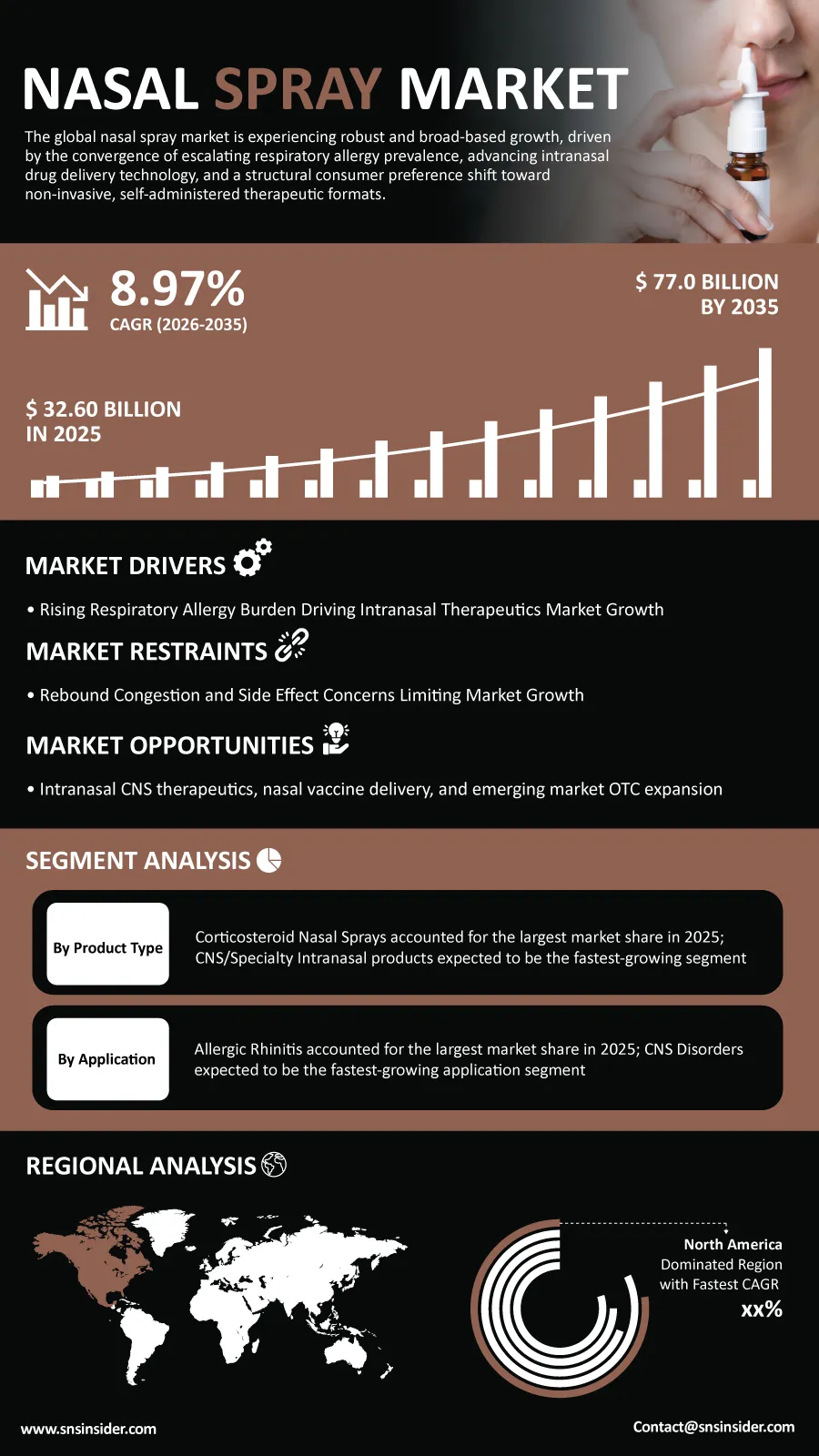
The global Nasal Spray Market is witnessing steady momentum as healthcare providers and consumers increasingly embrace non-invasive drug delivery solutions for respiratory care and beyond. According to a recent study by SNS Insider, the global Nasal Spray Market size valued at USD 32.60 billion in 2025, is anticipated to grow to USD 77.0 billion by 2035, registering a CAGR of 8.97% over the 2026–2035 forecast period. Growing rates of respiratory disorders, expanding over-the-counter treatment options, and pharmaceutical innovation are supporting sustained demand across both developed and emerging healthcare markets.
The utilization of nasal spray preparations has significantly widened its scope in recent times. Nasal sprays that were originally meant for relieving congestion have been found useful in treating allergies, chronic respiratory disorders, neurologic ailments, hormones, and even vaccines. Formulation and delivery of medication continue to advance through constant technological developments, making way for quicker acting and user-friendly therapies.
To Get Detailed Insights on the Nasal Spray Market – Request a Sample Report
Advanced Drug Delivery Technologies Expand Clinical Applications
Healthcare companies have been developing intranasal drug delivery systems that can deliver drugs quickly while offering better convenience to patients. The advancements in precision spray technologies, particle engineering, and preservative-free formulas have been making the treatment more effective, allowing for extended use of such drugs by patients.
The industry is gaining from growing scientific activity in relation to intranasal treatments of neurological conditions and increased focus on needle-free vaccines. In addition, higher penetration of the internet pharmacies, along with the availability of cheaper generics, is contributing to the broader access to such treatments by patients around the world.
Key Market Findings Highlight Expanding Growth Opportunities
Based on product type, corticosteroid nasal sprays accounted for the largest share of the global market in 2025 due to their widespread use in treating allergic rhinitis, sinusitis, and nasal inflammation. Meanwhile, CNS and specialty intranasal products are projected to record the fastest growth through 2035 as pharmaceutical innovation broadens therapeutic applications.
By application, nasal congestion remained the leading segment in 2025, supported by growing cases of respiratory infections, seasonal illnesses, and pollution-related symptoms. Allergic rhinitis is expected to register the fastest expansion throughout the forecast period as allergy prevalence continues to increase globally.
Across distribution channels, retail pharmacies and drug stores accounted for approximately 48% of total market revenue in 2025. However, online pharmacies are forecast to become the fastest-growing sales channel through 2035, reflecting rising digital healthcare adoption and convenient home delivery services.
Innovation, Accessibility, and Patient Convenience Shape Market Evolution
Manufacturers have increased focus on better customer experience with preservative free formulas, advanced spray pump design, and chronic daily use medications. Such improvements are contributing to decreased irritations and enhancing drug absorption along with dosage uniformity.
In parallel with that, the sector is enjoying high growth momentum in generic product development, making drugs more affordable for patients and motivating branded drug manufacturers to develop unique medicines. Intranasal drug delivery systems have also become a preferred choice for the delivery of neurological medicines because of their fast absorption properties.
Regional Markets Continue to Strengthen Worldwide
The North America region stayed the biggest regional market in 2025 due to developed healthcare infrastructure, extensive insurance coverage, and easy access to prescription and over-the-counter drugs. The U.S. constituted around 38% of the North American regional revenue and stayed the biggest national market. The market size in the United States in 2025 reached USD 10.95 billion and is expected to grow up to USD 21.73 billion by 2035, demonstrating 7.10% CAGR.
According to the forecast, Asia Pacific will become the most dynamic region during the forecast period due to increasing urbanization, air pollution, and expanding access to healthcare. In the region, the share of China in regional revenue was estimated to be about 45%.
In Europe, Germany constituted about 31% of the regional sales driven by development of the pharmaceutical sector and extensive use of prescription drugs. The share of Brazil in Latin American revenue amounted to about 44%, while the share of the United Arab Emirates in the Middle East & Africa market revenue was about 28%.
Leading Companies Accelerate Product Development
The competitive landscape continues to evolve as pharmaceutical companies expand manufacturing capacity, introduce generic alternatives, and develop next-generation intranasal therapies targeting both respiratory and neurological disorders. Major companies operating in the global nasal spray market include GlaxoSmithKline plc (GSK), AstraZeneca PLC, Novartis AG, Johnson & Johnson, Bayer AG, Viatris Inc., Cipla Ltd., Procter & Gamble Co., Emergent BioSolutions, Aurena Laboratories AB, Aytu Health, Lupin Limited, Teva Pharmaceutical Industries, Sanofi S.A., Pfizer Inc., Merck & Co., Inc., NeilMed Pharmaceuticals Inc., Neurelis, Inc., Hikma Pharmaceuticals PLC, and Bausch Health Companies Inc.
Recent industry developments continue to reinforce market expansion. During 2026, Hikma Pharmaceuticals broadened its U.S. generic nasal spray portfolio, Cipla Limited expanded manufacturing capacity for corticosteroid and saline formulations across emerging markets, while Neurelis, Inc. advanced commercialization of specialized intranasal neurological therapies.
An SNS Insider analyst Parry Kardani commented, "The nasal spray market is evolving into a sophisticated drug delivery platform that extends well beyond traditional respiratory treatments. Companies combining advanced formulation technologies, broader therapeutic applications, and patient-focused product innovation are expected to strengthen their competitive position as demand for convenient, non-invasive healthcare solutions continues to accelerate worldwide."
About the Author

Get in touch




