
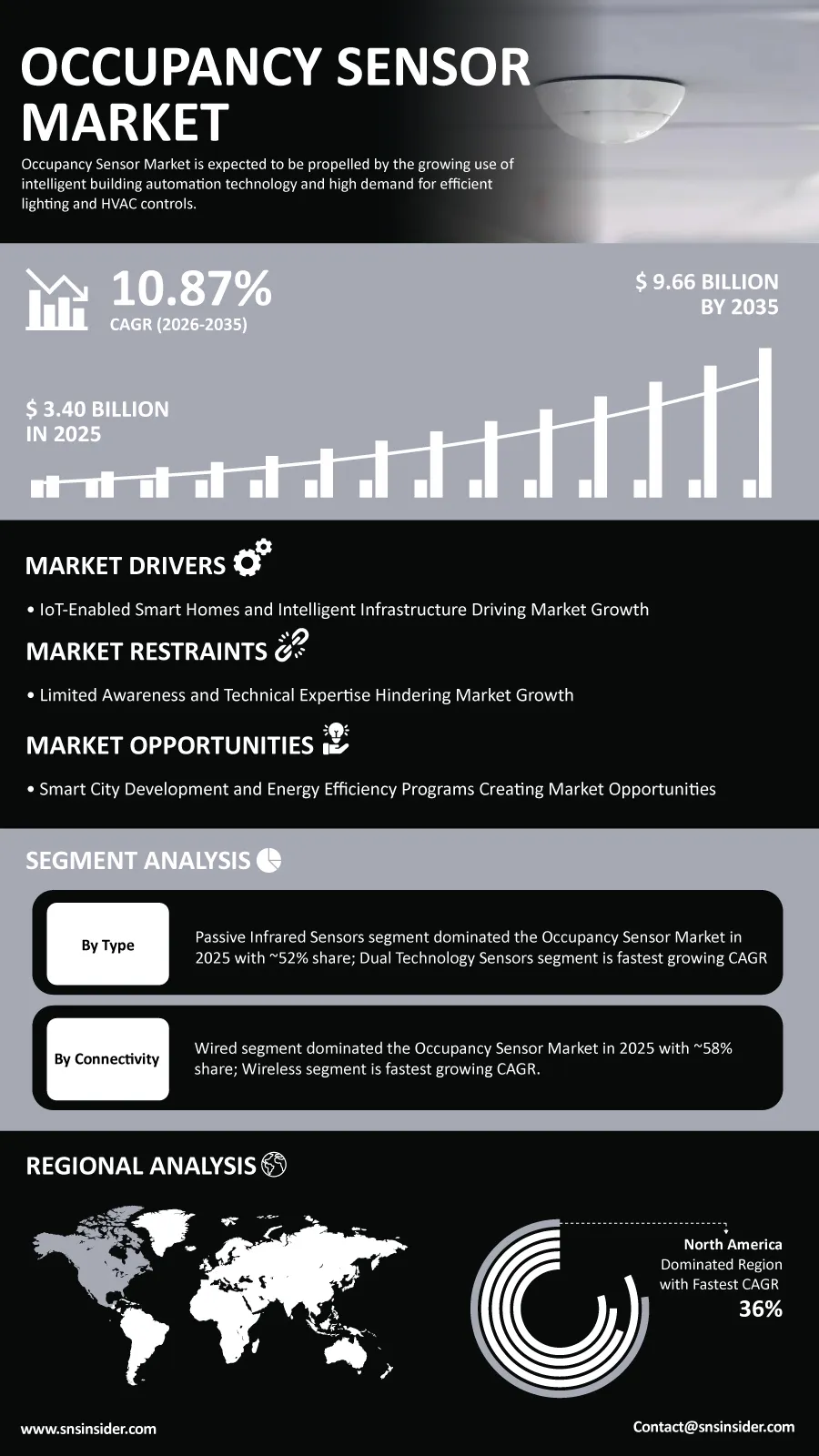
The global Occupancy Sensor Market is entering a strong growth phase as building owners, enterprises, and public infrastructure developers accelerate investments in intelligent automation and energy optimization. According to a recent study by SNS Insider, the global Occupancy Sensor Market size valued at USD 3.40 billion in 2025, is anticipated to grow to USD 9.66 billion by 2035, registering a CAGR of 10.87% over the 2026–2035 forecast period.
With the increased use of smart building technology, there will be an emerging need for occupancy sensors that can detect the presence of people in order to automate the control of lighting, heating, ventilation, and air conditioning systems. The increasing need to cut down unnecessary usage of energy has made the occupancy sensors an integral part of the connected building system.
Moreover, the expansion of IoT-enabled homes, smart workplaces, and digitalized commercial properties has provided a further boost to the market growth. The increasing incorporation of occupancy sensors in the building management systems is enabling facility managers to take wise decisions about energy and space usage.
To Get Detailed Insights on the Occupancy Sensor Market – Request a Sample Report
Smart Building Investments Create New Growth Opportunities
The ongoing effort toward sustainable development and building of energy-efficient structures presents substantial business opportunities for occupancy sensor producers. The use of automated occupancy-based systems capable of reacting to occupancy is gaining popularity among commercial properties, education facilities, healthcare establishments, retail centers, and industrial buildings.
Modernizing already-existing buildings is an additional business opportunity for occupancy sensors. With the appearance of wireless sensors, which do not require much cabling and construction efforts, this goal becomes much easier to achieve.
Additionally, the rise of smart city initiatives will positively impact the market growth in the coming years. There is a tendency to include connected devices in government initiatives on energy-efficient buildings.
Key Market Insights Highlight Shifting Demand Patterns
By type, Passive Infrared Sensors accounted for approximately 52% of global market revenue in 2025, supported by their cost efficiency, low power consumption, and widespread use in automated lighting and security applications. Dual Technology Sensors are projected to register the fastest growth as users seek greater detection accuracy through combined sensing methods.
Based on connectivity, wired occupancy sensors held around 58% of market revenue in 2025, benefiting from dependable power availability and established use in large commercial and industrial facilities. Wireless sensors are expected to experience the fastest growth as their simplified installation and retrofit compatibility make them attractive for smart buildings and connected infrastructure.
In terms of application, lighting control contributed approximately 44% of market revenue in 2025. Occupancy-based lighting systems help reduce unnecessary electricity consumption by automatically adjusting illumination according to room usage. Energy management is projected to be the fastest-growing application as businesses increasingly connect occupancy data with broader building automation and IoT platforms.
By end use, commercial facilities represented approximately 46% of market revenue in 2025 due to extensive deployment across offices, hospitals, schools, and retail properties. Residential applications are projected to expand at the fastest pace as smart home adoption increases and consumers seek automated solutions for lighting, HVAC, security, and energy savings.
Energy Optimization and Space Intelligence Strengthen Adoption
Occupancy sensors are moving on from being mere presence sensors into becoming part of overall building intelligence systems. Current technology offers information that can allow building operators to know how buildings are being used and ways to increase their energy efficiency.
Combining occupancy detection with other functions, such as environmental sensing, wireless networking, and cloud computing has enhanced the use of the technology. This has opened up possibilities for organizations to increase the use of rooms, as well as environmental quality programs in buildings.
As organizations continue to set sustainability goals, occupancy-based automation will find more applications.
North America Leads with 36% Revenue Share While Asia Pacific Accelerates Smart City and IoT Growth
It is anticipated that North America will continue to retain its market dominance position and will hold about 36% share of total market revenues in 2025. This region will be growing on account of high adoption of intelligent building systems, strong demand for energy efficiency, and significant investment in commercial connectivity solutions. The U.S. will continue to dominate in the region owing to higher smart buildings penetration and automation requirements.
Asia Pacific will be the fastest-growing regional market due to factors such as high rate of urbanization, large-scale constructions, development of smart cities, and investments in IoT-based infrastructure. Adoption of connected home and wireless automation solutions is further extending the market addressability base.
The combination of government-led sustainability programs and rising demand for energy-efficient buildings is expected to create substantial opportunities for occupancy sensor providers across Asia Pacific through 2035.
Industry Participants Focus on Connected Sensor Innovation
The competitive landscape is evolving as manufacturers focus on improving detection precision, connectivity, energy efficiency, and integration with building management systems. Companies are increasingly developing multifunctional sensor platforms that combine occupancy detection with environmental monitoring and intelligent analytics.
Key companies operating in the global Occupancy Sensor Market include Signify, Honeywell International, Schneider Electric, Johnson Controls, Acuity Brands, Legrand, Leviton Manufacturing, Lutron Electronics, Siemens, Eaton Corporation, GE Current, Hubbell Incorporated, Panasonic Corporation, Bosch, Texas Instruments, Omron Corporation, Delta Electronics, Crestron Electronics, OPTEX, and Enerlites.
An SNS Insider analyst Sushant Kadam commented, “The transition toward intelligent and energy-efficient buildings is creating a strong foundation for occupancy sensor adoption. As organizations place greater emphasis on automated energy management, smart space utilization, and sustainability objectives, technology providers that combine accurate sensing with seamless IoT and building management integration are expected to capture significant opportunities in the coming years.”
About the Author

Get in touch




