
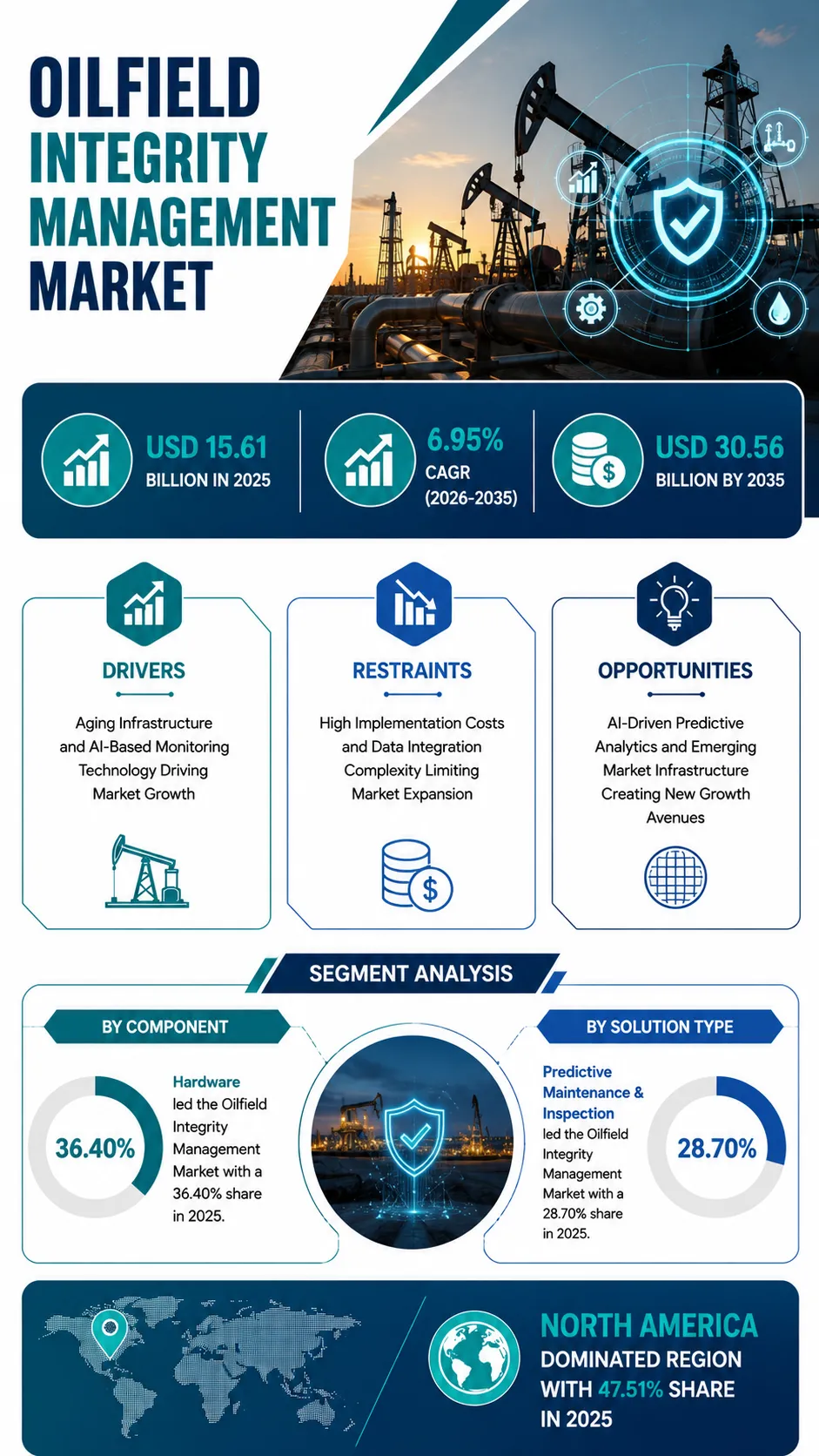
The global Oilfield Integrity Management Market is set for significant expansion as operators worldwide continue investing in advanced asset monitoring and predictive maintenance technology. “According to a recent study by SNS Insider, the global Oilfield Integrity Management Market size valued at USD 15.61 Billion in 2025, is anticipated to grow to USD 30.56 Billion by 2035, registering a CAGR of 6.95% over the 2026–2035 forecast period.”
There have been tremendous changes within oilfield integrity management technology over time due to which many operators who aim at improving asset reliability can take advantage of this trend. This includes the need for more predictive, AI-driven systems that will provide operators with the ability to prevent unplanned downtime. This applies in situations where integrity management solutions are used across onshore and offshore production infrastructure.
Operators are constantly working hard to ensure that their integrity management systems perform better than before in order to meet various needs of oil and gas producers worldwide.
To Get Detailed Insights on the Oilfield Integrity Management Market – Request a Sample Report
Predictive Asset Reliability Ecosystems Create New Demand
The oilfield integrity management market has evolved from basic inspection routines to more advanced AI-driven predictive maintenance use cases. The growing investment in hybrid AI plus physics-based analytics, cloud-native software platforms, and aging infrastructure assessment for a variety of applications has required the development of more efficient and reliable monitoring systems.
New designs of integrity management platforms can increase asset reliability, reduce unplanned downtime, and allow for formal aging infrastructure assessment. This gives operators the possibility to be more effective when managing mature assets and doing better regulatory compliance.
Technology providers, oilfield service companies, and regulatory agencies are increasingly cooperating thanks to the growing interest in developing future solutions for oilfield asset integrity.
Key Market Findings Highlight High-Growth Segments
The predictive maintenance and inspection segment dominated all categories in the oilfield integrity management market share with a market revenue share of 28.70% in 2025 due to its central role in preventing unplanned downtime.
The fastest growing category is expected to be aging infrastructure assessment which will grow at a CAGR of 8.40% through 2035. This will be possible owing to the increasing need for formal fitness-for-purpose evaluation of life-extended assets.
By component, hardware held the largest share of total market revenue of 36.40% in 2025 due to its foundational role in capturing real-time integrity data. The software segment will see the fastest growth in revenue generation at a CAGR of 8.80%.
Based on application, onshore generated a share of 58.50% of market revenue in 2025 cost efficiency and simpler implementation. On the other hand, offshore applications will be the segment recording the fastest revenue growth at a CAGR of 8.20%.
Distributive trends are changing as well. Traditional onshore applications remain substantial, but offshore integrity management will turn out to be the fastest-growing application through 2035, on the back of deepwater risk avoidance, remote-controllable systems, and increased demand from complex offshore conditions.
Reliability, Prediction, and Compliance Gain Importance
In this regard, operators have been looking at integrity management systems that would make their assets more reliable and require less reactive maintenance and be more compliant.
Innovation in AI-driven analytics, digital twin technology, and cloud-native platforms has been making it possible for companies to come up with systems that can operate effectively across demanding oilfield conditions. In addition to that, increasing emphasis on regulatory compliance and aging asset justification is also making it possible for companies to find solutions that optimize asset integrity performance.
Such trends are likely to become even more prominent in the future.
North America Emerges as the Largest Market with 47.51% Revenue Share Amid Rising Digital Adoption
The North America region represented 47.51% share of global market revenue in 2025 and was the largest regional market, owing to extensive oil production infrastructure and a strong presence of leading service providers. In addition, the Middle East & Africa region is expected to be the fastest-growing market during the forecast period, propelled by major oil and gas producing countries and applications across the region's fast-growing production optimization industries.
On the other hand, Europe represented a meaningful share of global market revenue in 2025, aided by North Sea offshore production infrastructure and strong regulatory emphasis on aging asset assessment.
Leading Companies Drive Innovation and Competition
The environment continues to stay very dynamic since players continue innovating on products and technologies as well as forming partnerships in order to enhance their position in the industry.
Some of the major companies that operate in the global oilfield integrity management market are Baker Hughes Company, Schlumberger Limited, Halliburton Company, John Wood Group PLC, Aker Solutions ASA, Siemens AG, Emerson Electric Co., IBM Corporation, Oracle Corporation, and Honeywell International Inc.
An SNS Insider Analyst Sakshi Kale commented, "The rapid commercialization of AI-driven predictive maintenance technology is creating unprecedented demand for high-performance oilfield integrity management systems. Companies that successfully combine reliability, predictive analytics, regulatory compliance, and advanced engineering capabilities will be best positioned to capitalize on emerging opportunities across onshore and offshore production applications."
About the Author

Get in touch




