
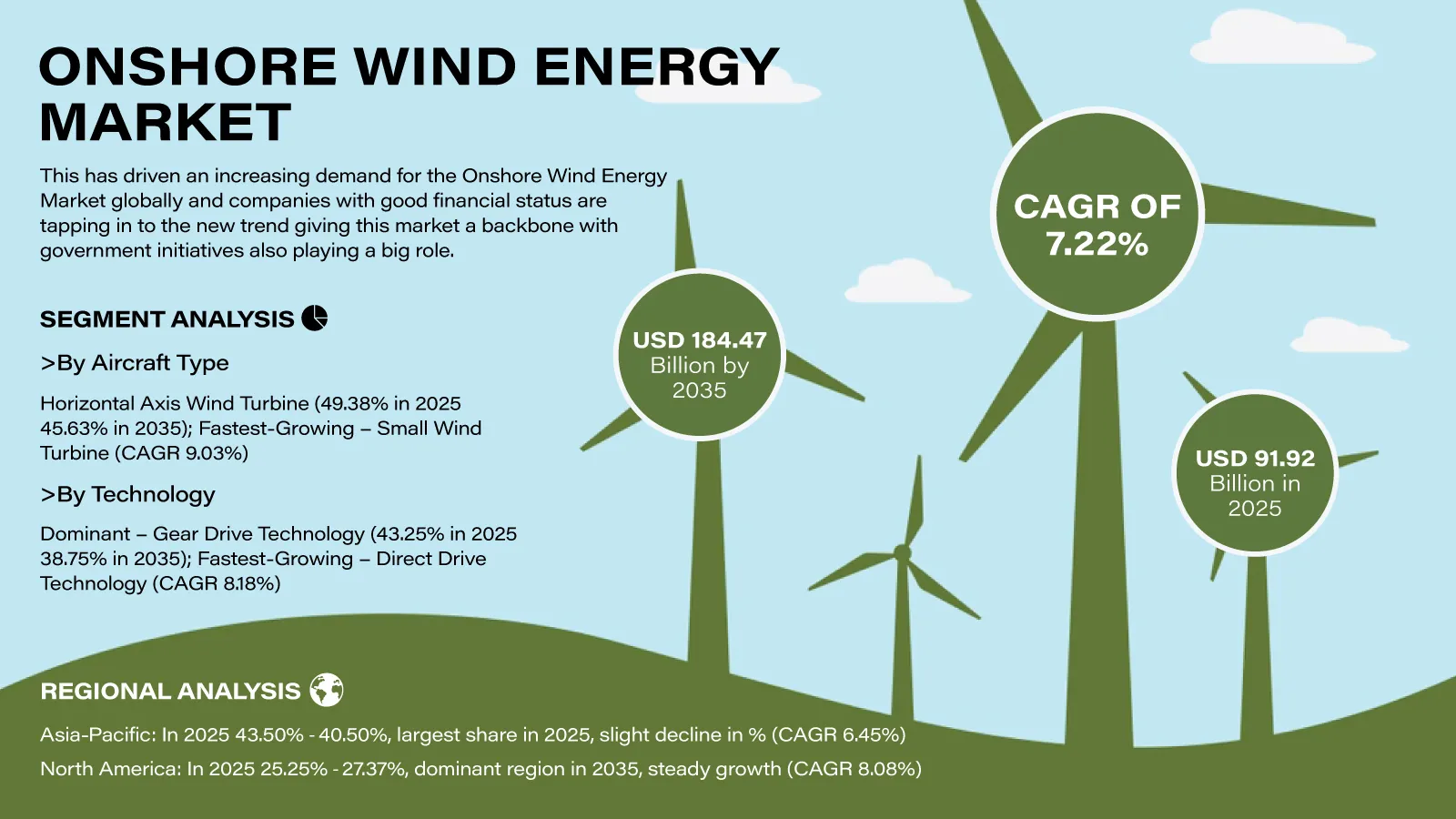
The global Onshore Wind Energy Market is expected to maintain strong momentum over the coming decade as countries accelerate renewable energy deployment to strengthen energy security and reduce carbon emissions. According to a recent study by SNS Insider, the global Onshore Wind Energy Market size valued at USD 91.92 billion in 2025, is anticipated to grow to USD 184.47 billion by 2035, registering a CAGR of 7.22% over the 2026–2035 forecast period.
Growing power consumption, advanced plans for carbon reduction, and supportive regulatory structures have made both utilities and independent power producers interested in increasing onshore wind capacity in developed as well as developing countries. The constant upgrading of wind turbine efficiency and cost effectiveness is also making investors more confident about renewable energy projects.
With grid companies increasingly upgrading their transmission system and integrating more renewables into their power supply mixes, onshore wind is set to increase its prominence within diversified energy mixes. Investments in digital asset management, predictive maintenance, and smart grid systems are also increasing efficiency of onshore wind operations.
Renewable Energy Investments Continue to Unlock Market Opportunities
The global governments are supporting clean energy developments by way of favorable policies, long-term purchasing arrangements, and financing incentives that are intended to boost renewable capacity buildout. These efforts are leading developers to develop bigger wind farms and invest in the latest turbine technology.
Market participants are looking at the concept of hybrid renewable energy plants where the system integrates onshore wind generation along with solar power generation and battery storage along with hydrogen generation. This is providing greater grid stability as well as optimized energy efficiency.
Simultaneously, efforts toward repowering through the installation of upgraded systems that will replace old turbines and allow for the generation of more power without increasing the size of the facility are gaining importance.
Key Market Insights Highlight Shifting Demand Patterns
According to turbine type, it is predicted that horizontal axis wind turbines will make up 49.38% of the market revenue by 2025 owing to its widespread installation in utility scale projects and its efficient operation. Small wind turbines are forecasted to experience the highest growth till 2035 with a CAGR of 9.03%.
Depending on the technology used, it is forecasted that gear drive system will generate 43.25% of the market revenue by 2025 because of the wide installation base of these turbines and the reliability of the gear drive systems. The fastest growing technology will be direct drive technologies which will grow at a CAGR of 8.18%.
Depending on the installation type, it is expected that conventional onshore installation will generate 83.13% of the market revenue by 2025 due to the development of wind farms worldwide. Repowering installations are forecasted to grow with the highest CAGR of 15.57% during the forecast period.
In terms of application, utility-scale projects are forecast to account for 69.25% of global market revenue in 2025. Community-scale installations are expected to grow at the fastest pace through 2035 as local renewable energy initiatives and distributed electricity generation continue expanding.
Technology Advancements Strengthen Long-Term Industry Growth
There has been constant improvement in the area of turbine design, electronic monitoring, and predictive maintenance that help generate more energy while cutting down on operational costs. With larger rotors, taller hub heights, and improved controls, wind farms have become increasingly efficient under various geographic locations.
Developers have also introduced the concept of artificial intelligence, remote diagnostics, and performance monitoring technologies to enhance turbine performance and increase the longevity of the equipment. This would help boost the viability of projects while ensuring that renewable energy growth continues.
Regional Markets Demonstrate Strong Growth Potential
It is expected that the Asia Pacific region will hold 43.50% share of the worldwide market revenue by 2025 on the back of investments in renewable energy, positive government policies, and capacity addition across leading economies. Large-scale infrastructural developments, along with rising power demand, have made the region a leader in the market.
The North American region is forecast to be the fastest-growing regional market, recording a CAGR of 8.08% from 2021 to 2035. Growth in the region can be attributed to corporate renewable energy purchases, policy developments, and investments in utility-scale wind power projects.
As countries continue pursuing long-term energy transition strategies, investments in modern wind generation infrastructure are expected to remain a central component of future electricity supply planning.
Industry Participants Focus on Innovation and Capacity Expansion
The competition in the onshore wind power industry is getting fiercer with the development of more powerful turbines, increasing global manufacturing capabilities, and improving service programs. Companies are focusing on innovative products, asset optimization through digitization, and forming partnerships in order to enhance their project performance and meet the demands of renewable energy companies.
Key companies operating in the global Onshore Wind Energy Market include Vestas, Siemens Gamesa Renewable Energy, GE Renewable Energy / GE Vernova, Goldwind, Nordex Group, Enercon, Suzlon Energy, MingYang Smart Energy, Envision Energy, Sany Renewable Energy, Dongfang Electric Corporation, Mitsubishi Heavy Industries, Doosan Heavy Industries & Construction, Acciona Energia, Shanghai Electric Wind Power, Sinovel Wind Group, TPI Composites, Vensys Energy, Clenergy, Iberdrola, and United Power / Windey Energy Technology Group.
An SNS Insider analyst Santosh Bhul commented, “Growing investments in renewable energy infrastructure, continuous advances in turbine technology, and supportive government policies are creating a strong foundation for sustained market expansion. Companies that focus on improving efficiency, accelerating repowering projects, and integrating intelligent energy management solutions will be well positioned to capitalize on future growth opportunities.”
About the Author

Get in touch




