
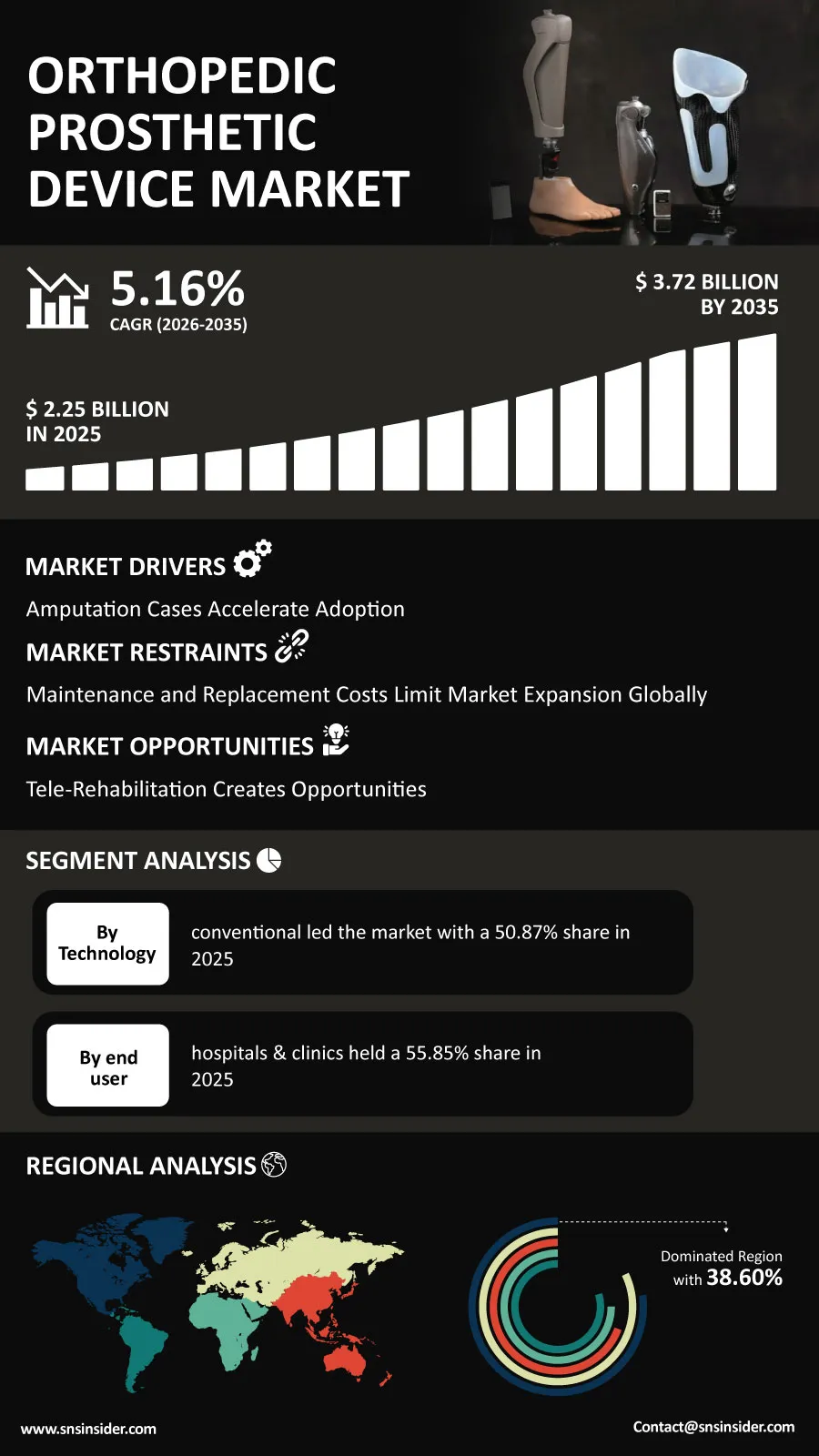
The global Orthopedic Prosthetic Device Market is witnessing sustained momentum as healthcare systems place greater emphasis on restoring mobility and improving long-term quality of life for patients affected by limb loss. “According to a recent study by SNS Insider, the global Orthopedic Prosthetic Device Market size valued at USD 2.25 billion in 2025, is anticipated to grow to USD 3.72 billion by 2035, registering a CAGR of 5.16% over the 2026–2035 forecast period.”
Modern prosthetic solutions are still in high demand due to the rising prevalence of diabetes, vascular illnesses, traumatic injuries, and age-related musculoskeletal issues. While advancements in materials science, digital engineering, and customized fitting methods are improving patient outcomes, healthcare providers are also investing in rehabilitation programs that prioritize functional recovery. Stronger healthcare systems and easier access to cutting-edge prosthetic care are two further ways that emerging economies are boosting market growth.
To Get Detailed Insights on the Orthopedic Prosthetic Device Market – Request a Sample Report
Personalized Prosthetic Technologies Transform Patient Care
In order to increase comfort, durability, and mobility, the orthopaedic prosthetics business is moving towards highly customized solutions. Myoelectric controls, sensor-enabled systems, CAD/CAM manufacturing, 3D printing, and other technologies are shortening production times while enabling more accurate fittings.
By enabling patients to get ongoing treatment outside of hospital settings, digital rehabilitation tools and remote monitoring systems are also transforming how clinicians manage recovery. Advanced prosthetic devices are becoming more widely available in a variety of healthcare settings thanks to government-backed rehabilitation programs, insurance expansion, and partnerships between medical device manufacturers and technology innovators.
Key Market Findings Highlight Strong Growth Opportunities
Lower limb prosthetics remained the leading product category, accounting for 60.80% of market revenue in 2025, reflecting the growing number of lower-extremity amputations linked to diabetes, trauma, and vascular disease. Meanwhile, the custom prosthetics segment is projected to expand at the fastest pace with a 6.16% CAGR through 2035 as demand increases for personalized mobility solutions.
Titanium and alloy-based prosthetics represented 37.12% of total revenue in 2025 owing to their durability, strength, and biocompatibility. Carbon fiber devices are forecast to record the highest growth at a 5.59% CAGR, supported by demand for lightweight, high-performance prosthetic systems.
Conventional prosthetic technologies held the largest technology share at 50.87% in 2025 because of their affordability and widespread availability. However, electric-powered prosthetics are expected to register the fastest expansion with a 5.47% CAGR, benefiting from advances in artificial intelligence, sensors, and motion control.
Hospitals and clinics generated 55.85% of market revenue in 2025 as they remained the primary centers for prosthetic fitting and rehabilitation. Home care and personal use applications are projected to grow at the fastest rate, recording a 5.80% CAGR, supported by increasing tele-rehabilitation services and portable prosthetic solutions.
Innovation, Rehabilitation, and Digital Healthcare Support Market Expansion
Products that improve mobility, reduce maintenance needs, and increase long-term user satisfaction are becoming more and more important to manufacturers. Users are becoming more independent and able to move more naturally thanks to machine learning-assisted prosthetic systems, lightweight materials, and intelligent sensors.
By allowing physicians to monitor recovery remotely, modify treatment plans, and maximize prosthetic function without frequent hospital visits, telehealth integration into rehabilitation services is also transforming patient care. It is anticipated that these advancements would increase access to rehabilitation services in underserved areas and improve patient compliance.
Regional Markets Continue Building Growth Momentum
Due to its sophisticated healthcare infrastructure, extensive use of myoelectric and bionic prosthetics, advantageous reimbursement regulations, and well-established rehabilitation networks, North America accounted for 38.60% of the global market revenue in 2025. With its market estimated at USD 653.29 million in 2025 and expected to increase at a 5.07% CAGR to USD 1,071.26 million by 2035, the United States continues to be the region's biggest contributor.
Asia-Pacific is expected to grow at the quickest rate in the area, with a 6.04% CAGR through 2035. Manufacturers continue to have a lot of chances due to rising healthcare spending, rising disposable incomes, growing rehabilitation facilities, and increased knowledge of cutting-edge prosthetic technology in China, India, Japan, and Australia.
Europe maintains a strong position through robust healthcare systems and favorable reimbursement frameworks, while Latin America and the Middle East & Africa are steadily improving market accessibility through infrastructure development and public healthcare initiatives.
Leading Companies Strengthen Competitive Landscape
Competition continues to intensify as manufacturers accelerate investments in smart prosthetic technologies, lightweight materials, digital rehabilitation platforms, and personalized device development. Product innovation, strategic partnerships, and geographic expansion remain central to long-term growth strategies.
Major companies operating in the global orthopedic prosthetic device market include Ottobock SE & Co. KGaA, Össur hf., Blatchford Group, Hanger, Inc., WillowWood, Inc., Fillauer Companies, Inc., Touch Bionics, Endolite Ltd., College Park Industries, Inc., RSLSteeper, ALPS South, Inc., Chas. A. Blatchford & Sons Ltd., Savio Orthopedics, Proteor SA, Otto Bock HealthCare LP, Freedom Innovations, Inc., Trulife, Ltd., Medfit Ltd., Endoskeletal Prosthetics Co., and Dynamic Prosthetics Ltd.
An SNS Insider analyst Parry Kardani commented, "The orthopedic prosthetic device market is entering a new phase where personalized engineering, intelligent technologies, and expanding rehabilitation access are collectively redefining patient mobility. Companies capable of delivering innovative, durable, and cost-effective solutions will be well positioned to capture growth opportunities across both developed and emerging healthcare markets.
About the Author

Get in touch




